
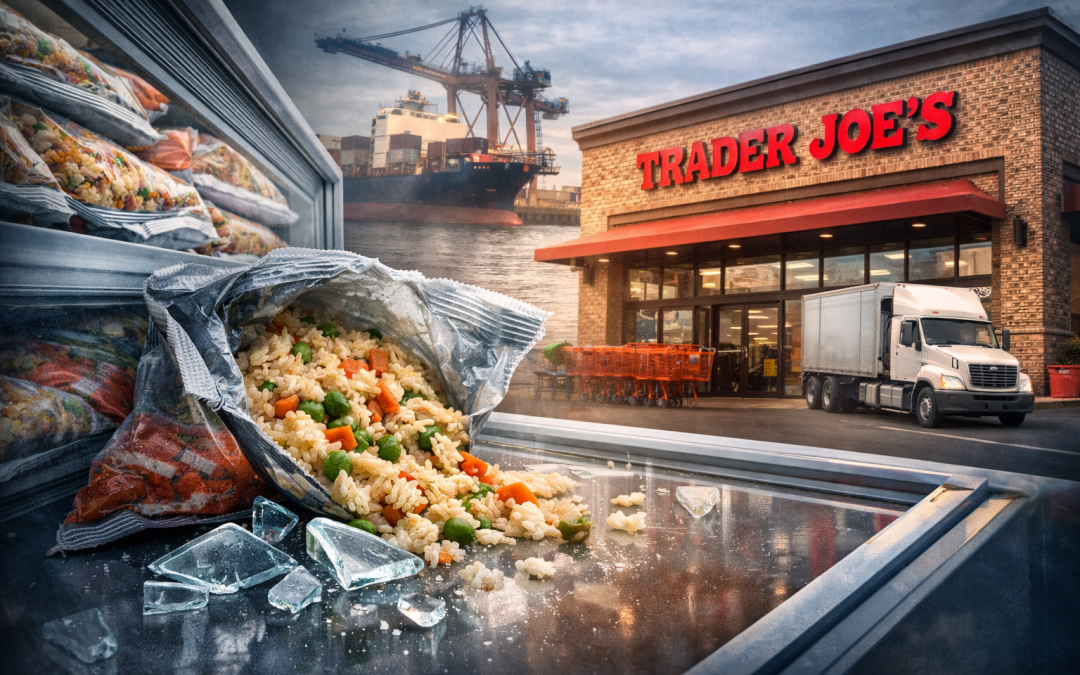
Trader Joe’s Frozen Food Recall Raises Questions for Boise Retail and Food Supply Chains
Food safety recalls usually feel like a grocery store problem.
But sometimes they highlight something much bigger — the complexity of modern supply chains that support Boise commercial real estate, retail tenants, and regional logistics.
A recent recall affecting one of the country’s most popular grocery brands is a good example.
According to reporting by Emilie Ritter Saunders in the Idaho Business Review, nearly 10 million pounds of frozen food products sold by Trader Joe’s are being pulled from shelves nationwide, including in Idaho.
(You can read the original story here: https://idahobusinessreview.com/2026/03/24/trader-joes-recalls-frozen-food-glass-idaho/.)
While the recall centers on food safety, the situation also highlights the complex logistics systems that support grocery retailers — and why supply chains remain a critical piece of the Boise retail real estate market.
What Triggered the Nationwide Recall
The recall involves a large batch of frozen food products distributed across dozens of states.
The issue stems from potential contamination involving glass fragments found in certain packaged items.
Key facts reported by Idaho Business Review include:
- Roughly 9.8 million pounds of frozen food affected
- More than 400,000 cases of vegetable fried rice involved
- Products distributed in 43 states, including Idaho
- The likely source traced to carrots used in the food preparation process
The manufacturer, Ajinomoto Foods North America, issued the recall notice through the Food and Drug Administration.
The recall was classified as a Class II recall, meaning the risk of serious health consequences is considered low but not impossible.
Federal regulators noted that the glass fragments could range in size from small slivers to larger pieces.
Because of that possibility, regulators recommended that customers either discard the products or return them to stores.
Products Affected in the Recall
Several frozen food products sold by Trader Joe’s were listed in the recall notice.
Items include:
- Vegetable Fried Rice
- Chicken Fried Rice
- Japanese Style Fried Rice
- Chicken Shu Mai
Some of these products were produced under additional brand labels distributed through other grocery channels.
The recall originally began in February and later expanded in early March after further investigation into the contamination issue.
Federal inspectors said the vegetable ingredient supply chain — specifically carrots — appears to be the most likely source.
Where Trader Joe’s Operates in Idaho
Shoppers in Idaho can find Trader Joe’s stores in several locations across the state.
Current locations include:
- Boise — downtown area
- Meridian — along Eagle Road retail corridor
- Coeur d’Alene — northern Idaho retail district
Because the products were distributed nationally, stores in Idaho were included among the locations impacted by the recall.
Why Food Recalls Matter for Boise Commercial Real Estate
At first glance, a product recall might seem unrelated to the property market.
But grocery chains like Trader Joe’s play a major role in shaping retail leasing in Boise.
Grocery stores are often considered anchor tenants that help drive foot traffic to shopping centers.
When supply chain disruptions occur — whether from contamination issues, transportation delays, or manufacturing problems — they can impact how retailers manage inventory, logistics, and vendor relationships.
For landlords and investors in Boise retail real estate, grocery tenants are particularly important because they tend to generate consistent traffic even during economic downturns.
Food recalls rarely affect the long-term viability of these stores, but they do highlight how complicated modern distribution networks have become.
My Take: Supply Chains Are the Hidden Driver of Retail Real Estate
From a Boise commercial real estate perspective, stories like this reinforce something that often goes unnoticed.
Retail success is heavily dependent on supply chain reliability.
Grocery retailers rely on enormous national distribution systems that involve food producers, packaging companies, transportation networks, and regional warehouses.
When one link in that chain breaks — even something as simple as contaminated produce — the ripple effects can spread across dozens of states.
For the Treasure Valley retail market, grocery tenants remain some of the most stable and desirable occupants for shopping centers.
But their operations also depend on highly coordinated logistics infrastructure.
And that means industrial real estate, trucking networks, and cold storage facilities remain just as important to the retail ecosystem as storefronts themselves.
Mike Gioioso (joy-OH-so) has for 16+ years been helping companies of all sizes buy, build, and lease perfect places for business in greater Boise, Idaho and beyond. www.streetsmartidaho.com mike@streetsmartidaho.com 208-209-9166
Tags: #TraderJoe’s, #Boisecommercialrealestate, #Boiseretailrealestate, #Boiserealestatemarket, #Idahogrocerystores, #foodsupplychain, #Boiseretailleasing, #TreasureValleyretailmarket, #Idahofoodrecall, #Boisegrocerytenants, #retaildevelopmentBoise, #Boiseinvestmentproperty, #Idahobusinessnews, #Boiseeconomictrends, #TreasureValleyeconomy