Vacant Office to Affordable Housing: What a Salt Lake Redevelopment Could Signal for Boise Commercial Real Estate
Across the country, empty office buildings are creating a new question for cities: what should happen to space that no longer fits modern demand?
One redevelopment project in Salt Lake City offers an interesting answer—and it may provide clues for how other growing Western cities could approach similar challenges.
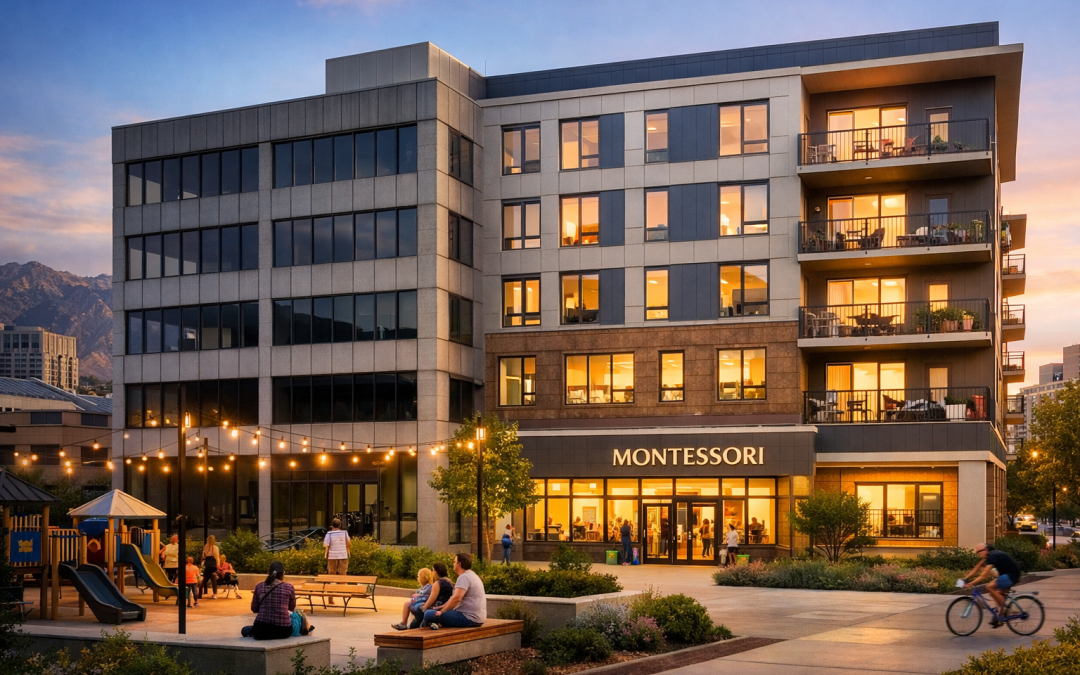
According to reporting by Elisabeth Slay and Cameron Rice in CoStar News (read the original article here: https://product.costar.com/home/news/2140370203), a former medical office building in Salt Lake City has been converted into an affordable housing community known as Arbor 515.
The redevelopment transformed a vacant property into nearly one hundred residential units while introducing an innovative model designed to help renters build financial stability over time.
What Happened to the Vacant Office Building
The building once housed medical offices connected to the University of Utah Health but eventually sat empty.
Instead of leaving the property underutilized, developers converted it into a residential project with a new purpose.
Key details from the CoStar report include:
- The redevelopment created 96 apartment units
- Monthly rents average roughly $1,082, below the area’s broader market average
- Units range from studio apartments to four-bedroom layouts
- The building includes a Montessori school on the ground floor
- The project was developed by The Giv Group
- Ownership involves Perpetual Housing Fund
The project also partnered with Community Housing of Utah to introduce a unique “tenant-wealth” structure aimed at helping renters build financial resources.
The Tenant-Wealth Model: A Different Approach to Renting
One of the most unusual aspects of the project is how it approaches the traditional rental model.
Rather than simply collecting rent, the program offers benefits intended to help residents improve long-term financial security.
According to project information cited in the CoStar article, those benefits may include:
- Annual rent rebates
- Participation in building refinancing or sale proceeds
- Access to emergency financial assistance
- Support pathways toward eventual homeownership
The idea behind the program is simple: stability in housing can create opportunities for families to build financial momentum.
City leaders have pointed to the project as a new way to approach affordable housing in urban areas.
Why This Matters for Western Real Estate Markets
While the project sits in Salt Lake City, the concept has broader implications across many growing markets—including Boise.
Cities throughout the West are seeing two simultaneous trends:
First, demand for housing continues to rise as populations grow.
Second, some commercial office buildings face higher vacancy rates due to changing workplace patterns.
Adaptive reuse—turning old commercial space into residential housing—has emerged as one possible solution.
Projects like this demonstrate that underutilized office buildings can potentially become housing without requiring entirely new construction.
What Boise Could Learn From This Approach
In the Boise commercial real estate market, office demand remains relatively healthy compared with some major cities. However, the long-term national trend of changing office use is still something investors and developers watch carefully.
If office vacancy ever increases locally, projects like Arbor 515 could provide a blueprint.
Possible opportunities could include:
Adaptive reuse conversions
Older office buildings may be redesigned into housing or mixed-use developments.
Transit-oriented redevelopment
Projects located near employment centers and transit infrastructure could support higher-density living.
Mixed-use community spaces
Integrating schools, services, or retail into residential projects can create more complete neighborhoods.
For cities experiencing rapid growth like Boise, creative redevelopment ideas may become increasingly valuable.
Local Insight: Why Adaptive Reuse Is Worth Watching
From a Boise development perspective, projects like this highlight something important: real estate markets evolve.
Buildings that made perfect sense twenty years ago might serve a different purpose today.
Instead of demolishing older properties, adaptive reuse offers a way to extend their life while addressing current needs.
If Boise continues to experience population growth and housing demand, creative redevelopment strategies could eventually play a role here as well.
For investors, developers, and landlords following Boise commercial real estate trends, this type of project shows how flexibility and innovation can unlock value in properties that might otherwise sit empty.
Mike Gioioso (joy-OH-so) has for 16+ years been helping companies of all sizes buy, build, and lease perfect places for business in greater Boise, Idaho and beyond.
www.streetsmartidaho.com mike@streetsmartidaho.com 208-209-9166
Tags: #Boisecommercialrealestate, #Boisedevelopment, #adaptivereuserealestate, #officetohousingconversion, #Boisehousingdemand, #commercialredevelopment, #affordablehousingdevelopment, #realestatetrendswesternUS, #SaltLakeCitydevelopment, #commercialrealestatetrends, #mixedusedevelopment, #urbanredevelopment, #investmentpropertyBoise