
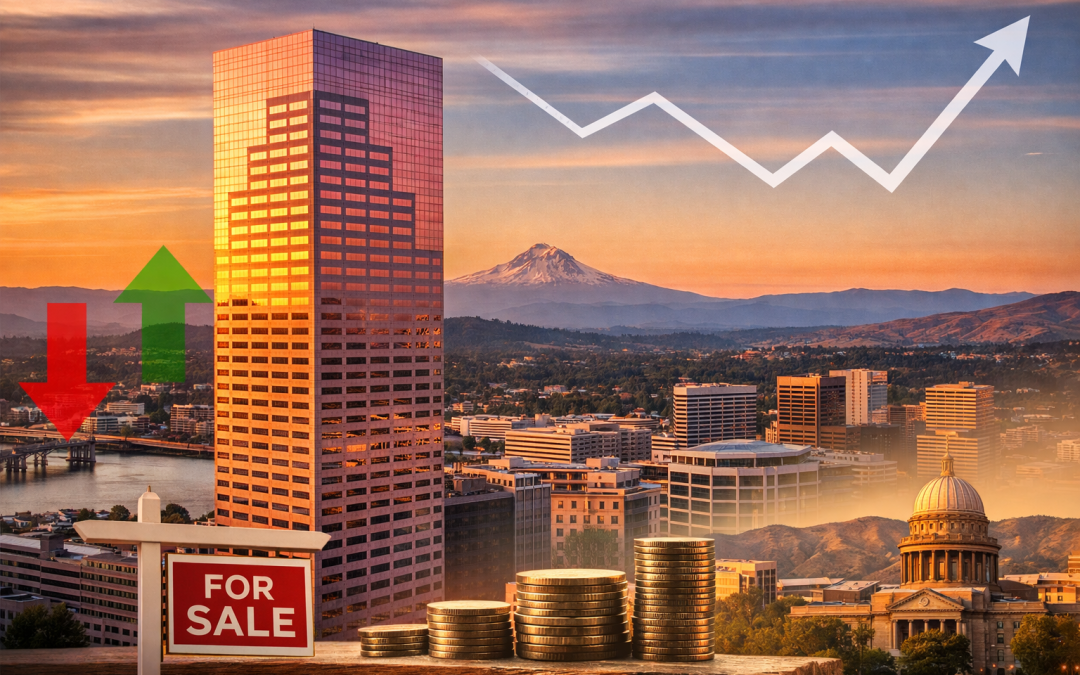
Portland’s Iconic “Big Pink” Sale Could Signal a New Pricing Era for West Coast Office Markets
Downtown office markets across the western United States are still adjusting to a very different reality than existed before the pandemic.
Vacancy levels remain elevated in many cities. Investor confidence has been uneven. And office pricing has shifted dramatically as remote and hybrid work reshape demand.
But sometimes a single high-profile transaction can signal that a market may be stabilizing — even if prices look very different than they once did.
According to reporting by Brian Yermal Jr. and Chris Sangiuliano in CoStar News (see the original article here: https://product.costar.com/home/news/1730594746), the recent sale of Portland’s well-known U.S. Bancorp Tower, often called “Big Pink,” is being viewed by industry professionals as an important turning point for that city’s office market.
While the story comes from Oregon, the broader implications could matter for investors watching Boise commercial real estate and office markets across the West.
A Landmark Office Tower Trades at a Deep Discount
The transaction involved one of Portland’s most recognizable buildings.
The U.S. Bancorp Tower, located at 111 SW Fifth Avenue, rises 42 stories and contains more than 1.15 million square feet of office space.
Key facts from the transaction include:
- Purchased by Swickard Auto Group, led by investor Jeff Swickard
- Sale price of about $45 million
- Roughly $39 per square foot
- Building approximately 50% vacant at time of sale
- Previously sold in 2015 for more than $316 million
That price difference highlights just how dramatically the office market has shifted.
The building once traded at more than $300 per square foot when the market was strong and occupancy was high. The most recent sale closed at a fraction of that valuation.
Even so, many local observers see the deal as a positive sign rather than a negative one.
Why?
Because the building sold quickly and the new owner intends to invest in renovations.
A Market Reset for Office Pricing
Across the country, many large office properties have struggled to trade since the pandemic.
Buyers and sellers often disagree on pricing, which has slowed deal activity in many downtown markets.
The Portland transaction may represent something important: a price discovery moment.
Industry observers noted that the deal shows where investors may now be willing to step in and purchase large office assets.
Instead of waiting for the market to return to pre-2020 values, some buyers are stepping forward at lower prices with a long-term redevelopment or repositioning strategy.
In the case of “Big Pink,” the buyer has indicated plans to upgrade both the tower and its surrounding plaza.
That type of reinvestment is often necessary to reposition older office buildings for the next phase of demand.
Why This Matters for Boise Commercial Real Estate
Although Boise’s office market has remained healthier than many large West Coast cities, the broader trends still matter.
Several lessons from the Portland deal could eventually influence Boise development and investment strategies.
Office Pricing Is Adjusting Nationwide
Even strong regional markets are seeing investors become more cautious.
As interest rates and workplace trends change, valuation expectations for office buildings may continue evolving.
Capital Is Still Looking for Opportunities
Even in challenging markets, investors are willing to buy assets if pricing reflects new realities.
Discounted acquisitions can create opportunities for repositioning, redevelopment, or adaptive reuse.
Renovation and Repositioning Are Becoming More Important
Older buildings that want to compete with newer office product often require upgrades such as:
- modern amenities
- improved common areas
- flexible office layouts
- updated building systems
Investors increasingly see these improvements as part of long-term value creation.
Local Market Impact: What Boise Investors Should Watch
Compared with cities like Portland or Seattle, Boise’s office market has been relatively stable.
Vacancy rates remain lower, and population growth continues to support business expansion across the Treasure Valley.
However, national trends still influence investment decisions.
Investors in Boise commercial real estate may increasingly focus on:
- well-located buildings with repositioning potential
- opportunities to acquire older assets at adjusted pricing
- office properties that can adapt to flexible workspace demand
Markets often reset in phases. Large coastal cities usually move first, and smaller regional markets follow later.
That’s why deals like the Portland tower sale can serve as early indicators.
My Take: Office Markets Are Entering a New Phase
From a Boise commercial real estate perspective, the biggest takeaway from this transaction is that the office market is transitioning into a new cycle.
The past decade’s pricing levels may not return quickly in many cities.
But that doesn’t mean opportunity disappears.
In fact, periods of price correction often create some of the most interesting investment opportunities for long-term owners willing to reposition assets.
For investors watching the western U.S. office market, the sale of Portland’s “Big Pink” tower may represent something important:
the beginning of a new pricing baseline — and potentially the start of the next investment cycle.
Mike Gioioso (joy-OH-so) has for 16+ years been helping companies of all sizes buy, build, and lease perfect places for business in greater Boise, Idaho and beyond.
www.streetsmartidaho.com
mike@streetsmartidaho.com
208-209-9166
Tags: #boisecommercialrealestate, #boiseofficemarket, #portlandofficemarket, #officebuildingsales, #commercialrealestateinvestment, #westcoastofficemarket, #officemarketrecovery, #downtownofficevacancy, #officebuildingrepositioning, #adaptivereuseofficebuildings, #commercialrealestatetrends