
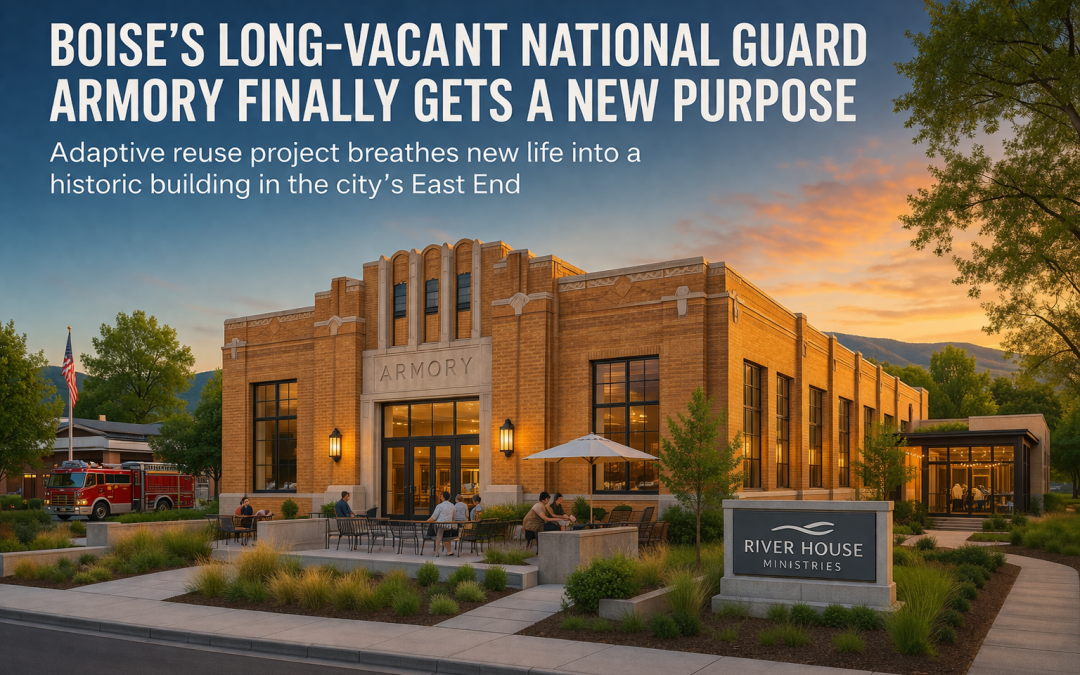
Boise’s Long-Vacant National Guard Armory Finally Gets a New Purpose
Across growing cities, one of the biggest development opportunities often hides in plain sight: historic buildings that have sat unused for decades.
These properties can be challenging to redevelop, but when the right project emerges, they can transform neglected spaces into active parts of the community again.
A recent decision in Boise highlights exactly that kind of redevelopment opportunity.
According to reporting by Royce McCandless in the Idaho Press (see the original article here: https://www.idahopress.com/news/local/after-decades-of-vacancy-historic-idaho-national-guard-armory-to-be-repurposed-by-ministry/article_d452a058-7ccb-4030-a666-5b4451c1987b.html), the Boise City Council voted to uphold approval allowing River House Ministries to repurpose the historic Idaho National Guard Armory in the city’s East End.
For anyone following Boise commercial real estate, the project reflects a broader trend: the growing importance of adaptive reuse and historic building revitalization in urban markets.
A Historic Building With Decades of Uncertainty
The armory building has been part of Boise’s landscape for nearly a century.
Originally constructed in the 1930s, the structure served the Idaho National Guard for several decades before eventually falling out of military use in the early 1970s.
Since then, the property has experienced a long period of uncertainty.
Over the years, several redevelopment ideas were proposed, including concepts for:
- recreational facilities
- performing arts space
- residential development
None of those plans ultimately moved forward.
The building has remained vacant for decades, gradually falling into disrepair despite its designation on the National Register of Historic Places.
The property sits in Boise’s East End neighborhood, near the Boise Bike Park and adjacent to Fire Station No. 1.
A Ministry Steps Forward With a Redevelopment Plan
In 2024, River House Ministries proposed converting the armory into a permanent home for its congregation.
The church currently serves around 700 members and has been operating from rented facilities.
Its redevelopment plan includes several features designed to serve both the congregation and the surrounding neighborhood.
Planned elements include:
- restoration of the historic building
- public events hosted throughout the year
- outdoor gathering space
- a small café open daily
City planners determined the project could move forward through a conditional use permit (CUP) process.
The Planning and Zoning Commission narrowly approved the permit after public hearings and discussion.
One condition included traffic calming measures along nearby streets in coordination with the Ada County Highway District.
Debate Over Mixed-Use Expectations
While many community members supported bringing the vacant building back to life, the proposal did face some neighborhood concerns.
Because the property sits within a Neighborhood Activity Center (NAC) designation, some residents argued the redevelopment should include more traditional mixed-use elements such as retail or neighborhood services.
Critics of the plan expressed concern that the church use might primarily serve its congregation rather than the surrounding community.
Supporters, however, pointed to several community-focused aspects of the project, including:
- public gathering spaces
- café access during normal business hours
- sidewalks improving neighborhood walkability
- availability of the space for community events
After reviewing the appeal filed by a nearby resident, the Boise City Council voted unanimously to uphold the Planning and Zoning Commission’s approval, allowing the project to move forward.
Why Adaptive Reuse Is Becoming More Important
This redevelopment effort reflects a broader pattern happening across many cities.
Historic buildings often face three major challenges:
- high renovation costs
- structural repairs
- modern code requirements
In the case of the armory, more than $1 million in improvements will be required just to restore the building to safe operating condition.
Despite these challenges, adaptive reuse projects can offer several advantages.
They preserve architectural history while also avoiding demolition and new construction.
For cities like Boise, these projects can also help strengthen neighborhood identity.
What This Means for Boise Commercial Real Estate
For investors, developers, and brokers tracking Boise commercial real estate, the armory project highlights a key development trend.
As Boise continues growing, the city is increasingly balancing historic preservation with modern redevelopment.
Older buildings that once served military, industrial, or civic purposes may find new life as:
- community gathering spaces
- creative offices
- retail destinations
- cultural or nonprofit centers
Adaptive reuse can also activate underutilized properties without dramatically altering neighborhood character.
That balance is particularly important in historic areas such as the East End.
Local Market Impact: Revitalization Without New Construction
One notable aspect of the armory project is that it preserves the building’s Art Deco architecture while adding new functionality.
Supporters of the redevelopment emphasized that the project respects both the historic structure and the surrounding neighborhood.
Instead of replacing the building with new construction, the redevelopment allows the property to finally reopen after decades of inactivity.
City officials and residents noted that the site had deteriorated significantly during its long vacancy.
Restoring the structure could bring renewed activity to the area while maintaining Boise’s architectural heritage.
My Take: Historic Buildings Can Become Community Anchors Again
From a Boise commercial real estate perspective, this story highlights the power of adaptive reuse.
Vacant historic buildings often appear difficult to redevelop because of regulatory hurdles, construction costs, and zoning questions.
But when the right user steps forward, these properties can become important neighborhood anchors.
The armory project demonstrates that redevelopment doesn’t always mean building something new.
Sometimes the best opportunity is bringing an overlooked property back to life.
As Boise continues expanding, we may see more projects that reposition historic structures in ways that combine preservation, community use, and economic activity.
Mike Gioioso (joy-OH-so) has for 16+ years been helping companies of all sizes buy, build, and lease perfect places for business in greater Boise, Idaho and beyond.
www.streetsmartidaho.com
mike@streetsmartidaho.com
208-209-9166
Tags: #boisecommercialrealestate, #boisedevelopment, #boisehistoricredevelopment, #adaptivereuseboise, #boiseurbanredevelopment, #historicbuildingrestoration, #boiseeastenddevelopment, #boisezoningdecisions, #historicpropertyredevelopment, #mixedusezoningboise