
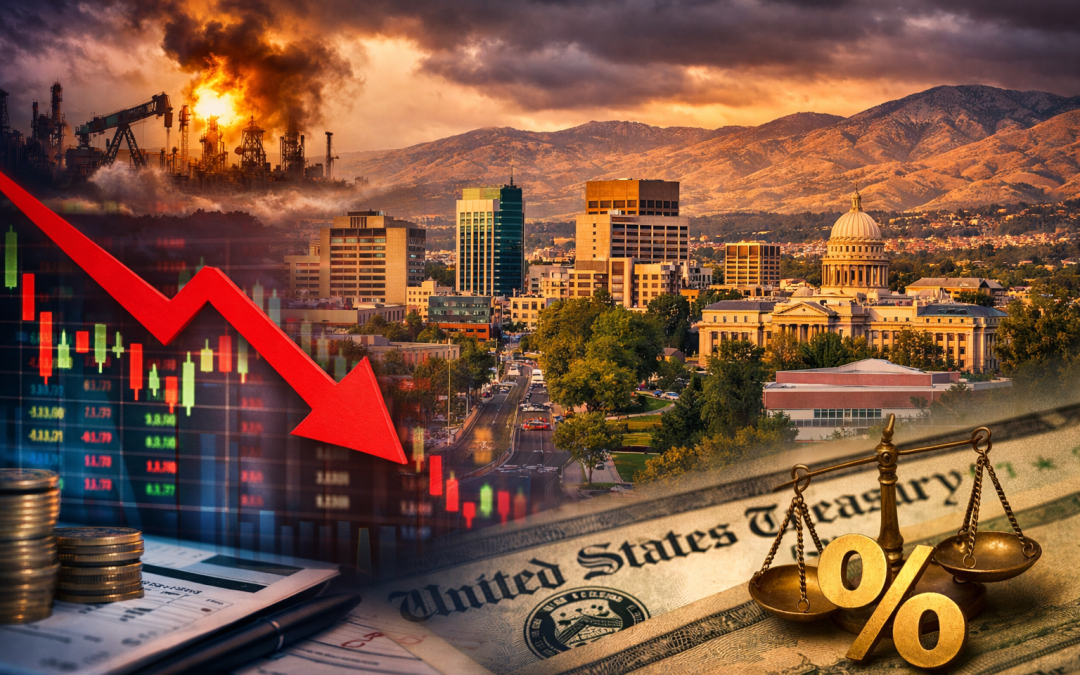
Market Volatility and Rising Rates: What the Latest Stock Market Pullback Could Mean for Boise Commercial Real Estate
Financial markets are sending a cautious signal as 2026 begins — and while Wall Street headlines may seem far removed from Idaho, the ripple effects often reach local real estate markets faster than many people expect.
According to reporting by Chibuike Oguh in Reuters, published by the Idaho Business Review (read the original article here: https://idahobusinessreview.com/2026/03/31/sp-500-worst-quarter-iran-war-rate-concerns/), the S&P 500 is on pace to record its weakest quarter since 2022. The decline reflects a mix of geopolitical tensions, rising energy prices, and uncertainty around interest rates and artificial intelligence’s impact on major technology firms.
For anyone involved in Boise commercial real estate, development, or investment, shifts like this are worth paying attention to. National financial trends often influence capital flows, borrowing costs, and investor sentiment — all factors that shape local real estate activity.
What’s Driving the Market Pullback
Several forces are converging to create volatility in the broader market.
Key developments reported in the article include:
- The S&P 500 falling roughly seven percent during the first quarter of the year.
- Major technology firms — often called the “Magnificent Seven” — declining significantly, with some companies down more than twenty percent.
- The U.S. ten-year Treasury yield approaching the mid-four percent range, reflecting uncertainty about where interest rates may head next.
Investors began the year expecting the Federal Reserve to gradually lower borrowing costs. But higher oil prices and inflation concerns have made the outlook less clear.
Markets tend to react quickly when expectations around rates shift, since interest rates influence everything from corporate investment decisions to mortgage costs.
Why Global Events Are Affecting Financial Markets
The recent market volatility is not tied to a single issue.
Several broader concerns have contributed to investor caution:
Geopolitical tensions
Conflict involving Iran has pushed energy prices higher, raising concerns about inflation.
Interest rate uncertainty
Bond yields have climbed as markets question whether the Federal Reserve will maintain a tougher stance on inflation.
Technology sector correction
Some of the largest tech companies that led the post-pandemic market rally have experienced sharp pullbacks as investors reassess growth expectations and spending on artificial intelligence infrastructure.
Credit market nerves
Developments in private credit markets — including some funds limiting withdrawals — have also added to broader financial anxiety.
Taken together, these forces have pushed investors toward a more defensive stance.
Why Investors in Boise Real Estate Should Pay Attention
Even though Boise is far from Wall Street, the national capital markets heavily influence commercial real estate investment and development in the Treasure Valley.
When stock markets decline or interest rates remain elevated, several real estate trends often follow:
- Investors become more cautious about acquisitions.
- Development financing becomes more expensive.
- Institutional capital may slow its pace of new real estate investments.
- Commercial lenders tighten underwriting standards.
For the Boise development pipeline, the biggest factor remains borrowing costs.
Higher Treasury yields often translate into higher commercial loan rates. That can influence feasibility for new office projects, apartment developments, or retail centers.
At the same time, market volatility sometimes pushes investors toward tangible assets like real estate, which can act as a long-term inflation hedge.
What This Could Mean for Boise’s Growth
The Treasure Valley economy continues to expand thanks to strong population growth and job creation.
However, national financial conditions still shape how quickly projects move forward.
If interest rates remain elevated, developers may:
- delay some construction starts
- focus on smaller or phased projects
- prioritize high-demand sectors like multifamily housing or healthcare facilities
Meanwhile, certain property types — especially medical office, industrial space, and necessity-based retail — tend to remain resilient even when financial markets fluctuate.
For tenants, periods of uncertainty can sometimes create opportunities. Landlords may become more flexible on lease terms or tenant improvement allowances to maintain occupancy.
Local Insight: Volatility Is Normal — But It Still Matters
Every real estate cycle includes periods where financial markets get nervous.
The important question for Boise is whether broader economic fundamentals remain strong.
Right now, the region still benefits from:
- steady in-migration
- expanding healthcare and technology sectors
- continued population growth across Ada and Canyon counties
Those factors help support long-term demand for Boise commercial real estate.
Still, investors and developers should keep an eye on interest rates and capital markets. When borrowing costs shift quickly, the pace of real estate transactions and new construction often adjusts as well.
The takeaway: what happens on Wall Street rarely stays on Wall Street — and the next phase of Boise’s development cycle will likely be influenced by how financial markets evolve over the coming months.
Mike Gioioso (joy-OH-so) has for 16+ years been helping companies of all sizes buy, build, and lease perfect places for business in greater Boise, Idaho and beyond.
www.streetsmartidaho.com
mike@streetsmartidaho.com
208-209-9166
Tags: #boisecommercialrealestate, #boisedevelopment, #treasurevalleyeconomy, #interestrates, #commercialrealestateinvestment, #boiserealestatetrends, #idahobusinessnews, #capitalmarkets, #realestateeconomics, #boiseinvestmentpropert