
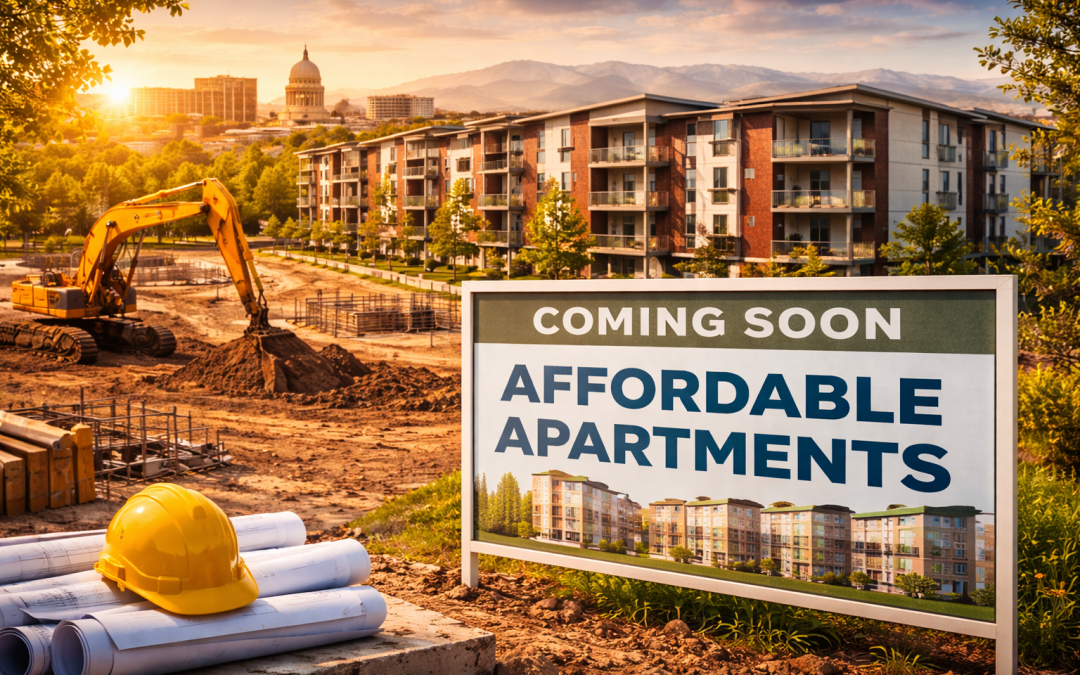
Boise’s West Bench Is Getting Over Two Hundred Affordable Apartments — What It Means for Local Development
Housing availability has become one of the most important issues shaping growth in the Treasure Valley. As Boise continues to expand, the ability to create homes at different price points is increasingly influencing everything from workforce stability to long-term economic development.
A new project on Boise’s west bench highlights how public and private partnerships are beginning to address that challenge.
According to reporting by the Idaho Press (you can read the original article here: https://www.idahopress.com/news/local/boise-ada-county-collaboration-helps-bring-affordable-apartments-to-boise-bench/article_c5c03205-cb47-4978-85a6-d09359a05970.html), city leaders, Ada County officials, and a private developer recently broke ground on a large affordable housing project that will bring more than two hundred income-restricted apartments to the Boise Bench. Idaho Press
While the development focuses on housing, projects like this also have broader implications for Boise commercial real estate, workforce stability, and neighborhood growth across the Treasure Valley.
A New Affordable Housing Project Takes Shape on the Boise Bench
The new development, called Dorado Station Apartments, is planned for a site along Eldorado Street near Fairview Avenue in west Boise.
When completed, the project will include 212 apartments across multiple unit sizes, including:
- one-bedroom units
- two-bedroom units
- three-bedroom units
The building will also include housing reserved for residents at different income levels. Some units are designated for households earning a percentage of the region’s median income, while a portion will support residents transitioning out of homelessness through a partnership with a local housing initiative.
The project is expected to open in 2027 once construction is completed.
How Public Land Is Helping Make Projects Possible
One of the most notable aspects of the development is how the land was structured.
The project was made possible through Boise’s housing land trust strategy, which allows the city to maintain ownership of certain properties while leasing them to developers for residential construction.
This approach can lower one of the largest costs associated with new housing: land acquisition.
By reducing that expense, developers are better able to build income-restricted housing that might otherwise be financially difficult to deliver.
The project also represents another collaboration with the same developer that previously worked with the city on earlier affordable housing projects in Boise.
Funding Partnerships Help Close the Financing Gap
Large housing developments often require multiple funding sources, and this project is no exception.
The estimated development cost is around $70 million, and a combination of local partnerships helped bridge the final financing gap.
Ada County contributed nearly five million dollars in remaining funds from the federal Emergency Rental Assistance program that was originally created during the pandemic to support renters.
Local officials said redirecting those funds toward long-term housing solutions allowed the money to create permanent community benefits rather than temporary assistance.
Partnerships among the city, the county, and housing authorities helped move the project from planning into construction.
Why Housing Supply Matters for Boise Commercial Real Estate
Although Dorado Station is a residential development, projects like this can have ripple effects throughout the local economy.
From a Boise commercial real estate perspective, workforce housing plays a major role in the region’s growth.
When housing becomes difficult to afford, it can create challenges for employers trying to attract and retain workers.
More balanced housing supply can support several areas of the local market:
Workforce Stability
Employees who can live near their jobs help strengthen Boise’s labor market.
Retail and Service Demand
New residential density increases demand for grocery stores, restaurants, fitness studios, and other neighborhood businesses.
Neighborhood Revitalization
Housing projects often bring infrastructure improvements and additional investment into surrounding areas.
The Boise Bench, in particular, has become an increasingly attractive location due to its proximity to downtown, major roads, and established neighborhoods.
Local Insight: Why Boise’s Housing Strategy Matters for Long-Term Growth
Cities across the western United States are grappling with housing affordability.
Boise is no exception, but initiatives like the housing land trust program show how local governments can use creative tools to partner with private developers.
For those watching Boise development and commercial real estate trends, the bigger takeaway is that housing supply and economic growth are closely connected.
When cities can create housing across multiple price ranges, they strengthen the foundation that supports:
- business expansion
- retail leasing in Boise
- office demand
- long-term investment in the Treasure Valley
Projects like Dorado Station may not grab the same headlines as large commercial developments, but they play an important role in shaping Boise’s future growth.
Mike Gioioso (joy-OH-so) has for 16+ years been helping companies of all sizes buy, build, and lease perfect places for business in greater Boise, Idaho and beyond.
www.streetsmartidaho.com
mike@streetsmartidaho.com
208-209-9166
Tags: #boisecommercialrealestate, #boisedevelopment, #boisebenchdevelopment, #boiseaffordablehousing, #treasurevalleyhousingmarket, #boiseapartmentdevelopment, #boisemultifamilymarket, #boisehousingsupply, #treasurevalleydevelopment, #boiseinvestmentproperty, #boisegrowthtrends, #boiseeconomicdevelopment, #boiseurbandevelopment, #adacountyhousingmarket, #boiseresidentialdevelopment