
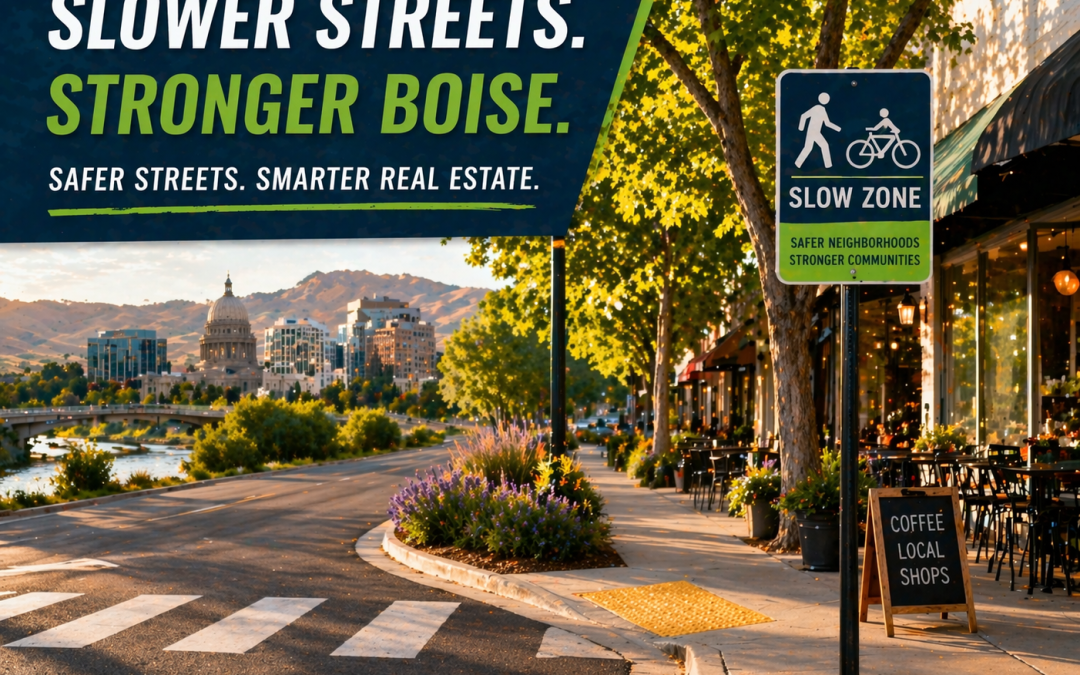
Boise’s New Slow Zones Signal a Shift — What Safer Streets Mean for Commercial Real Estate
Sometimes the biggest changes in a city don’t come from cranes or new construction.
They come from how people move.
And in Boise, a new push for safer streets could quietly shape the future of Boise commercial real estate in ways many aren’t talking about yet.
According to reporting by Idaho Press (read the original article here: https://www.idahopress.com/news/local/bizdev/achd-to-test-reduced-speeds-in-boises-north-end-neighborhoods-starting-in-january/article_ef30023e-cc91-4844-bc45-d6008d07cf14.html), the Ada County Highway District and the City of Boise are launching a pilot program to reduce speed limits in parts of the North End—one of the city’s most established and pedestrian-heavy neighborhoods.
At first glance, it’s about safety.
But zoom out, and it’s about how Boise is evolving.
What’s Changing: Streets Are Being Rebalanced
The new “slow zone” pilot will reduce speed limits to around twenty miles per hour on several key neighborhood streets, including corridors like Harrison Boulevard and nearby residential routes.
Additional measures include:
- Increased police presence for enforcement and education
- Pedestrian crossing enhancements
- Stricter parking enforcement near intersections and crosswalks
The program will be monitored over several months to evaluate its impact.
This comes after a tragic pedestrian incident that heightened community concern and accelerated action.
The bigger takeaway?
👉 Boise is prioritizing pedestrian safety and neighborhood livability more aggressively.
Why It Matters: Walkability Drives Real Estate Value
In commercial real estate, how people move through an area directly affects value.
Slower streets and safer crossings often lead to:
- Increased foot traffic
- Stronger neighborhood retail performance
- Higher demand for nearby residential and mixed-use projects
For retail leasing Boise, this matters more than it might seem.
When streets feel safer and more walkable:
- People stay longer
- They visit more businesses
- They return more often
That’s a direct boost to small-format retail, cafes, and service-based tenants.
The Trade-Off: Access vs Experience
There’s always a balance in these types of changes.
Slower speeds can mean:
- Longer drive times
- More congestion during peak hours
- Potential frustration for commuters
But they also create:
- More predictable traffic flow
- Safer intersections
- A more neighborhood-focused environment
From a Boise development perspective, this is a strategic shift:
👉 The city is leaning toward experience over speed.
And that tends to favor:
- Local retail corridors
- Mixed-use developments
- Walkable urban neighborhoods
Policy Constraints Are Adding Complexity
One important wrinkle in all of this is new state-level legislation that limits how transportation agencies can implement pedestrian and bike improvements.
In some cases:
- Road redesigns must primarily benefit vehicles
- Lane reductions are restricted on certain road types
- Some previously planned projects have been paused
That creates a more complex environment for future infrastructure planning.
For developers and investors, it means:
👉 Not all walkability improvements will be easy to implement moving forward.
Local Market Impact: What to Watch in Boise
Here’s how this could play out across the Boise commercial real estate landscape:
Retail
- Neighborhood retail corridors could see stronger performance
- Increased demand for smaller, pedestrian-oriented spaces
Office
- Walkable areas may become more attractive to tenants
- Employee experience and accessibility continue to matter
Residential & Mixed-Use
- Properties near “slow zones” may see increased appeal
- Higher demand for urban, lifestyle-focused living
Development Strategy
- Greater emphasis on location within walkable submarkets
- More focus on pedestrian access and design
Key Takeaways
- Boise is prioritizing pedestrian safety through reduced speed zones
- Walkability improvements can increase retail and property value
- New legislation may limit future infrastructure flexibility
- Neighborhood-focused development is gaining momentum
My Take: This Is About the Future of Boise’s Identity
From a Boise commercial real estate perspective, this isn’t just a traffic story.
It’s a signal about where the city is headed.
Boise is evolving from a car-first growth model toward something more balanced:
- Still accessible
- But increasingly community-focused
- And more intentional about how neighborhoods function
That matters.
Because the most successful real estate markets today aren’t just easy to drive through—they’re places people actually want to spend time in.
Here’s how I’d think about it:
- Investors: Look closely at walkable submarkets—they’re gaining long-term value
- Landlords: Position properties to benefit from increased foot traffic
- Developers: Prioritize pedestrian-friendly design where possible
- Tenants: Consider how location impacts customer behavior, not just access
Bottom line: safer streets don’t just protect people—they reshape how real estate performs.
And in Boise, that shift is just getting started.
Mike Gioioso (joy-OH-so) has for 16+ years been helping companies of all sizes buy, build, and lease perfect places for business in greater Boise, Idaho and beyond.
www.streetsmartidaho.com mike@streetsmartidaho.com 208-209-9166
Tags: #boisecommercialrealestate, #boisedevelopment, #boisewalkability, #boiserealestate, #retailleasingboise, #boiseinfrastructure, #pedestriansafetyboise, #boisenorthendrealestate, #treasurevalleydevelopment, #boisemixedusedevelopment, #walkableneighborhoodsboise, #boiseretailmarket, #urbanplanningboise, #boisezoningandpolicy, #idahotransportationpolicy