
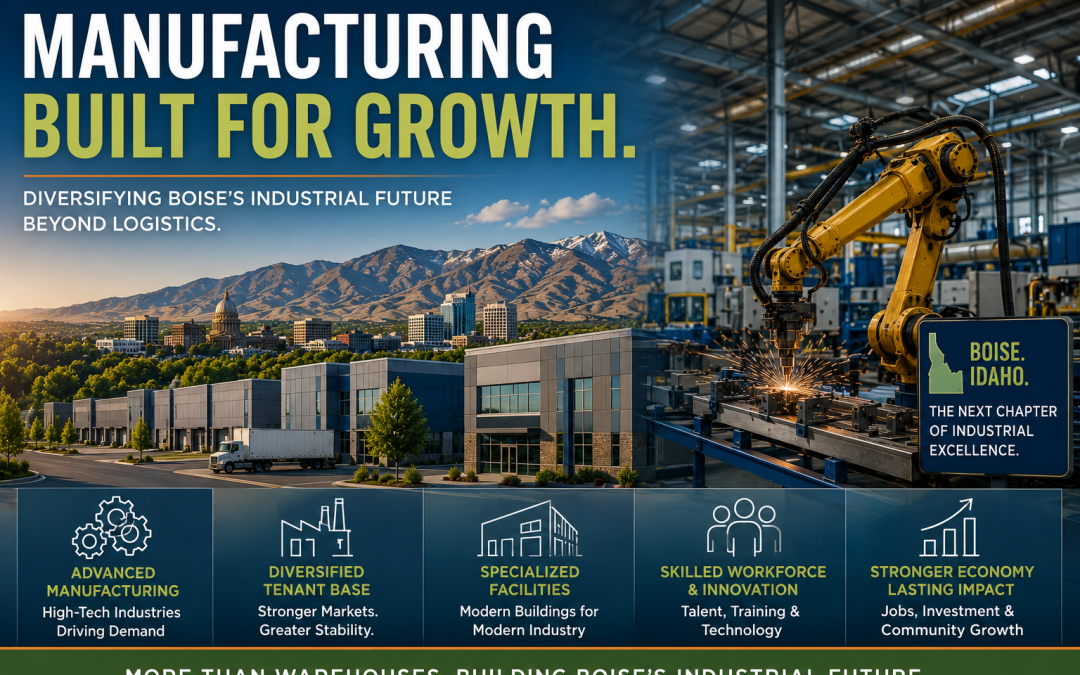
Why Manufacturing Could Become the Next Growth Engine for Boise Industrial Real Estate
Industrial real estate is changing.
For years, warehouses and distribution centers drove much of the demand for industrial buildings. Now, another group of tenants is becoming increasingly important: manufacturers.
According to reporting by Elliott Krivenko in CoStar News, manufacturing companies are making up a larger share of industrial leasing activity in the Puget Sound region as logistics demand moderates. You can read the original CoStar article here: https://product.costar.com/home/news/352968806. This article is based on that reporting while exploring what these changing tenant preferences could mean for Boise commercial real estate, industrial development, manufacturing growth, and future leasing opportunities across the Treasure Valley.
Industrial Demand Is Becoming More Diverse
Industrial markets perform best when they aren’t dependent on just one type of tenant.
CoStar’s research shows that while logistics companies continue to lease the largest amount of industrial space in the Seattle-area market, manufacturing businesses have steadily increased their share over the past several years.
Manufacturing users represented a growing portion of industrial leasing activity between 2020 and 2025, reflecting a broader mix of occupiers entering the market rather than relying almost exclusively on warehouse and distribution demand.
Employment trends tell a similar story.
Recent federal labor data cited by CoStar indicates manufacturing employment returned to positive growth while logistics-related employment softened slightly.
That changing balance suggests industrial demand may become more resilient as manufacturers expand alongside traditional warehouse users.
Why Boise Should Watch This Trend
The Treasure Valley has already been experiencing many of the same economic forces.
Manufacturing continues expanding throughout southwest Idaho thanks to major employers in semiconductors, food processing, precision manufacturing, aerospace, electronics, and advanced technology.
Projects involving Micron Technology, JTS, food manufacturers, and numerous advanced industrial companies have helped diversify Idaho’s employment base over the past several years.
Unlike many logistics operations, manufacturers often require facilities with specialized electrical systems, greater power capacity, heavier floor loads, upgraded utilities, enhanced ventilation, and skilled labor access.
Those requirements create opportunities for developers capable of delivering higher-quality industrial space.
A More Balanced Tenant Mix Benefits Landlords
One lesson from the Puget Sound market is that diversity strengthens industrial real estate.
When leasing demand comes from manufacturers, logistics providers, suppliers, contractors, technology companies, and research firms simultaneously, industrial markets become less vulnerable to slowdowns in any single industry.
For investors and landlords, that can lead to:
- More consistent leasing activity
- Broader tenant demand
- Increased flexibility in building design
- Improved long-term occupancy
- Greater market stability
Instead of relying on one dominant user type, industrial owners benefit from serving multiple sectors with different business cycles.
Boise’s Competitive Position Continues Improving
Idaho has several advantages that could continue attracting manufacturing investment.
Lower operating costs, business-friendly policies, available land, expanding infrastructure, and a growing workforce have already encouraged companies to establish or expand operations across the Treasure Valley.
As advanced manufacturing continues evolving, Boise’s industrial market may see increasing demand for buildings that support production, assembly, research, engineering, and light manufacturing—not simply warehousing.
That could influence future industrial park design, utility planning, and speculative development throughout Ada and Canyon counties.
My Take
Industrial real estate isn’t becoming less important.
It’s becoming more specialized.
The strongest markets are attracting a wider variety of industrial users instead of depending almost entirely on logistics companies.
For Boise commercial real estate, that’s encouraging news.
Manufacturing jobs typically create long-term economic benefits, generate higher wages, and support surrounding suppliers, contractors, transportation companies, and service businesses. Those ripple effects often translate into additional demand for industrial buildings, office space, retail centers, housing, and commercial development throughout the region.
If Boise continues attracting advanced manufacturing alongside distribution and logistics, the Treasure Valley could build an even stronger and more resilient industrial real estate market over the coming decade.
Mike Gioioso (joy-OH-so) has for 16+ years been helping companies of all sizes buy, build, and lease perfect places for business in greater Boise, Idaho and beyond. www.streetsmartidaho.com mike@streetsmartidaho.com 208-209-9166
Tags: #boisecommercialrealestate, #boiseindustrialrealestate, #industrialdevelopment, #manufacturing, #advancedmanufacturing, #microntechnology, #boisedevelopment, #industrialleasingboise, #warehousespaceboise, #treasurevalleygrowth, #flexindustrialspace, #commercialrealestateinvestment, #idahomanufacturing, #industrialproperty, #economicdevelopment, #logistics, #businessexpansion, #commercialproperty, #industrialmarkettrends, #idahobusiness