
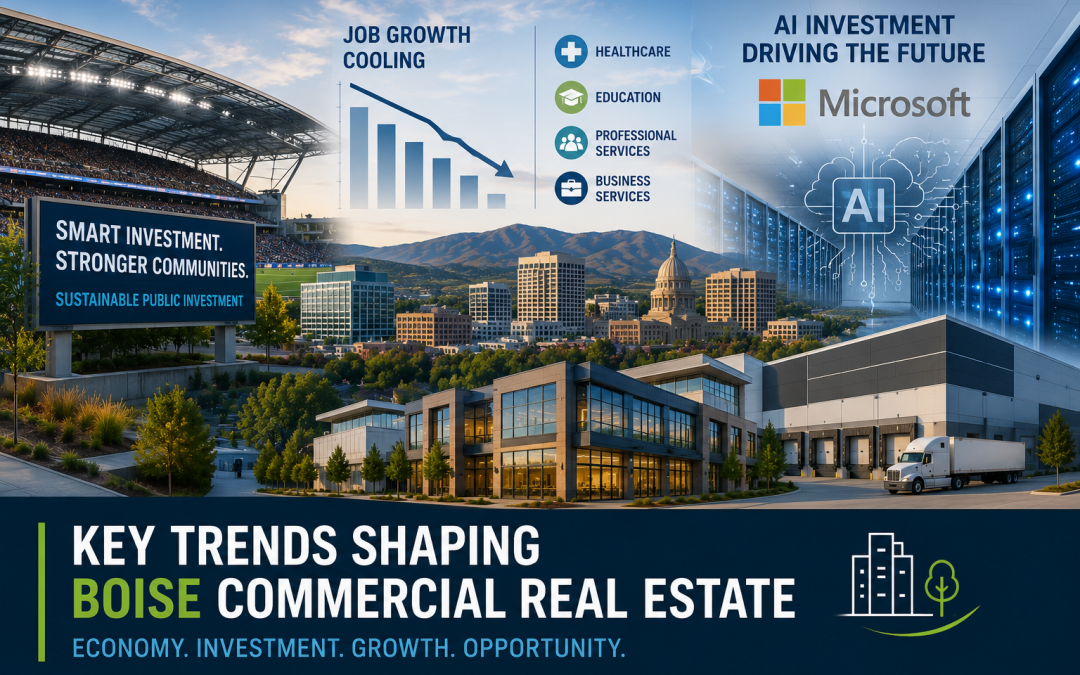
What Slowing Job Growth, AI Investment, and Stadium Spending Could Mean for Boise Commercial Real Estate
Commercial real estate isn’t driven by just one headline.
Office demand, industrial construction, retail leasing, and land development are all influenced by broader economic trends happening across the country. Three recent national stories—public spending on sports stadiums, slowing job growth, and Microsoft’s latest artificial intelligence investment—offer valuable clues about where commercial real estate may be heading next.
According to reporting by Lou Hirsh in CoStar News, recent developments highlight changing priorities in public investment, the labor market, and technology expansion. You can read the original CoStar News article here: https://product.costar.com/home/news/1621486601. This article is based on that reporting while exploring what these national trends could mean for Boise commercial real estate, future development, and investment opportunities throughout the Treasure Valley.
AI Investment Continues To Drive Commercial Real Estate Demand
One of the biggest stories isn’t about traditional office leasing—it’s about artificial intelligence.
Microsoft recently announced plans to invest $2.5 billion into a new subsidiary focused on helping businesses adopt AI technologies. The company expects approximately 6,000 employees to support the initiative.
Microsoft joins a growing list of technology companies—including Amazon, Google, OpenAI, Anthropic, and Oracle—that continue investing billions into artificial intelligence infrastructure.
For commercial real estate, that matters because AI growth fuels demand for:
- Data centers
- Office space for engineering and consulting teams
- Industrial buildings supporting technology supply chains
- Power infrastructure
- Telecommunications upgrades
Boise has already benefited from technology investment, and continued AI expansion across the western United States could create additional opportunities for the Treasure Valley’s office, industrial, and infrastructure markets.
Job Growth Is Cooling—But Some Industries Continue Expanding
The latest federal employment report showed hiring slowing more than many economists expected.
The economy added approximately 57,000 jobs during June, while unemployment remained relatively stable at 4.2%.
Not every industry moved in the same direction.
Areas continuing to add workers included:
- Healthcare
- Education
- Professional services
- Business services
Meanwhile, hiring slowed across several sectors, including:
- Retail
- Leisure and hospitality
- Manufacturing
- Transportation
- Construction
For Boise commercial real estate, that mixed picture reinforces an important lesson.
Property demand rarely rises evenly across every asset class.
Healthcare office space, medical facilities, and professional office buildings may continue seeing steady activity even when other commercial sectors experience slower growth.
Stadium Projects Are Becoming More Financially Complex
The CoStar report also highlighted new research from the Pew Research Center examining public investment in professional soccer stadiums.
Over the past several decades, government funding has helped Major League Soccer expand from just a handful of teams into one of America’s fastest-growing professional sports leagues.
However, Pew researchers found that some publicly financed stadium projects have struggled to generate the long-term tax revenue and economic activity originally projected.
Several municipalities have shifted away from directly financing stadium construction and instead focus on supporting surrounding infrastructure, environmental improvements, workforce programs, and broader community benefits.
That represents an important shift in public development strategy.
Why This Matters for Boise Development
Whether discussing technology, sports facilities, or employment, one common theme emerges:
Investors are becoming more selective.
Public agencies are evaluating infrastructure investments more carefully.
Employers are making targeted hiring decisions.
Developers are placing greater emphasis on projects that demonstrate measurable long-term value.
For Boise, that may encourage continued investment in projects that improve:
- Transportation infrastructure
- Utility capacity
- Mixed-use development
- Workforce housing
- Business parks
- Innovation districts
Rather than pursuing growth at any cost, communities increasingly focus on developments that support long-term economic competitiveness.
Boise Could Benefit From These Long-Term Trends
Boise continues building a diversified economy supported by healthcare, manufacturing, technology, logistics, education, and professional services.
Those industries generally align well with the sectors that continue showing resilience nationally.
As companies expand their use of artificial intelligence and digital infrastructure, Boise’s relatively affordable business environment, growing workforce, and expanding transportation network could make the Treasure Valley increasingly attractive for future investment.
The city’s continued investment in infrastructure, business development, and quality of life also positions it to compete for employers seeking alternatives to larger, more expensive metropolitan areas.
My Take
From my perspective in Boise commercial real estate, the biggest takeaway isn’t that one industry is booming or slowing—it’s that today’s market rewards thoughtful investment.
Technology companies continue spending billions.
Healthcare remains a reliable source of employment growth.
Communities are becoming more disciplined about public development incentives.
Those trends all point toward a commercial real estate market that increasingly values projects with lasting economic benefits rather than short-term excitement.
For Boise developers, landlords, investors, and business owners, that’s encouraging.
The Treasure Valley has built much of its recent success by focusing on sustainable growth, diversified industries, and long-term planning. If those fundamentals remain in place, Boise should continue attracting commercial investment even as national markets become more selective.
Mike Gioioso (joy-OH-so) has for 16+ years been helping companies of all sizes buy, build, and lease perfect places for business in greater Boise, Idaho and beyond.
www.streetsmartidaho.com
mike@streetsmartidaho.com
208-209-9166
Tags: #boisecommercialrealestate, #boisedevelopment, #artificialintelligence, #microsoftai, #boiseofficemarket, #industrialrealestate, #economicdevelopment, #boisebusinessgrowth, #healthcarerealestate, #retailleasingboise, #mixedusedevelopment, #commercialpropertyinvestment, #datacenters, #infrastructureinvestment, #treasurevalleydevelopment, #officeleasingboise, #commercialrealestatetrends