
Why Smaller Industrial Buildings Could Be the Next Big Opportunity for Boise Commercial Real Estate
The biggest industrial real estate story today isn’t about giant distribution centers.
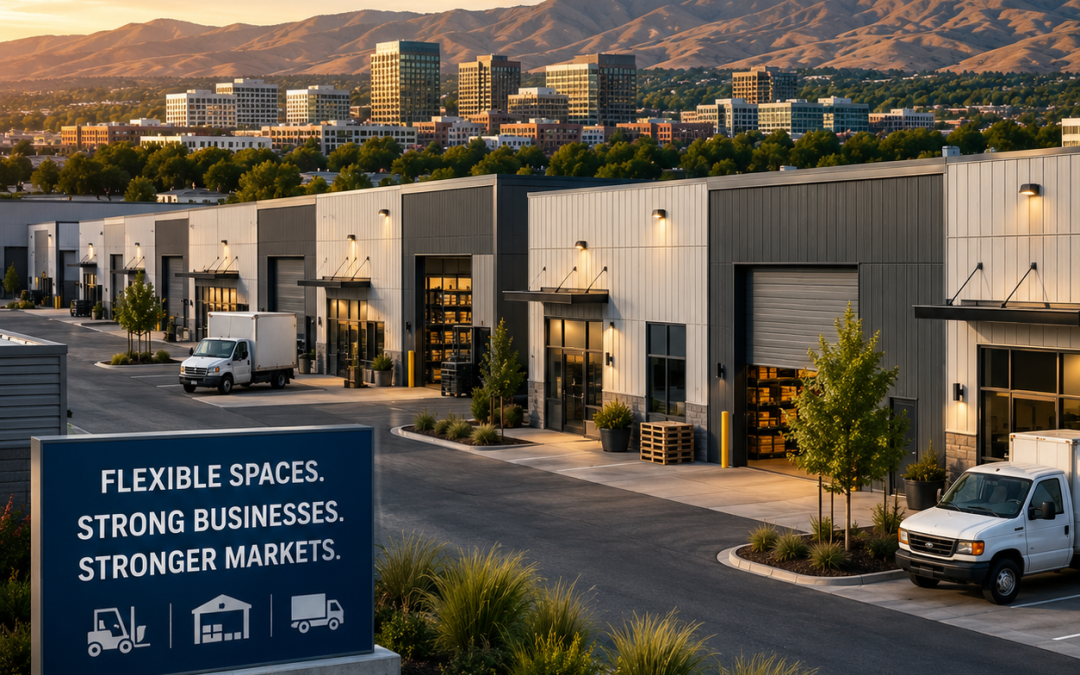
Instead, many investors are turning their attention to smaller warehouses that serve local businesses, contractors, manufacturers, and distributors. As demand shifts toward these flexible spaces, markets across the country—including Boise—could see new investment opportunities emerge.
According to reporting by Randyl Drummer in CoStar News, California-based MCA Realty recently acquired three multitenant industrial buildings in the Kent Valley near Seattle, continuing a broader trend of investors targeting smaller warehouse properties. You can read the original CoStar News article here: https://product.costar.com/home/news/1037666789.
This article is based on that reporting while exploring what these national industrial trends could mean for Boise commercial real estate, industrial development, and investment throughout the Treasure Valley.
Small-Bay Industrial Space Is Becoming More Valuable
For years, developers focused on building massive warehouses designed for national logistics companies.
Today, another segment of the market is attracting growing attention.
Smaller industrial buildings—particularly those that can accommodate multiple tenants—are seeing healthy leasing activity because they serve a much broader range of local businesses.
The Seattle-area transaction illustrates that trend.
MCA Realty purchased the West Valley Distribution Center, a three-building industrial portfolio totaling approximately 138,300 square feet in Kent, Washington. The company plans to renovate the properties and create flexible spaces ranging from roughly 4,000 to 40,000 square feet, making the buildings attractive to many different types of tenants.
Rather than relying on one large occupant, multitenant industrial properties can generate demand from dozens of local businesses across different industries.
Demand Is Coming From Smaller Businesses
One of the most interesting findings in CoStar’s reporting is where leasing activity is occurring.
Over the past year, approximately 90% of industrial lease transactions in the Puget Sound region involved spaces under 50,000 square feet.
Those smaller leases represented more than half of all industrial space leased during the period.
National vacancy data tells a similar story.
Industrial buildings between 50,000 and 100,000 square feet have average vacancy rates around 6.5%, while buildings smaller than 50,000 square feet have vacancy below 5%. By comparison, larger industrial facilities over 100,000 square feet average roughly 9% vacancy.
Those numbers suggest demand remains strongest for flexible warehouse space that can accommodate growing local businesses instead of only major distribution companies.
Why This Matters for Boise Commercial Real Estate
The Treasure Valley shares many characteristics with markets experiencing strong small-bay industrial demand.
Boise continues attracting:
- Local manufacturers
- Construction companies
- HVAC and plumbing contractors
- Electrical suppliers
- Technology firms
- Food distributors
- Last-mile logistics companies
- Small e-commerce businesses
Many of these companies don’t need 300,000-square-foot distribution centers.
Instead, they’re looking for industrial suites between 3,000 and 30,000 square feet with warehouse space, loading doors, office areas, and room for future expansion.
That creates opportunities for Boise commercial real estate developers and investors to focus on multitenant industrial projects rather than pursuing only large warehouse developments.
As land prices continue rising throughout Ada and Canyon counties, maximizing flexibility within industrial buildings may become increasingly important.
Investment Activity Is Picking Up
The Seattle acquisition also reflects renewed investor confidence in industrial real estate.
According to CoStar, industrial sales activity across the greater Seattle market has rebounded significantly, with 2026 transaction volume on pace to match or exceed 2025, the strongest annual investment year in three years.
Institutional investors are increasingly looking for industrial properties that offer stable occupancy, diversified tenant bases, and opportunities to add value through renovations or improved leasing strategies.
These same characteristics can be attractive in the Boise market as investors continue searching for high-growth regions with expanding business communities.
Local Insight
One of the biggest misconceptions in industrial real estate is that bigger always means better.
In reality, many of the businesses driving Idaho’s economy simply need practical, functional warehouse space—not million-square-foot fulfillment centers.
As Boise continues growing, demand for flexible industrial buildings that serve local and regional businesses may outpace demand for larger speculative warehouse projects.
Developers who can provide modern small-bay industrial space with efficient layouts, quality loading access, and room for tenant growth could find themselves well positioned as the Treasure Valley’s industrial market continues to mature.
The Seattle transaction demonstrates that experienced investors are already recognizing this shift. Boise may not be far behind.
Mike Gioioso (joy-OH-so) has for 16+ years been helping companies of all sizes buy, build, and lease perfect places for business in greater Boise, Idaho and beyond.
www.streetsmartidaho.com
mike@streetsmartidaho.com
208-209-9166
Tags: #boisecommercialrealestate, #boiseindustrialrealestate, #smallbayindustrial, #industrialleasingboise, #warehousespaceboise, #boisedevelopment, #treasurevalleyindustrial, #industrialinvestment, #commercialpropertyinvestment, #industrialdevelopment, #flexindustrialspace, #warehouseinvestment, #logisticsrealestate, #industrialbuildings, #industrialproperty