
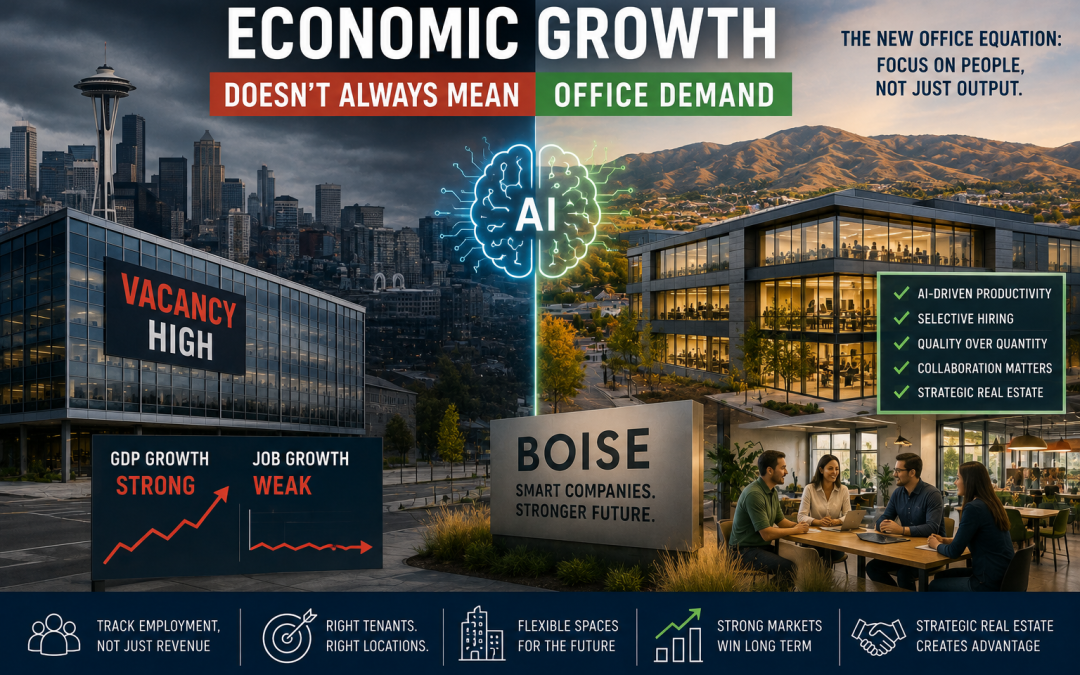
Why Economic Growth May No Longer Guarantee Office Demand—and What It Means for Boise Commercial Real Estate
A booming economy used to send a pretty clear signal to commercial real estate investors.
Businesses grow.
Companies hire.
More employees need desks.
Office buildings fill up.
Artificial intelligence may be disrupting that relationship.
Washington provides an interesting example. The state recently posted some of the strongest economic growth in the country, yet its major office markets continue dealing with elevated vacancy.
According to reporting by Elliott Krivenko of CoStar Analytics, Washington’s economy grew significantly faster than the national economy during the first quarter of 2026, largely because of its technology sector. But that economic expansion hasn’t produced comparable employment growth.
You can read the original CoStar Analytics article here: https://product.costar.com/home/news/1584951500
For Boise commercial real estate, the takeaway isn’t about Seattle specifically.
It’s about something much bigger.
If companies can produce more revenue and economic output without adding employees at the same pace, traditional assumptions about office demand may need to change.
Economic Growth and Job Growth Are Starting to Separate
Washington’s economy expanded at an annualized rate of approximately 4.5% during the first quarter, according to Bureau of Economic Analysis data cited by CoStar.
The national economy grew roughly 2.1%.
Technology played a major role in Washington’s performance, with the information sector responsible for much of the state’s increase in economic output.
Normally, that kind of growth would sound very positive for office landlords.
But employment tells a different story.
According to the CoStar analysis, employment growth in Washington’s information sector remained extremely modest.
The sector was also still roughly 6.7% below its August 2022 employment peak.
That’s an important distinction.
Companies are generating more economic output.
But they aren’t necessarily hiring large numbers of people to produce it.
Artificial intelligence, automation, cloud computing, and productivity software could make that disconnect increasingly common.
And that matters for office real estate.
Seattle Shows Why GDP Doesn’t Fill Buildings
Seattle has one of the country’s strongest technology economies.
Yet its office market remains heavily challenged.
The metropolitan area’s office vacancy rate is around 17%, according to CoStar, compared with rates below 6% during portions of the late 2010s.
Some submarkets have considerably more empty space.
Downtown Seattle and Bellevue’s I-90 Corridor have experienced vacancy above 30%.
That would have been difficult to imagine during the technology expansion that preceded the pandemic.
The lesson is simple:
A strong economy and a strong office market are no longer necessarily the same thing.
For investors analyzing Boise office real estate, that’s an important change.
Looking only at GDP, population growth, or corporate revenue may not tell us enough about future space demand.
We also need to know how many people companies are actually hiring—and where those employees are working.
AI Companies Are Leasing Space, But Selectively
There is some encouraging news in Seattle.
AI companies have been taking office space.
Anthropic reportedly leased approximately 113,000 square feet at Dexter Yards in Seattle’s South Lake Union area.
Other AI and technology companies have also made significant commitments in Bellevue-area submarkets, including OpenAI, Databricks, and xAI.
These transactions matter because they show that technology companies haven’t abandoned physical offices.
In fact, certain AI companies appear willing to make substantial office commitments when they want access to concentrated pools of engineering and technical talent.
But there’s a catch.
A handful of large leases doesn’t necessarily fix a market with millions of square feet of vacant space.
That’s exactly what Seattle is demonstrating.
For Boise commercial real estate, this suggests that future office recovery may be uneven.
Certain buildings could perform extremely well.
Others may continue struggling.
The Office Market Could Become More About Quality Than Quantity
The old office model was often based on headcount.
More employees meant more square footage.
If a company hired 100 additional workers, it might need another 15,000 to 25,000 square feet.
But what happens if AI allows that company to generate similar growth with 40 new employees instead?
The company may still want office space.
It just might not need as much.
At the same time, it may be willing to pay more for a better environment.
That could benefit high-quality office buildings.
Companies may increasingly prioritize:
- Strong locations
- Modern conference rooms
- Collaborative areas
- Flexible floor plans
- Natural light
- Restaurants and amenities nearby
- High-speed connectivity
- Parking
- Attractive common areas
- Spaces employees actually want to use
That could widen the gap between the best office buildings and everything else.
Boise’s Office Market Has an Important Advantage
Boise isn’t Seattle.
That’s actually important.
Seattle entered this cycle with an enormous office inventory built around some of the world’s largest technology companies.
Boise has a much smaller office market.
That means the Treasure Valley doesn’t necessarily need thousands of companies to begin expanding for conditions to improve.
A relatively modest number of growing employers can have a meaningful impact.
But the same fundamental rule still applies.
Employment creates office demand more directly than economic output does.
Micron could generate tremendous economic activity.
Technology companies could become more productive.
Local businesses could increase revenue.
AI startups could raise capital.
Those are all positive signals.
But office landlords ultimately need people occupying buildings.
That’s why job growth in office-using industries should remain one of the most important indicators for Boise office leasing.
Local Insight: Start Tracking Employees, Not Just Companies
When evaluating an office tenant, one of the first questions I would increasingly ask is:
How is this company’s headcount changing?
Not just revenue.
Not just funding.
Not just whether the company is “growing.”
Actual employees.
A company could increase revenue substantially while reducing administrative staff because of automation.
Another company might be growing revenue more slowly but adding salespeople, engineers, customer-service employees, and managers.
From an office landlord’s perspective, the second company could generate more real estate demand.
This is especially important as AI becomes integrated into professional services.
Accounting.
Legal services.
Insurance.
Finance.
Technology.
Marketing.
Architecture.
Engineering.
Commercial real estate itself.
All of these industries traditionally consume office space.
If AI changes their staffing models, it could eventually change their real estate requirements.
Smaller Offices Could Benefit
One possible outcome is increased demand for smaller, higher-quality office suites.
Instead of leasing 20,000 square feet, a company might take 12,000.
Instead of 5,000 square feet, another might take 3,000.
But those tenants could demand better space.
That could create opportunities for landlords capable of dividing larger vacancies into smaller suites.
Move-in-ready office space could become particularly attractive.
Growing companies don’t always want to spend six months designing and constructing an office.
They may prefer space that already offers conference rooms, kitchens, private offices, collaborative areas, and modern finishes.
For Boise office landlords, flexibility may become increasingly valuable.
AI Could Actually Bring Some Companies Back Together
There is also an argument that AI could strengthen certain kinds of office demand.
Developing complex technology requires collaboration.
Engineering teams need to solve difficult problems.
Startups need to build culture.
Managers need to train employees.
Creative teams need to exchange ideas.
Some companies may decide those activities work better when people spend meaningful time together.
The recent AI-related leasing activity in Seattle supports that possibility.
Companies aren’t necessarily leasing space because every employee must sit at a desk five days a week.
They may be leasing space because talented people working together still matters.
That could favor office buildings designed around collaboration rather than rows of individual workstations.
Boise Developers Should Be Careful With Speculative Office Construction
For developers, the lesson from Seattle is particularly important.
Strong economic growth alone isn’t enough reason to build more office space.
Before starting speculative development, I would want clear answers to several questions.
Where is office-using employment growing?
Which industries are adding workers?
What size spaces are tenants actually leasing?
Which buildings are outperforming?
Are tenants expanding or simply relocating into better space?
How much shadow space exists inside currently occupied offices?
And how much competing space is already available?
Those questions are more important than broad economic headlines.
For Boise development, office construction should increasingly be based on demonstrated tenant demand rather than assumptions that economic growth will eventually fill the building.
Investors May Find Opportunities in the Divide
A changing office market doesn’t necessarily mean office real estate is a bad investment.
It means investors need to be more selective.
The growing difference between high-quality and obsolete buildings could create opportunities.
Some properties may be available at prices well below replacement cost.
Others could be repositioned.
Large floor plates might be divided.
Common areas could be improved.
Amenities could be added.
Parking could be upgraded.
Buildings in strong locations could potentially attract companies leaving older or less convenient properties.
The key is understanding whether the property can compete for the tenants that still want office space.
Buying a cheap office building simply because it is cheap isn’t a strategy.
Buying one that can become significantly more competitive may be.
What Boise Commercial Real Estate Should Watch Next
Washington’s experience offers a useful warning for growing markets.
Economic output can rise without producing a corresponding increase in office demand.
For Boise, I would watch several indicators closely:
Office-using employment. Are professional and technology companies actually adding people?
Average lease size. Are companies taking smaller spaces?
AI-related hiring. Are technology companies building teams in Boise?
Flight to quality. Are tenants moving into better buildings without increasing overall square footage?
Sublease availability. Are companies still carrying space they no longer need?
New construction. Is supply being added faster than tenant demand?
Those indicators will probably tell us more about the future of Boise’s office market than GDP growth alone.
The New Office Equation
For decades, the office market followed a relatively straightforward formula:
Economic growth created companies.
Companies created jobs.
Jobs created office demand.
AI may be changing the middle of that equation.
Businesses can potentially grow faster without increasing headcount at the same rate.
That doesn’t eliminate the office.
It changes what drives demand for it.
The buildings that succeed may increasingly be those that attract companies competing for talented people—not simply those offering the most square footage.
For Boise commercial real estate, that’s an important distinction.
Boise’s economy can grow.
Technology investment can increase.
Micron can expand.
AI companies can emerge.
Businesses can become more productive.
But for the office market, one question still matters more than almost anything else:
How many people need a place to work?
Understanding that relationship could be critical for Boise landlords, investors, developers, and tenants navigating the next phase of the office market.
Mike Gioioso (joy-OH-so) has for 16+ years been helping companies of all sizes buy, build, and lease perfect places for business in greater Boise, Idaho and beyond.
www.streetsmartidaho.com mike@streetsmartidaho.com 208-209-9166
Tags: #boisecommercialrealestate, #boiseofficemarket, #boiseofficeleasing, #officerealestateboise, #boisedevelopment, #artificialintelligence, #aiofficedemand, #technologyjobsboise, #micronboise, #treasurevalleybusiness, #commercialpropertyinvestment, #boiseofficespace, #officevacancy, #flighttoquality, #officeleasingtrends