
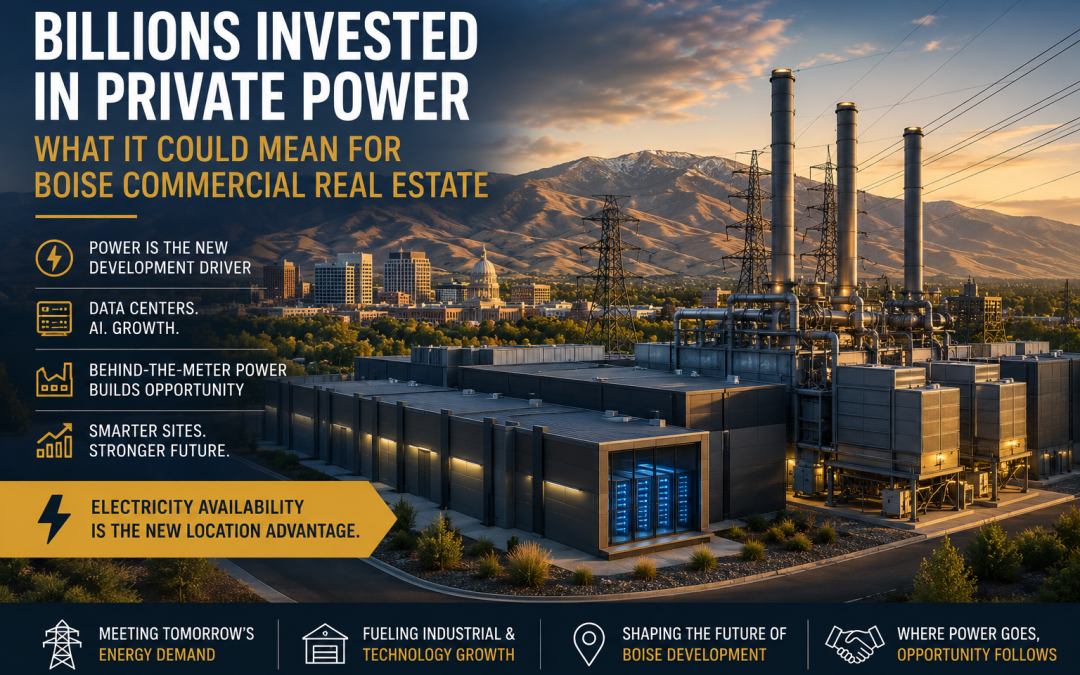
Why Billions Are Flowing Into Private Power—and What It Could Mean for Boise Commercial Real Estate
The next major constraint on commercial development may not be land.
It may not even be interest rates or construction costs.
It could be electricity.
Artificial intelligence and data centers are creating enormous demand for power across the country. Now some of the world’s largest investment firms are putting billions of dollars behind an alternative solution: build power infrastructure specifically for the biggest users instead of waiting for the traditional electrical grid to catch up.
That shift could eventually have important implications for Boise commercial real estate, industrial development, data centers, utilities, and large-scale economic development throughout Idaho.
According to reporting by Linda Moss of CoStar News, energy infrastructure company Williams secured approximately $5.34 billion from an investment group led by Blackstone Credit & Insurance, with participation from Apollo and KKR. The capital will help develop five energy projects intended to serve large power users, including data centers.
You can read the original CoStar News article here: https://product.costar.com/home/news/897058256
The investment is significant on its own.
But the bigger commercial real estate story is the emergence of power as something developers may increasingly have to secure alongside land, financing, and entitlements.
Data Centers Are Changing the Development Equation
For decades, commercial real estate development followed a fairly predictable process.
Find the land.
Secure financing.
Get approvals.
Build infrastructure.
Construct the project.
Lease or sell it.
For extremely power-intensive users, that process is becoming more complicated.
A site can have great freeway access, favorable zoning, available land, and a willing municipality—and still be difficult to develop if sufficient electricity isn’t available.
Data centers make that problem especially visible.
The growth of artificial intelligence, cloud computing, streaming, digital services, and other technologies requires enormous amounts of computing capacity.
That computing capacity requires electricity.
Lots of it.
The Williams projects represent more than 6 gigawatts of potential generation capacity. To put the scale into perspective, that’s enough electricity to serve millions of homes or multiple large data center campuses.
The five projects are planned for Ohio and Utah.
The Utah location is especially worth watching from Idaho because it demonstrates that large-scale technology and energy investment isn’t limited to traditional coastal technology hubs.
The Mountain West is becoming part of the conversation.
Private Power Could Become Part of Commercial Real Estate Infrastructure
One of the most interesting parts of the Williams strategy is the use of what’s known as behind-the-meter power.
Instead of relying entirely on the traditional electrical grid, electricity can be produced at or near a major facility and delivered directly to that user.
In simple terms, imagine a huge data center requiring an enormous amount of electricity.
Traditionally, the local utility would need enough generation, transmission, substations, and other infrastructure to serve that facility.
With behind-the-meter generation, some or potentially much of that power can be produced specifically for the project.
Williams is using natural gas generation at some locations.
That could accomplish two things.
First, it can help large projects move forward when the public grid doesn’t have enough available capacity.
Second, it may reduce some of the pressure that extremely large electricity users place on the broader utility system.
Whether this model ultimately lowers costs for ordinary utility customers will depend on how individual projects and markets are structured.
But from a commercial real estate perspective, the concept is important.
Power generation could increasingly become part of the development itself.
That’s a major shift.
We’ve already seen developers pay for roads, utilities, sewer extensions, traffic improvements, and other infrastructure necessary to make projects work.
For the largest industrial and technology developments, electricity generation may increasingly join that list.
What This Could Mean for Boise Development
Idaho has several characteristics that make the power conversation particularly relevant.
The state continues attracting manufacturing, technology, semiconductor, logistics, and other industrial investment.
At the same time, population growth creates additional residential and commercial electricity demand.
Then there is artificial intelligence.
AI infrastructure could dramatically increase competition for available electrical capacity across the country.
For Boise commercial real estate, that means power availability deserves much more attention during site selection.
A developer evaluating a large industrial property in the Treasure Valley may traditionally focus on questions such as:
- Is the property zoned correctly?
- How much land is available?
- Is sewer capacity sufficient?
- How close is the freeway?
- What are the development impact fees?
- Is there enough labor nearby?
- How much will construction cost?
Increasingly, another question may belong near the top of that list:
How much power can actually be delivered to this property—and when?
That last part matters.
A utility might eventually be capable of serving a project.
But if the required infrastructure takes several years to build, the site may not work for a company that needs to open much sooner.
That can directly affect land values.
Two industrial sites that appear almost identical on a map could have very different economic value if one can accommodate a major electrical load and the other cannot.
Power Availability Could Create a New Class of Premium Industrial Sites
This could eventually change how industrial land is marketed.
For years, brokers have highlighted attributes such as freeway frontage, rail service, clear heights, loading docks, yard space, and proximity to labor.
Power capacity could become another major selling point.
Properties near substations, transmission infrastructure, natural gas pipelines, or other energy resources could attract additional attention from advanced manufacturers and technology users.
The same applies to Boise industrial real estate.
Developers may begin spending more time evaluating utility infrastructure before acquiring land.
Large tenants may request detailed information about electrical capacity much earlier in the leasing process.
Investors may also place premiums on industrial properties capable of accommodating high-energy users.
In some cases, energy infrastructure could influence site selection as much as transportation infrastructure.
That is especially true for:
- Data centers
- Semiconductor facilities
- Advanced manufacturing
- Battery manufacturing
- Large cold-storage facilities
- Automated warehouses
- Artificial intelligence infrastructure
- Certain research and technology facilities
These users don’t simply need buildings.
They need infrastructure ecosystems.
Institutional Capital Is Following the Power Problem
There’s another important signal in the Williams transaction.
Look at who is investing.
Blackstone is leading the transaction, alongside investment capital connected with Apollo and KKR.
These aren’t small speculative investors.
They are among the largest alternative investment firms in the world.
Under the agreement reported by CoStar, the investors will receive a 49% noncontrolling interest in the five projects, while Williams keeps majority ownership and operational control.
Approximately $4.4 billion of the commitment represents the investors’ share of anticipated growth capital spending, with additional consideration bringing the overall commitment to roughly $5.34 billion.
The structure tells us something important.
Institutional investors increasingly view energy infrastructure as an opportunity tied directly to the growth of digital infrastructure.
Data centers need power.
AI needs data centers.
Power infrastructure therefore becomes one of the picks-and-shovels investments behind the AI economy.
For commercial real estate investors, that’s worth paying attention to.
The biggest opportunities created by artificial intelligence may not necessarily be the data centers themselves.
They could also include the land, substations, generation facilities, transmission systems, industrial buildings, pipelines, and supporting infrastructure needed to make those facilities possible.
Local Insight: Power May Become the New Location, Location, Location
Commercial real estate has always been about location.
But what makes a location valuable changes over time.
Retail historically wanted traffic and rooftops.
Industrial users wanted highways and rail.
Office tenants wanted access to workers and amenities.
Tomorrow’s large industrial and technology users may increasingly prioritize access to electricity.
That could have major implications for Boise development and Treasure Valley commercial real estate.
A beautiful industrial site with excellent freeway access isn’t particularly valuable to a 100-megawatt user if the electrical infrastructure can’t support the operation.
Meanwhile, land that once appeared less desirable could become extremely valuable if it sits near substantial energy infrastructure.
That doesn’t mean Boise should chase every data center or energy-intensive project.
Communities also have to consider water use, infrastructure costs, utility rates, employment generation, tax revenue, land consumption, and the overall economic benefit created by these developments.
But it does mean commercial real estate professionals need to understand energy infrastructure better than they did a decade ago.
Power is becoming part of site selection.
What This Means for Boise Commercial Real Estate
The $5.34 billion Williams transaction is taking place far from Boise, but the forces driving it are national.
Artificial intelligence is increasing electricity demand.
Data center developers are competing for power.
Utilities face long timelines for major infrastructure upgrades.
Institutional investors see an opportunity to finance solutions.
And developers are beginning to rethink how energy fits into the commercial real estate equation.
For Boise investors, developers, brokers, and landowners, the takeaway is simple:
Don’t evaluate tomorrow’s industrial sites using yesterday’s checklist.
Understanding zoning, access, demographics, labor, and construction costs remains essential.
But increasingly, understanding electrical capacity, substations, transmission, generation, and utility timelines could be just as important.
As billions of dollars move into private energy infrastructure, the commercial real estate industry may be entering a period when electricity availability directly shapes where some of America’s largest projects get built.
If that trend continues, some of the most valuable industrial land in the future may not simply be land near a freeway.
It may be land near power.
Mike Gioioso (joy-OH-so) has for 16+ years been helping companies of all sizes buy, build, and lease perfect places for business in greater Boise, Idaho and beyond.
www.streetsmartidaho.com mike@streetsmartidaho.com 208-209-9166
Tags: #boisecommercialrealestate, #boiseindustrialrealestate, #boisedevelopment, #datacenters, #aidatacenters, #datacenterdevelopment, #idahodatacenters, #artificialintelligenceinfrastructure, #boiseindustrialdevelopment, #powerinfrastructure, #energyinfrastructure, #behindthemeterpower, #industriallandboise, #treasurevalleyindustrialrealestate, #idahopowerinfrastructure