
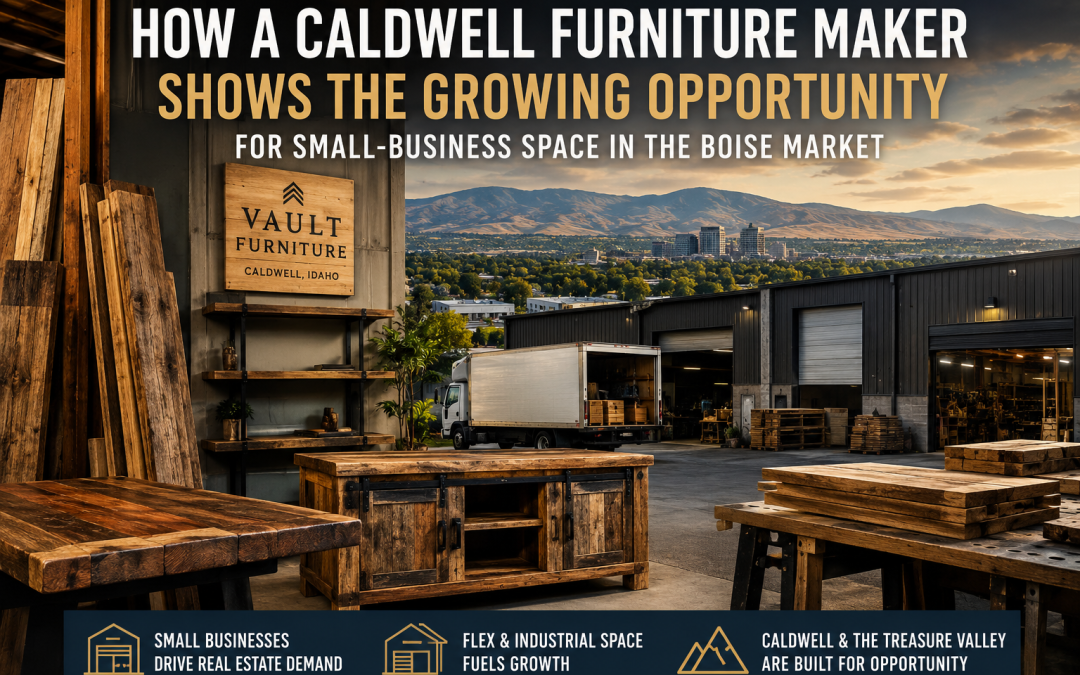
How a Caldwell Furniture Maker Shows the Growing Opportunity for Small-Business Space in the Boise Market
Some of the most interesting commercial real estate growth in the Treasure Valley does not begin with a national retailer, a major distribution center, or a large corporate office.
Sometimes it starts with a small business that simply needs more room.
Vault Furniture in Caldwell is a good example. The custom furniture company has turned reclaimed wood, online sales, and made-to-order craftsmanship into a growing Idaho business. Its story also highlights an important trend for Boise commercial real estate: successful online businesses still need physical space to make, store, package, and ship what they sell.
According to reporting by Steve Lombard in the Idaho Business Review, husband-and-wife owners Andy and Brandi Gooding relocated their furniture operation from the Midwest to Idaho after building their business through trade shows and online sales. Their company now operates in Caldwell and produces mostly custom furniture using reclaimed wood.
The original Idaho Business Review story can be read here:
https://idahobusinessreview.com/2026/07/21/vault-furniture-caldwell-custom-reclaimed-wood/
What makes the Vault Furniture story especially interesting from a commercial real estate perspective is what happened after the company arrived in Idaho.
Growth required more space.
And that is something landlords, developers, and investors across the Treasure Valley should be paying attention to.
E-Commerce Can Create Industrial Real Estate Demand
It is easy to think of online shopping as a threat to physical commercial real estate.
For manufacturers and product-based businesses, the opposite can happen.
Vault Furniture began selling online through Etsy in 2018. According to the Idaho Business Review, the company saw its internet sales accelerate during the pandemic. After moving to Idaho in 2020, that growth helped support an expansion that doubled the size of its shop.
That is an important distinction.
A company may not need a traditional storefront, but it can still need substantial commercial space.
An online furniture company may require:
- Workshop and production areas
- Material and lumber storage
- Finished-product storage
- Shipping and receiving space
- Loading access
- Office and design space
- Room to expand as sales increase
For Boise commercial real estate, this is one reason smaller industrial and flex properties remain important.
The Treasure Valley has thousands of businesses that may never need a large warehouse. What they often need instead is practical space where production, storage, office functions, and fulfillment can happen under one roof.
Caldwell, Nampa, Meridian, Garden City, and Boise can all serve different versions of this demand.
Caldwell Can Give Growing Businesses Room to Scale
Vault Furniture’s move also illustrates why Caldwell continues to matter within the larger Treasure Valley business ecosystem.
The Boise metro is not one commercial real estate market anymore.
Businesses can choose among several communities depending on their customers, workforce, transportation needs, space requirements, and occupancy costs.
For a manufacturing or maker business, being directly in downtown Boise may offer little advantage if most customers are ordering online.
A Caldwell location can potentially give a company access to the broader Treasure Valley while allowing it to focus its real estate dollars on production capacity rather than premium retail visibility.
That becomes especially valuable as a company grows.
Vault Furniture reportedly doubled its shop after online demand increased. The Idaho Business Review also reported that the company generated more than $90,000 in sales during the month before the article was published.
Those numbers help demonstrate how quickly a small business’s commercial real estate requirements can change.
A company can move from a garage, barn, or small workshop into dedicated commercial space—and then discover that it needs twice as much room several years later.
That creates opportunities for owners of small-bay industrial, flex, warehouse, and light-manufacturing properties throughout the Boise metro.
Specialized Businesses Need Flexible Buildings
There is another commercial real estate lesson in the company’s business model.
Vault Furniture does not simply resell finished products.
The company makes them.
Approximately 75% of its work is custom, according to the Idaho Business Review. Its products include made-to-order furniture, shelving, and brackets, with much of the furniture incorporating reclaimed lumber.
That creates real estate requirements that are different from those of a typical retailer or office tenant.
A maker or light-manufacturing tenant may care more about electrical capacity, ceiling height, loading, ventilation, outdoor access, storage, parking, and the ability to modify the building than about expensive storefront exposure.
That is why functional commercial buildings can sometimes outperform prettier ones.
For landlords involved in industrial leasing in Boise and the Treasure Valley, understanding how the tenant actually operates can be just as important as knowing the square footage they want.
The right building is not always the newest building.
It is the building that lets the business operate efficiently.
Local Manufacturing Can Support a Larger Business Ecosystem
Vault Furniture’s reclaimed-wood strategy adds another layer to the story.
The company relies heavily on a supplier in St. Louis that provides reclaimed lumber, including older pine salvaged from historic structures. Finding consistent quantities of reclaimed material has been one of the challenges of the business.
That means the company’s operation involves more than simply building furniture.
There is an entire supply chain behind it.
Materials have to be sourced, transported, received, stored, processed, assembled, finished, packaged, and shipped.
Multiply that process across hundreds of growing small manufacturers and e-commerce businesses, and the commercial real estate impact becomes much larger.
These businesses can support demand for warehouses, contractor space, trucking, storage yards, suppliers, fabrication shops, logistics companies, and other service businesses.
That is one reason Boise development should not focus only on large industrial users.
Smaller companies can collectively create significant demand for industrial and flex space.
Local Insight: Watch the Businesses Between the Garage and the Big Warehouse
From a Boise commercial real estate standpoint, one of the most important parts of the Vault Furniture story is that the company did not follow the traditional retail growth model.
The owners originally imagined eventually opening a store.
Now they apparently do not need one.
Their online operation works well enough that the company can concentrate on production rather than maintaining a conventional retail storefront.
That is a useful reminder for landlords and developers.
E-commerce does not always eliminate commercial real estate demand. It can move that demand into a different property type.
Instead of leasing 2,000 square feet in a shopping center, an online business might eventually need 5,000, 10,000, or more square feet of flex or industrial space.
Those businesses are worth watching.
The company operating from a garage today could become tomorrow’s small-bay industrial tenant. The tenant occupying one bay today could need three bays several years from now.
For investors, that makes properties capable of accommodating incremental expansion especially attractive.
For developers, it supports the case for flexible industrial projects with multiple suite sizes.
And for brokers, it reinforces the value of identifying businesses before they become obvious real estate prospects.
What This Could Mean for Boise Commercial Real Estate
Vault Furniture is one company, so its experience should not be treated as proof of a broader market trend by itself.
But the business illustrates several forces already worth watching throughout the Treasure Valley: entrepreneurship, e-commerce, local manufacturing, population growth, and businesses seeking functional space outside the Boise core.
For commercial property owners, the opportunity may increasingly come from businesses that blur the traditional lines between retail, industrial, manufacturing, and e-commerce.
A tenant might sell nationwide online, manufacture products in Caldwell, store inventory in the same building, and have almost no need for traditional retail frontage.
Commercial real estate needs to adapt to those businesses rather than force them into old categories.
And as Caldwell and the western Treasure Valley continue attracting businesses and residents, practical flex and light-industrial space could become an increasingly important piece of the region’s commercial real estate inventory.
Vault Furniture’s story is ultimately about craftsmanship and entrepreneurship.
But from a real estate perspective, it also demonstrates something simpler:
When a small business succeeds, sooner or later it usually needs more space.
That is where business growth becomes a commercial real estate story.
Mike Gioioso (joy-OH-so) has for 16+ years been helping companies of all sizes buy, build, and lease perfect places for business in greater Boise, Idaho and beyond.
www.streetsmartidaho.com mike@streetsmartidaho.com 208-209-9166
Tags: #boisecommercialrealestate, #caldwellcommercialrealestate, #caldwellidahobusiness, #boiseindustrialrealestate, #caldwellindustrialrealestate, #treasurevalleycommercialrealestate, #boiseflexspace, #caldwellflexspace, #smallbayindustrial, #boiseindustrialleasing, #caldwellindustrialleasing, #lightmanufacturingboise, #idahomanufacturing, #madeinidaho, #idahosmallbusiness