
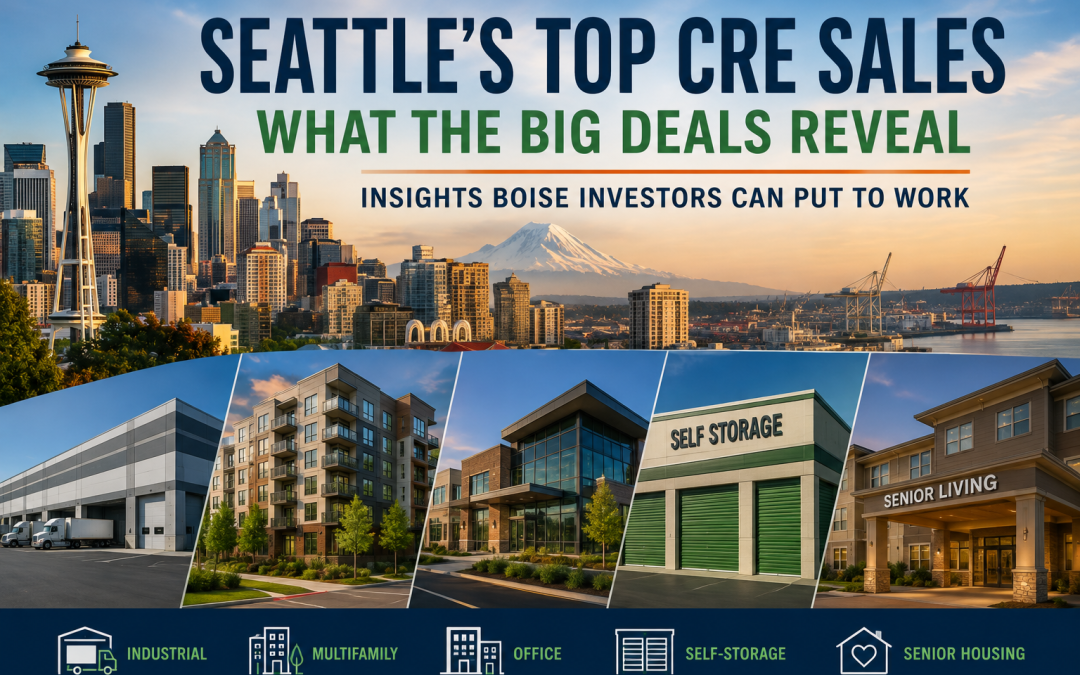
Seattle’s Biggest CRE Sales Offer Clues for Boise Investors
Seattle’s largest commercial property transactions may be happening hundreds of miles from Boise, but the money moving through the Puget Sound market offers some useful signals for Idaho investors.
Industrial properties, new apartments, senior housing and self-storage all appeared among Seattle’s notable second-quarter transactions. More important than the individual sale prices is what buyers were willing to pay for: modern buildings, strong locations, reliable tenants and access to growing population and employment centers.
According to CoStar Research, these transactions were selected among the Seattle-Puget Sound winners of CoStar’s second-quarter 2026 Power Broker Quarterly Deal Awards. The original CoStar News report provides the full list of recognized transactions, properties and brokers.
For Boise commercial real estate, these aren’t direct comparables. Seattle and Boise operate at very different scales. But institutional investment decisions in a nearby Pacific Northwest market can still tell us where sophisticated capital sees long-term value.
Industrial Real Estate Is Still Attracting Serious Capital
The largest transaction highlighted by CoStar was a roughly $220 million acquisition involving a large distribution property and land in Spanaway, Washington.
Amazon purchased the portfolio from Ashley Furniture Industries. The transaction included a distribution warehouse at 20623 34th Ave. E along with nearby land. Combined, the properties totaled more than 1.1 million square feet.
That is obviously far larger than a typical Boise industrial real estate transaction.
But the investment characteristics are familiar.
The property offered modern distribution capabilities, significant loading infrastructure and access to transportation, employment and population centers.
Another industrial transaction reinforces the point.
New Mountain Capital acquired a roughly 299,700-square-foot Everett food production facility for $65 million. The property was fully occupied by Kettle Cuisine and included specialized food manufacturing improvements.
In Puyallup, Lincoln Property Co. acquired the Canyon Road Commerce Center for $37.2 million. The approximately 275,000-square-foot project consists of two warehouses developed in 2023.
Put those deals together and a pattern emerges:
Functional, well-located industrial real estate continues to attract capital.
That matters in the Treasure Valley.
Boise, Meridian, Nampa and Caldwell don’t need billion-dollar distribution centers to benefit from the same underlying trends. Local companies still need warehouse, manufacturing, contractor, flex and distribution space.
The strongest properties tend to solve operational problems.
Can trucks get in and out easily?
Is there adequate loading?
Does the building have the right clear height?
Is there sufficient power?
Can employees reach the property conveniently?
How quickly can a tenant connect with Interstate 84?
Those fundamentals can matter more than flashy finishes.
Multifamily Buyers Are Targeting Newer Properties and Strong Locations
Multifamily accounted for several of the largest transactions recognized by CoStar.
KKR purchased a two-property apartment portfolio in Seattle and Redmond for $172 million. The portfolio included 430 units across two communities completed in 2024.
Another recently built apartment project, Corner 63 in Seattle, traded for $59.25 million. The 139-unit community was also completed in 2024.
The location offered access to retail, restaurants, employment and the University of Washington area.
The Waterford Apartments in Everett sold for $53.3 million to the Spokane Indian Housing Authority, while Seattle Social Housing purchased Elara at the Market for $60.9 million with plans to use the property for permanently affordable mixed-income housing.
These transactions involved very different buyers and strategies, but they highlight an important point for Boise development:
Multifamily demand isn’t one single investment category anymore.
Private equity, traditional apartment investors, housing authorities, public entities and mission-driven organizations can all be pursuing residential properties for different reasons.
For Boise and the Treasure Valley, that creates an interesting environment.
Population growth continues to create housing demand, but new apartment development has become more challenging as land, construction, financing and operating costs have increased.
That makes newer, well-located existing properties potentially more valuable—particularly when replacing them would be difficult or expensive.
For Boise investment property buyers, replacement cost deserves close attention.
If an apartment project can be purchased for substantially less than the cost of buying land and building a competing property today, that difference can become an important part of the investment thesis.
Specialized Property Types Are Getting Attention Too
Seattle’s biggest transactions weren’t limited to apartments and warehouses.
A Bellevue self-storage facility sold for approximately $50.7 million. The property contained nearly 1,000 storage units and served nearby residential and commercial areas.
Healthpeak Properties acquired a senior housing property in Lynnwood for $53 million.
The City of Redmond also purchased a property on Union Hill Road for approximately $38.5 million for a future municipal maintenance and operations center.
These deals show just how broad commercial real estate investment has become.
Investors aren’t only chasing traditional office buildings and shopping centers.
Capital is targeting properties tied to demographic and operational demand.
Senior housing benefits from an aging population.
Self-storage can benefit from household formation, moving activity, downsizing and apartment living.
Industrial facilities benefit from logistics and manufacturing.
Medical properties benefit from population growth and health care demand.
For Boise commercial real estate investors, that creates opportunities outside the traditional four major asset classes.
What Seattle’s Deals Could Mean for Boise Commercial Real Estate
Seattle and Boise should not be treated as interchangeable markets.
Seattle is larger, more expensive and home to major institutional employers and investors. Its transactions often involve pricing and property sizes rarely seen in Idaho.
Still, capital tends to follow similar fundamentals.
Investors want properties that are difficult to replace, useful to tenants and positioned near economic activity.
That creates several lessons for the Treasure Valley.
Industrial functionality matters
A warehouse isn’t valuable simply because it’s a warehouse.
Modern loading, yard configuration, access, power, clear height and proximity to transportation can create meaningful differences between competing properties.
That will continue to matter as Boise industrial real estate expands west through Meridian, Nampa and Caldwell.
New construction can command attention
Several Seattle transactions involved properties completed within the past few years.
Newer properties can offer modern layouts, better amenities, lower near-term capital needs and stronger appeal to tenants.
But high construction costs can also make recently completed buildings harder to reproduce.
That scarcity can support investment value.
Demographics are driving multiple asset classes
Senior housing, apartments and self-storage all appeared among the major sales.
Boise’s population growth and migration trends can support similar demand.
The opportunity isn’t simply more rooftops.
It’s understanding what those households need after they arrive.
That includes housing, medical services, storage, restaurants, retail, childcare, entertainment and employment space.
Local Insight: Follow What Institutional Buyers Value
The biggest lesson I take from Seattle’s second-quarter transactions isn’t the sale prices.
It’s the property characteristics behind the prices.
Institutional buyers appear willing to deploy substantial capital when properties combine strong locations with modern functionality, reliable demand and barriers to replacement.
Boise investors can apply the same thinking on a much smaller scale.
A 20,000-square-foot industrial building in Nampa isn’t comparable to a million-square-foot Amazon acquisition near Seattle. But both investments can depend on the same fundamental question:
Does this property make sense for the businesses that need to use it?
The same applies to retail leasing Boise properties.
A shopping center with good visibility, easy access, growing surrounding households and a strong tenant mix may remain desirable even when capital markets become difficult.
For multifamily investors, location and replacement cost matter.
For developers, understanding future tenant demand before buying land becomes increasingly important.
And for Boise investment property buyers, the best opportunities may not always be the newest or most exciting properties. They may be buildings with characteristics that are difficult for competitors to reproduce.
Seattle’s transaction volume also gives us another reason to watch capital movement throughout the Pacific Northwest.
Institutional investment may enter Seattle first because of its size and liquidity. As pricing, yields and opportunities change, investors can broaden their searches into secondary markets.
Boise can potentially benefit from that process.
The Treasure Valley offers a smaller investment market, but it also provides population growth, business expansion and a development pipeline that continues to reshape the region.
The question for local owners and investors is not whether Boise will become Seattle.
It shouldn’t.
The better question is whether we can identify which investment fundamentals working in larger markets also make sense here—and get ahead of them.
Mike Gioioso (joy-OH-so) has for 16+ years been helping companies of all sizes buy, build, and lease perfect places for business in greater Boise, Idaho and beyond.
www.streetsmartidaho.com mike@streetsmartidaho.com 208-209-9166
Tags: #boisecommercialrealestate, #boiseinvestmentproperty, #boiserealestate, #idahocommercialrealestate, #boisedevelopment, #boiseindustrialrealestate, #retailleasingboise, #treasurevalleycommercialrealestate, #seattlecommercialrealestate, #pacificnorthwestcommercialrealestate, #boisemultifamily, #nampaindustrialrealestate, #commercialrealestateinvestment, #selfstorageinvestment, #seniorhousingrealestate