
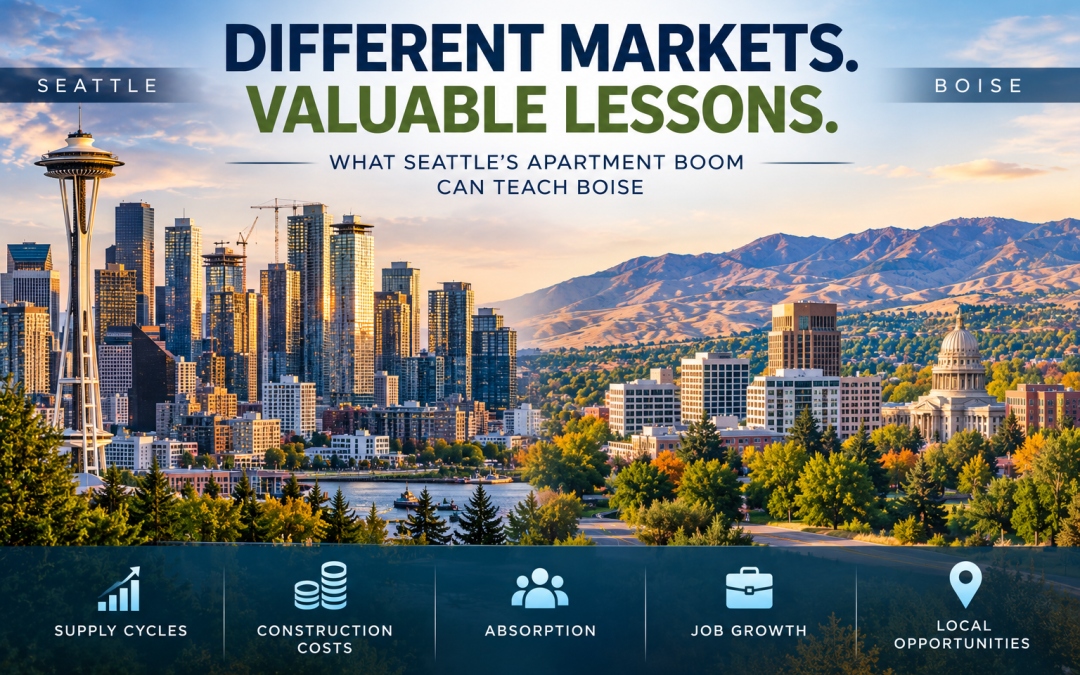
Seattle’s Apartment Pipeline Offers Lessons for Boise Multifamily Development
One of Seattle’s biggest apartment projects is finally preparing to welcome residents after nearly seven years of construction. The project is impressive because of its size, but the more interesting story for Boise real estate may be its timing.
Seattle House is arriving just as new multifamily construction across the Puget Sound region has slowed. At the same time, several other major apartment towers are approaching completion nearby.
That combination—large deliveries today and fewer projects starting behind them—is worth watching in Boise.
According to reporting by Randyl Drummer of CoStar News, Seattle House is preparing to open its roughly 1,130 apartments in Seattle’s Denny Triangle after a development process that began in 2019 and endured pandemic disruptions, labor issues, rising costs, and changing market conditions.
The original CoStar News article can be found here: https://product.costar.com/home/news/2060792525
Seattle Shows How Quickly the Development Cycle Can Change
Seattle House consists of two 45-story towers at 2300 Sixth Ave., close to Amazon’s downtown operations and South Lake Union employment base.
Developers Concord Pacific and HB Management began the project near the end of 2019.
A lot changed before the project reached the leasing stage.
Construction was disrupted by the pandemic. A concrete-truck-driver strike created another major delay. Meanwhile, interest rates and construction costs moved sharply higher.
Now the project is entering an apartment market that looks very different from the one in which construction started.
That is one of the biggest risks in commercial real estate development.
A developer isn’t building for today’s market. A developer is trying to anticipate the market several years into the future.
For a major high-rise project, the difference between groundbreaking and stabilization can span an entire real estate cycle.
Boise development operates at a different scale, but the principle is exactly the same.
A Boise multifamily project that looks attractive when land is acquired still has to make sense after design, entitlement, financing, construction, lease-up, and stabilization.
Interest rates can change.
Construction costs can change.
Rents can change.
Vacancy can change.
And competing projects can appear while you’re building.
Seattle House is a large-scale example of that development risk.
A Wave of Apartments Is Arriving as New Construction Slows
The Seattle project is also opening alongside significant nearby competition.
CoStar reported that two additional high-rise developments near Amazon’s campus are expected to open in early 2027.
Aero1200 is planned for 927 apartments across two towers. Another project, Sloane, is expected to bring 442 apartments to the area.
Combined with Seattle House, those three developments represent roughly 2,500 new apartments entering a relatively concentrated section of Seattle.
That creates a major test for absorption.
Seattle House itself is targeting the luxury segment. Its two towers are connected by a multilevel podium containing more than 50,000 square feet devoted to retail and amenities. Features include rooftop gardens, coworking areas, a spa, and a pool.
The property’s units range from compact studios to larger two-bedroom apartments.
The location also commands premium rents.
According to CoStar data cited in the article, average apartment rent in the Denny Triangle is about $2,680 per month, compared with approximately $2,130 across greater Seattle.
That’s roughly a 26% premium.
But high rents don’t automatically guarantee easy lease-up.
Thousands of apartments arriving around the same time can give renters more choices, particularly within the luxury segment.
That can lead developers and owners to compete through concessions, amenities, unit finishes, marketing, and lease terms even when the long-term fundamentals remain healthy.
Why Boise Commercial Real Estate Should Pay Attention
Boise isn’t Seattle.
Our buildings are smaller, our employment base is different, and the scale of new construction is dramatically different.
But the development cycle works the same way.
When rents rise and vacancy falls, developers see opportunity. New projects are proposed. Financing is arranged. Construction starts.
Those apartments don’t appear immediately.
By the time they reach the market, conditions may have changed.
That lag is one reason Boise multifamily investors should pay attention not only to today’s vacancy rate, but also to the future supply pipeline.
What’s under construction?
What’s entitled?
What’s proposed but not financed?
Which projects are actually likely to break ground?
And where are those units concentrated?
Those questions matter because Boise commercial real estate is increasingly interconnected with residential development.
A new apartment project can support nearby retail, restaurants, coffee shops, fitness concepts, medical services, and other neighborhood businesses.
Large concentrations of new housing can also change traffic patterns and strengthen particular commercial corridors.
For developers working on mixed-use projects, residential density can help support ground-floor retail—but only when the tenant mix, visibility, parking, access, and surrounding demographics work.
Simply putting retail underneath apartments does not guarantee successful retail leasing in Boise.
Local Insight: The Next Opportunity May Come After Construction Slows
Perhaps the most interesting part of Seattle’s story isn’t the apartments opening today.
It’s what’s happening behind them.
CoStar reported that the Puget Sound multifamily construction pipeline has slowed substantially as higher borrowing costs and construction expenses have made new development harder to pencil.
That pattern deserves attention in Boise.
When construction slows, the immediate reaction is often negative. Fewer projects mean fewer construction jobs, fewer land transactions, and less development activity.
But there can be another side to the cycle.
Today’s construction slowdown can become tomorrow’s supply shortage.
If population and household growth continue while fewer apartments begin construction, existing properties may eventually face less new competition.
That can support occupancy and rent growth later in the cycle.
For Boise multifamily investors, that means today’s pipeline should be evaluated alongside the pipeline two or three years from now.
For developers, it means difficult periods can eventually create opportunity. The best time to deliver a project isn’t necessarily when everyone else is building.
For landowners, it reinforces the importance of patience and understanding where development economics are heading.
And for retail and commercial developers, fewer residential projects starting today could influence where future customer growth occurs.
Seattle also offers another important lesson: employment still matters.
Seattle House is positioned near Amazon and other major technology employers. CoStar’s market analysis suggested that return-to-office trends and continued urban demand could help absorb new units, although construction costs and slower employment growth remain challenges.
Boise should think about multifamily demand the same way.
Population growth matters, but so do jobs.
Strong employment centers help create sustainable housing demand. Sustainable housing demand supports retail and services. Those businesses, in turn, create additional commercial real estate demand.
That’s why Boise housing, employment, and commercial development shouldn’t be analyzed separately.
They are pieces of the same growth story.
Seattle House may be more than 500 miles from Boise, but the development lessons travel well.
Real estate cycles are long. Projects take years. Capital markets change quickly. New supply tends to arrive in waves.
For Boise developers and investors, understanding where we are in that cycle—and what is coming next—can be more valuable than simply looking at today’s rents.
Source: CoStar News reporting by Randyl Drummer, Aug. 13, 2026. This article provides Boise commercial real estate commentary and analysis based on that reporting and does not represent independent reporting of Seattle House or the Seattle multifamily market.
Mike Gioioso (joy-OH-so) has for 16+ years been helping companies of all sizes buy, build, and lease perfect places for business in greater Boise, Idaho and beyond.
www.streetsmartidaho.com mike@streetsmartidaho.com 208-209-9166
Tags: #boisecommercialrealestate, #boiserealestate, #boisemultifamily, #boisemultifamilyrealestate, #boiseapartmentmarket, #boiseapartments, #boiserealestatemarket, #boiseinvestmentproperty, #boiserealestateinvesting, #boisemultifamilyinvestment, #boisedevelopment, #boiseapartmentdevelopment, #treasurevalleycommercialrealestate, #treasurevalleymultifamily, #treasurevalleyapartments