
Boise Affordable Housing Debate Highlights Growing Pressure on the City’s Development Landscape
Housing demand across the Treasure Valley continues to intensify, and with that demand comes difficult conversations about density, neighborhood character, and how cities accommodate growth.
A recent proposal on Boise’s Bench illustrates just how complex those conversations have become.
According to reporting by Idaho Press (original reporting from KTVB — you can read the original article here: https://www.idahopress.com/news/local/boise-neighbors-voice-concerns-over-6-story-affordable-housing-development/article_ef081a66-f1e4-474d-9c50-cce5f0d27c8c.html), Boise’s Design Review Commission approved a proposed six-story affordable housing project along Fairview Avenue, even as nearby residents voiced significant concerns about the development’s scale and neighborhood impacts.
While the project is a single development proposal, it reflects a broader issue shaping Boise commercial real estate and Boise development: how the city balances rapid growth with existing neighborhood expectations.
What’s Being Proposed on Fairview Avenue
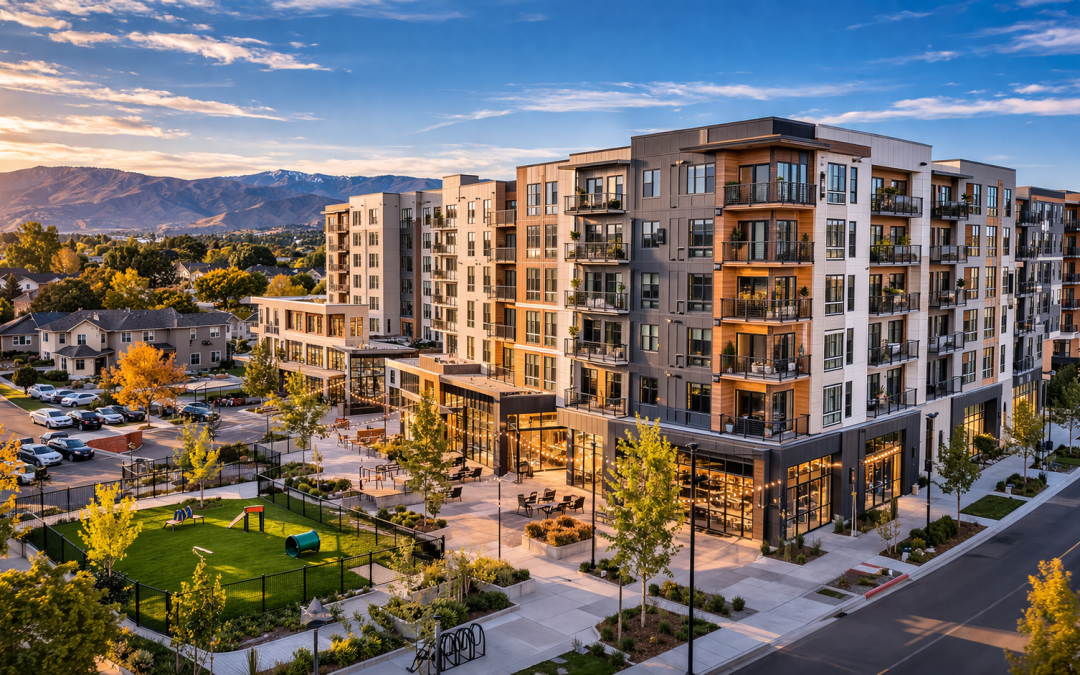
The project, known as Fairview Village Affordable Housing, would include more than two hundred residential units designed for households earning sixty percent or less of the area median income.
The building was designed by the Garden City architecture firm The Land Architect.
Key details from the proposal include:
- Approximately two hundred residential units
- Six stories in height
- About one hundred sixty parking spaces
- Amenities including a dog park
- Possible ground-level retail space
The development received approval from Boise’s Design Review Commission, which evaluates building design and site elements. Because the project complies with existing zoning rules, it did not require additional approvals from planning and zoning or the city council.
However, the commission did request several adjustments related to exterior lighting and mural design, which will be finalized in a future work session.
Why the Project Has Generated Opposition
Even though the project meets zoning rules, nearby residents expressed strong concerns during the public meeting process.
Many longtime neighbors said the scale of the building feels out of place within an area largely made up of single-family homes.
Common concerns raised during the hearing included:
Building height
Residents said a six-story structure could cast shadows and visually dominate nearby homes.
Parking availability
With more than two hundred units but fewer than two hundred parking spaces, neighbors worry about vehicles spilling onto surrounding streets.
Traffic and pedestrian safety
Some residents noted that sidewalks are limited in parts of the neighborhood, raising concerns about additional foot traffic and safety for children walking to school.
Neighborhood character
Several speakers said the project could dramatically change the feel of a long-established residential area.
More than twenty residents reportedly spoke during the meeting to voice their concerns.
Importantly, many emphasized that they support affordable housing in principle, but believe the building’s scale may be too large for the surrounding neighborhood.
Why Affordable Housing Projects Are Increasing in Boise
While neighborhood concerns are common in development discussions, the proposal also reflects a major trend shaping Boise development.
The Treasure Valley has experienced rapid population growth, and housing supply has struggled to keep up.
That has pushed rents higher and increased the need for housing options at different income levels.
Affordable housing developments often focus on residents earning sixty percent or less of area median income, which typically includes:
- service workers
- retail employees
- healthcare staff
- young professionals
- seniors and veterans
Cities across the country are facing similar pressures as they try to expand housing supply while maintaining neighborhood stability.
Support From Nearby Businesses
Not all local voices opposed the project.
A nearby shopping center manager expressed support for the development, noting that additional residents could benefit local businesses and help address Boise’s housing shortage.
Supporters also pointed to the site’s location advantages, including:
- proximity to neighborhood retail
- access to public transportation
- nearby biking routes
- connection to the Boise River Greenbelt
For businesses, additional housing density can bring more foot traffic and customers, particularly in neighborhoods with walkable amenities.
What This Means for Boise Commercial Real Estate
From a Boise commercial real estate perspective, the Fairview Avenue project highlights several trends that are becoming increasingly common across the region.
First, higher-density housing proposals are becoming more frequent, especially along major corridors.
Second, neighborhood feedback is becoming a central factor in shaping how projects evolve.
And third, affordable housing projects often bring mixed-use opportunities, such as ground-floor retail space that supports nearby businesses.
For retail leasing in Boise, residential density can significantly influence tenant demand.
More residents living nearby can support:
- restaurants
- neighborhood grocery stores
- service retail
- health and wellness businesses
In many cases, the viability of neighborhood retail depends heavily on nearby housing density.
Local Market Impact
As Boise grows, projects like Fairview Village are likely to become more common.
The city faces a balancing act between:
- expanding housing supply
- preserving neighborhood character
- managing infrastructure capacity
- supporting economic development
For developers and investors in Boise commercial real estate, this means understanding community dynamics is becoming just as important as zoning and financing.
Projects that incorporate thoughtful design, neighborhood engagement, and mixed-use amenities often have the strongest path forward.
My Take: Density Debates Will Shape Boise’s Future
From a Boise commercial real estate standpoint, debates like this are becoming a defining part of the region’s growth story.
The Treasure Valley is attracting new residents every year. That growth inevitably requires new housing, and in many cases, that means building taller and denser than existing neighborhoods are used to seeing.
At the same time, community concerns about scale, traffic, and neighborhood character are legitimate and deserve attention.
The most successful developments will likely be those that find a middle ground—delivering much-needed housing while thoughtfully integrating into surrounding neighborhoods.
As Boise continues to grow, conversations like the one surrounding Fairview Village will likely become a regular part of the city’s development landscape.
Mike Gioioso (joy-OH-so) has for 16+ years been helping companies of all sizes buy, build, and lease perfect places for business in greater Boise, Idaho and beyond.
www.streetsmartidaho.com mike@streetsmartidaho.com 208-209-9166
Tags: #boisecommercialrealestate, #boisedevelopment, #boiseaffordablehousing, #boisebenchdevelopment, #treasurevalleyhousingmarket, #boiseapartmentdevelopment, #boisemultifamilyhousing, #boisehousingsupply, #boisegrowthtrends, #adacountyhousingmarket, #treasurevalleydevelopment, #boiseneighborhooddevelopment, #boisehousingdemand, #boiseinvestmentproperty, #boiseresidentialdevelopment