
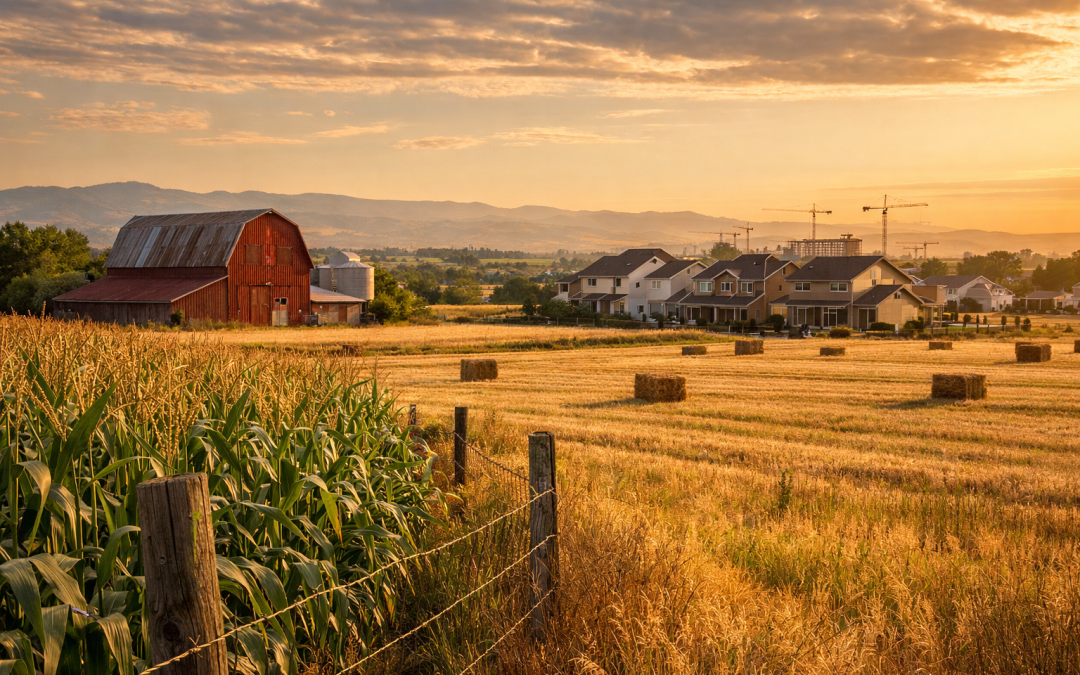
Canyon County Rethinks Agricultural Land Divisions as Growth Spreads Across the Treasure Valley
Population growth across the western side of the Treasure Valley is forcing local governments to confront a difficult question: how do you protect farmland while still allowing new development?
That debate is beginning to unfold in Canyon County, where officials are asking residents to weigh in on how agricultural land should be divided in the future.
According to reporting by Haadiya Tariq in the Idaho Press (read the original article here: https://www.idahopress.com/news/canyon-county-requesting-feedback-on-agricultural-land-policies/article_7a832642-33bb-4123-8ccb-1814e0a25343.html), county leaders are reviewing policies governing how farmland can be split into smaller parcels.
The discussion may sound technical, but it could have major implications for Boise commercial real estate, future housing supply, and long-term development patterns across the Treasure Valley.
A Surge in Agricultural Land Divisions
One reason county officials are revisiting the policy is simple: farmland parcels have been dividing quickly.
Between 2020 and 2025, Canyon County approved hundreds of land divisions in agricultural zones.
Key figures cited in the report include:
- 379 land divisions approved
- 1,028 new parcels created
- More than 20,000 agricultural parcels currently located outside city limits
These divisions often occur through an administrative process that does not require a public hearing, allowing landowners to split property under certain rules.
One major restriction is that newly created parcels typically cannot be smaller than one acre in agricultural zones.
For properties under 120 acres, additional limits may apply to how many times the land can be divided.
Why County Officials Are Asking for Public Input
Canyon County’s Development Services Department is now seeking feedback from residents before making potential updates to these regulations.
Officials say they want input from a wide range of stakeholders, including:
- Farmers and ranchers
- Property owners
- Developers
- Local residents
The county has launched a short public survey and plans to host a community open house to gather opinions.
The goal is to better understand how the current rules affect property rights, agricultural preservation, and future growth.
County leaders say the review aims to make the regulations clearer and more effective as development pressure increases.
The Bigger Growth Story Behind the Policy Review
While the policy discussion focuses on land divisions, the underlying issue is rapid growth in the Treasure Valley.
Canyon County — home to cities like Nampa and Caldwell — has become one of the fastest-growing parts of the Boise metro area.
As more people move to the region, demand for housing and development land continues to expand outward from the urban core.
Agricultural land often becomes the next frontier for new subdivisions, rural housing, and mixed-use development.
That shift creates tension between preserving farmland and accommodating population growth.
Why This Matters for Boise Commercial Real Estate
Land policy decisions in Canyon County may seem like a rural planning issue, but they can influence the broader Boise commercial real estate market.
Here’s why.
Housing growth fuels commercial demand
New residential parcels eventually bring new households. More households create demand for retail centers, schools, healthcare offices, and service businesses.
Land availability affects development costs
If agricultural land becomes easier to divide, more sites could become available for future residential and mixed-use development.
Growth patterns shape infrastructure
How land is subdivided influences where roads, utilities, and commercial centers will develop in the coming decades.
For investors and developers, these policy decisions can help determine where the next growth corridors in the Treasure Valley emerge.
Local Insight: The Westward Expansion of the Boise Metro
From a Boise commercial real estate perspective, Canyon County’s review highlights a long-term trend already underway.
Growth in the Boise metro area has been gradually shifting west.
Communities in Canyon County often offer:
- Lower land prices
- Larger parcels for development
- Opportunities for new master-planned neighborhoods
As those areas expand, commercial development typically follows residential growth.
Retail centers, medical offices, and service businesses often appear within a few years of new housing developments.
The conversation about agricultural land divisions may seem procedural today — but it could shape where the next wave of Treasure Valley development takes place.
Mike Gioioso (joy-OH-so) has for 16+ years been helping companies of all sizes buy, build, and lease perfect places for business in greater Boise, Idaho and beyond. www.streetsmartidaho.com mike@streetsmartidaho.com 208-209-9166
Tags: #Boisecommercialrealestate, #CanyonCountydevelopment, #TreasureValleygrowth, #Boisedevelopment, #Boisehousingexpansion, #Boisemetrogrowth, #Nampadevelopment, #CaldwellIdahodevelopment, #Idaholandusepolicy, #TreasureValleyhousingmarket, #Boiseinvestmentproperty, #Idahorealestatenews