
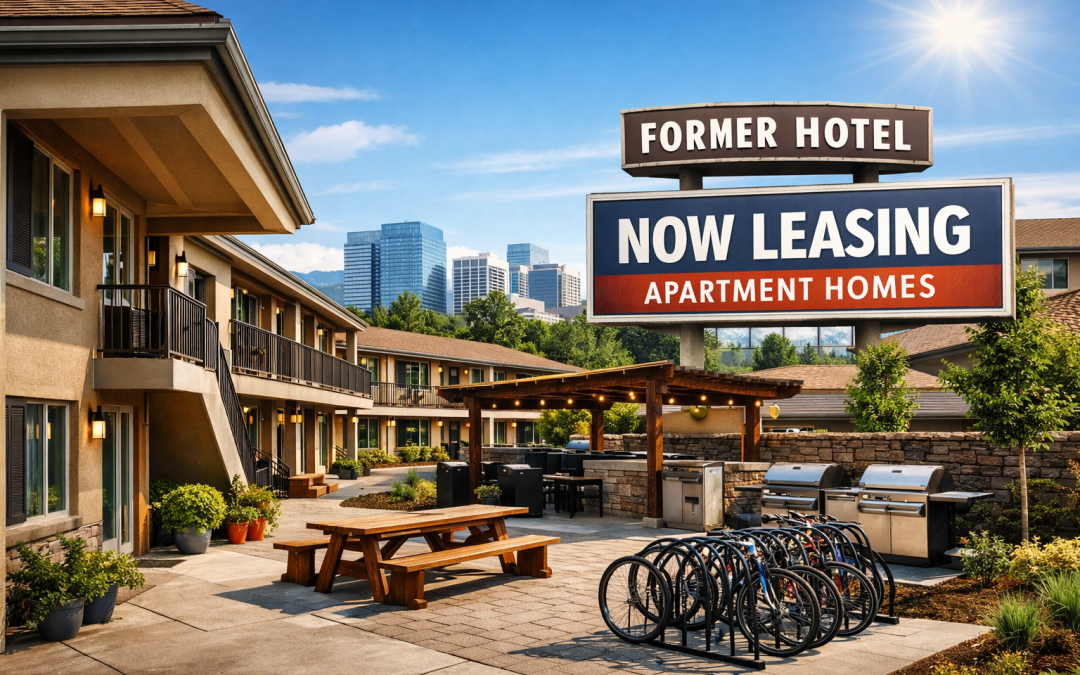
Hotel-to-Apartment Conversions Are Accelerating — What One Seattle Project Could Mean for Boise Housing and Commercial Real Estate
Across the country, developers are starting to rethink how existing buildings can solve housing shortages faster than traditional construction.
One growing strategy is converting aging hotels and motels into apartments, particularly in markets where rents have surged and new construction takes years to complete.
A recent redevelopment in the Seattle area shows how quickly these projects can move when developers, lenders, and city officials work together.
According to reporting by CoStar News journalists Randyl Drummer and Alexander Fairlie (see the original article here: https://product.costar.com/home/news/1306288205), an older hotel property in Bellevue, Washington was recently transformed into workforce housing — and the first resident moved in almost immediately after opening.
While the project is located in Washington, the concept offers valuable insight for Boise commercial real estate, where housing demand and adaptive reuse opportunities continue to grow.
An Aging Hotel Becomes Workforce Housing
The project began when Sage Investment Group acquired a former Quality Inn property in Bellevue.
Rather than redeveloping the land from scratch, the investment group converted the existing hotel structure into a studio apartment community now called Bellevue Ridge.
Key details about the project include:
- 106 studio apartments created through conversion
- property purchased in 2024
- units opened to residents in late 2025
- development timeline of roughly 18 months
That speed is noteworthy.
Ground-up apartment construction in many markets can take three to five years between planning, permitting, and building. Adaptive reuse can dramatically shorten that timeline.
The Bellevue Ridge project illustrates how existing buildings can be repositioned quickly to address housing shortages.
Designed for Workforce Renters
The apartment complex targets renters who often struggle to find housing in expensive metro areas.
The project focuses on groups such as:
- students
- retirees
- essential workers
- veterans
Each unit includes compact kitchen space, while the property also offers shared amenities that encourage residents to gather and socialize.
Community features include:
- shared kitchen areas
- bike storage
- laundry facilities
- media and recreation spaces
The project also incorporated efficiency upgrades like improved insulation and energy-recovery ventilation systems to reduce energy consumption.
Because of its speed and impact, the redevelopment received recognition through a CoStar Impact Award for the Seattle–Puget Sound region.
Why Adaptive Reuse Is Becoming a Bigger Trend
Projects like this reflect a larger shift happening across the United States.
Developers are increasingly turning to adaptive reuse — converting existing buildings to new uses — because it can solve multiple problems at once.
Older buildings often have:
- strong structural foundations
- existing infrastructure connections
- locations in established neighborhoods
Repurposing these structures can allow developers to deliver housing much faster than starting from the ground up.
This approach has been used for:
- office-to-apartment conversions
- hotel-to-housing projects
- retail-to-residential redevelopment
For cities struggling with housing affordability, adaptive reuse can provide a faster path to new units.
Why This Matters for Boise Commercial Real Estate
Although this project happened in the Seattle area, the underlying trend could eventually influence Boise development strategies.
The Treasure Valley has experienced rapid population growth in recent years, putting pressure on housing supply across the region.
At the same time, some older commercial properties may no longer perform as well as they once did.
That combination can create opportunities.
In Boise and surrounding cities, potential adaptive reuse candidates might include:
- older limited-service hotels
- aging office buildings
- underperforming retail properties
When redevelopment timelines for new housing stretch too long, repurposing existing structures can sometimes provide a faster solution.
For investors and developers watching Boise commercial real estate, this type of strategy may become more common if housing demand continues rising.
Local Market Impact: Housing Pressure and Redevelopment Opportunities
The Treasure Valley’s growth has created strong demand for both market-rate and workforce housing.
While many new apartment communities are under construction, developers still face challenges including:
- land costs
- entitlement timelines
- construction pricing
- infrastructure requirements
Adaptive reuse projects can sometimes bypass some of those obstacles.
Instead of starting with vacant land, developers begin with an existing structure — which can reduce both construction timelines and capital risk.
In markets where housing supply struggles to keep up with population growth, that speed advantage can be significant.
My Take: Creative Conversions Could Play a Role in Boise’s Housing Future
From a Boise commercial real estate perspective, the biggest lesson from this project is flexibility.
Markets evolve, and buildings that once served one purpose may eventually serve another.
Across the country, developers are starting to rethink older properties in ways that would have seemed unlikely a decade ago.
The Treasure Valley has already seen examples of redevelopment transforming aging properties into new uses.
If population growth continues and housing demand stays strong, adaptive reuse projects could become another important tool in the Boise development playbook.
Sometimes the fastest way to create new housing isn’t building something new — it’s reimagining what already exists.
Mike Gioioso (joy-OH-so) has for 16+ years been helping companies of all sizes buy, build, and lease perfect places for business in greater Boise, Idaho and beyond.
www.streetsmartidaho.com
mike@streetsmartidaho.com
208-209-9166
Tags: #boisecommercialrealestate, #boisehousingdevelopment, #workforcehousingboise, #boiseredevelopmenttrends, #adaptivereuserealestate, #hotelconversionapartments, #boisemultifamilymarket, #treasurevalleyhousinggrowth, #boisedevelopmenttrends, #idahocommercialrealestate, #apartmentdevelopmentboise, #commercialrealestateboise