
Why Idaho’s Rental Affordability Could Continue Fueling Boise Commercial Real Estate Growth
People don’t relocate only because of job opportunities. Increasingly, they move because they can no longer afford to live where they are.
That trend continues benefiting Idaho as households search for lower housing costs and a better overall cost of living. While Idaho isn’t the cheapest place to rent in America, it remains significantly more affordable than many coastal markets—a difference that could continue supporting population growth and commercial real estate demand throughout the Treasure Valley.
According to reporting by IBR Staff in the Idaho Business Review, citing an Investopedia analysis, Idaho’s rental costs remain well below states like California and Hawaii, even as the Gem State continues attracting new residents. You can read the original Idaho Business Review article here: https://idahobusinessreview.com/2026/07/16/renting-in-idaho-more-affordable-than-california/.
This article is based on that reporting while exploring what Idaho’s rental affordability could mean for Boise commercial real estate, future development, retail leasing, and long-term investment opportunities.
Idaho Still Offers Better Housing Value Than Many Western States
Although rental prices have climbed across Idaho over the past several years, they remain considerably lower than many of the nation’s highest-cost housing markets.
According to the report:
- Idaho’s median monthly rent is approximately $1,600.
- California’s median monthly rent exceeds $2,100.
- Hawaii’s median monthly rent is nearly $1,950.
- Idaho’s median household income is just over $81,000.
- Idaho’s overall cost of living is slightly below the national average.
- The state’s median home value is approximately $446,000.
By comparison, California continues to combine higher rents with dramatically more expensive home prices and a significantly higher cost of living.
The report also notes that nearly 15 million Americans relocated last year in search of a more affordable place to live, according to U.S. Census data.
Why This Matters for Boise Commercial Real Estate
Population growth has long been one of the biggest drivers of commercial real estate demand.
When new residents move into a region, they don’t simply rent apartments. They also need grocery stores, restaurants, healthcare providers, childcare centers, fitness facilities, retail shopping, offices, and industrial businesses that support a growing economy.
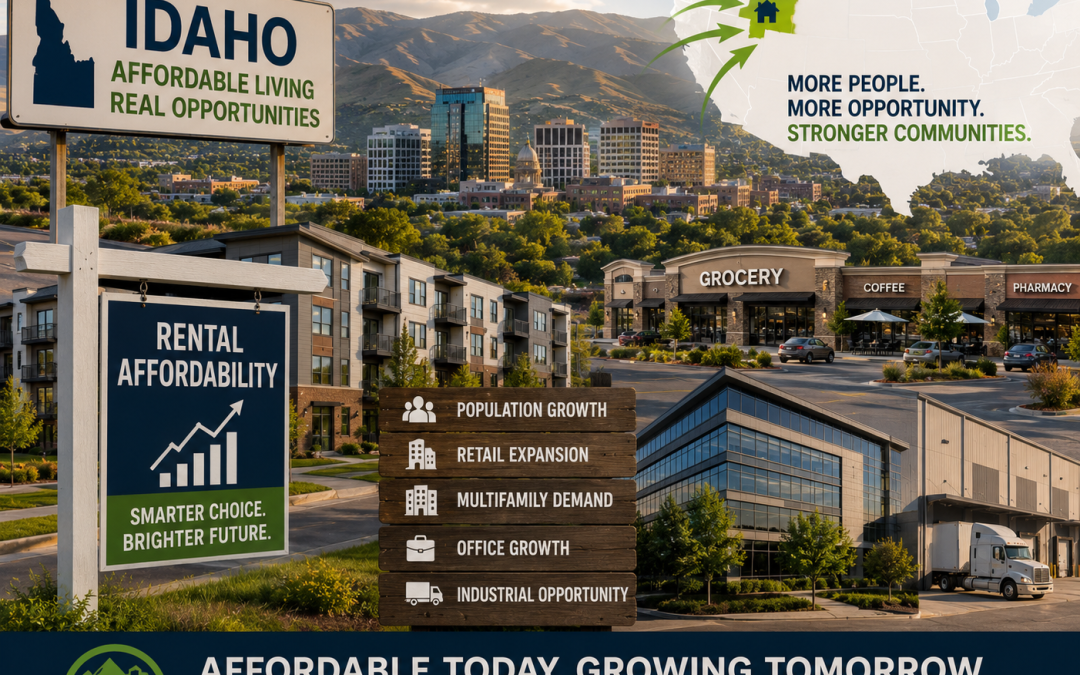
For Boise commercial real estate, continued migration can create opportunities across nearly every property sector.
Apartment developers may continue benefiting from steady rental demand as newcomers establish themselves before purchasing homes.
Retail leasing in Boise often follows residential growth, creating opportunities for neighborhood shopping centers, grocery-anchored developments, coffee shops, medical offices, and personal service businesses.
Industrial real estate can also benefit as population growth increases demand for distribution facilities, logistics operations, and last-mile delivery infrastructure.
Affordable Living Can Support Long-Term Economic Growth
Companies evaluating expansion opportunities often consider more than tax policy.
They also examine whether employees can reasonably afford to live nearby.
Compared with many West Coast markets, Idaho continues offering a more attainable cost of living, even if housing has become more expensive than it was several years ago.
That affordability advantage can help attract employers looking for markets where workers have greater purchasing power.
As employment expands, commercial real estate demand frequently follows.
Migration Creates New Development Opportunities
Many households leaving higher-cost states initially rent before buying a home.
That creates sustained demand for multifamily communities while also encouraging additional commercial construction in surrounding neighborhoods.
Communities throughout the Treasure Valley—including Meridian, Nampa, Caldwell, Kuna, Star, and Middleton—could continue seeing new mixed-use developments as residential growth drives demand for nearby services.
Developers often look for exactly this type of population momentum when evaluating future retail centers, office projects, and industrial investments.
Key Takeaways
- Idaho’s median monthly rent remains well below California’s.
- Idaho’s cost of living is close to the national average despite recent growth.
- Millions of Americans continue relocating in search of affordability.
- Population growth can support retail, office, multifamily, and industrial development.
- Affordable living remains an important competitive advantage for Idaho.
Local Insight
Housing affordability isn’t just a residential issue—it directly shapes commercial real estate.
When Idaho remains more affordable than competing states, businesses gain access to a larger workforce, developers gain confidence to build, and retailers find growing customer bases.
For Boise commercial real estate, the long-term opportunity isn’t simply lower rents. It’s the steady migration of people and employers looking for a market where living and doing business remain more attainable than many other parts of the western United States.
As long as Idaho maintains that competitive advantage, commercial development throughout the Treasure Valley is likely to remain supported by continued population and economic growth.
Mike Gioioso (joy-OH-so) has for 16+ years been helping companies of all sizes buy, build, and lease perfect places for business in greater Boise, Idaho and beyond.
www.streetsmartidaho.com
mike@streetsmartidaho.com
208-209-9166
Tags: #boisecommercialrealestate, #boisedevelopment, #idahorentalmarket, #boisemultifamily, #apartmentdevelopmentboise, #retailleasingboise, #idahocostofliving, #treasurevalleygrowth, #populationgrowthidaho, #commercialpropertyinvestment, #mixedusedevelopment, #workforcehousingidaho, #boiseofficemarket, #industrialrealestateboise, #economicdevelopmentidaho