
What Idaho’s New “ePotato” School Program Says About Agriculture and Boise’s Future Economy
When people think about Boise commercial real estate, they usually picture office buildings, retail centers, or industrial warehouses.
But one of Idaho’s biggest economic engines begins long before any of those properties are built.
It starts in the fields.
A new educational program designed to teach students about one of Idaho’s most important crops highlights how agriculture continues to shape the state’s long-term economy—and that has ripple effects for development, logistics, and land use across the region.
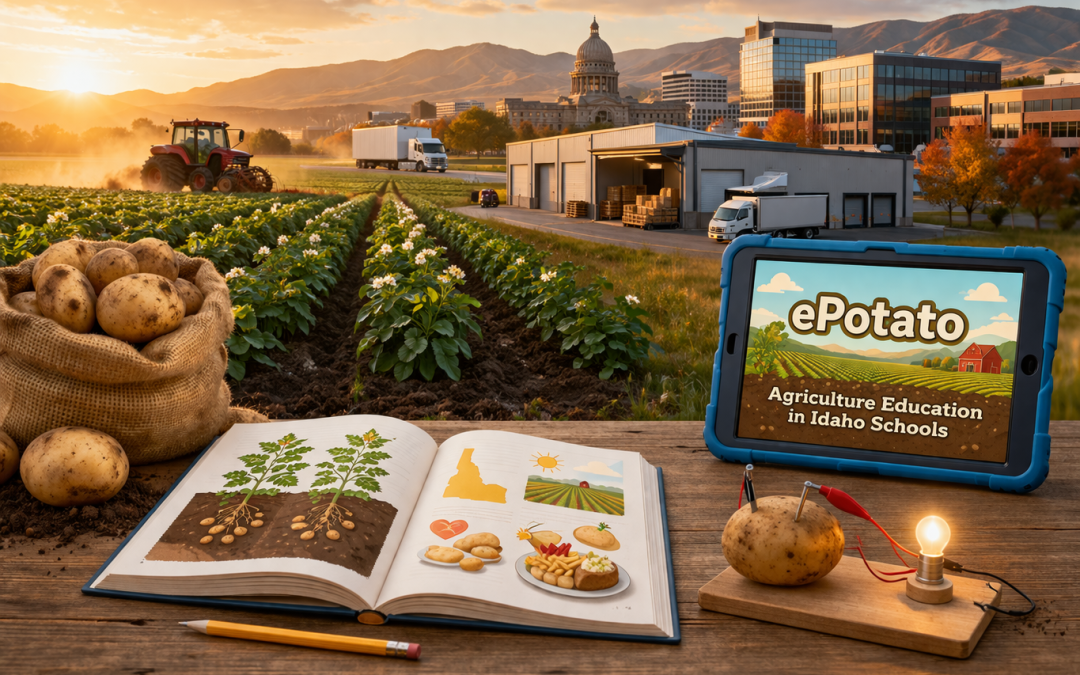
According to reporting by Emilie Ritter Saunders in the Idaho Business Review, the University of Idaho Extension recently introduced a new educational initiative called ePotato, designed to teach Idaho students how potatoes are grown, used, and valued in the state’s economy.
(Read the original article here: https://idahobusinessreview.com/2026/03/24/university-of-idaho-extension-launches-epotato-curriculum/.)
While the program focuses on classroom learning, it also reflects something bigger: Idaho’s agricultural economy remains deeply tied to the region’s growth—including parts of the Boise real estate market.
What the New ePotato Curriculum Teaches
The ePotato program was created to help elementary students better understand agriculture in their own communities.
The curriculum includes five one-hour learning modules that introduce topics such as:
- How potatoes grow and where they are cultivated
- The history and geography of potato farming
- Nutritional benefits of potatoes
- Cooking ideas and recipes
- Science experiments using potatoes
The lessons were designed for students in roughly third through fifth grade and meet several academic standards, including science, geography, language arts, and math.
The program is also free to download, making it accessible for teachers, 4-H leaders, and homeschool families across Idaho.
In classrooms around Franklin County, Extension educator Cherie Carter has been visiting schools to lead the lessons directly with students.
Some activities are hands-on. One classroom demonstration even uses a potato to generate electricity and power a small light.
A Program Built Through Idaho Agriculture Experts
Several agricultural educators collaborated to develop the curriculum.
Key contributors include:
- Matt Fisher, a 4-H Extension educator specializing in agriculture and STEM
- Siew Guan Lee, a Twin Falls County Extension educator focused on nutrition and health
The project began after Fisher conducted a community assessment in 2022 and found a need for better youth education about Idaho’s major crops.
The team expanded on a previously developed potato education program created by the university several years earlier.
Additional experts helped review and refine the material, including a potato storage specialist from the university’s agricultural research program.
Teachers and 4-H coordinators also tested portions of the curriculum before it launched statewide.
The result is an interactive program with videos, classroom activities, and lessons explaining why Idaho is such a strong environment for potato farming.
Why Agricultural Education Matters for Idaho’s Economy
At first glance, an elementary school agriculture lesson may seem unrelated to real estate or development.
But agriculture is still a major part of Idaho’s economic foundation.
Potatoes alone generate billions in agricultural output for the state each year.
Programs like ePotato aim to help students understand:
- Where food comes from
- How crops are grown and harvested
- Why agriculture remains important locally
Educators involved in the program say many students are initially surprised to learn about the farming operations around them.
The goal is to build awareness about local agriculture so students better recognize the economic systems in their own communities.
The Hidden Link to Boise Commercial Real Estate
From a Boise commercial real estate perspective, agriculture still influences the region in several important ways.
Food processing and logistics
Agricultural production drives demand for industrial real estate, including warehouses, distribution centers, and food processing facilities.
Transportation infrastructure
Crops grown throughout southern Idaho rely on trucking networks and cold storage facilities—supporting the growth of logistics properties.
Population and job growth
Agriculture helps sustain jobs across rural Idaho, which feeds migration patterns and economic activity in cities like Boise.
Supply chain businesses
Companies involved in packaging, equipment, transportation, and food distribution often cluster near major agricultural regions.
For investors and developers, this connection between farming and logistics can help explain why industrial real estate in the Treasure Valley has expanded so quickly in recent years.
My Take: Agriculture Still Shapes Idaho’s Growth
Boise may look like a fast-growing tech and business hub today, but agriculture is still deeply woven into Idaho’s identity and economy.
Programs like ePotato are interesting not just because they teach kids about farming—but because they reinforce how important agriculture remains to the state’s long-term economic health.
And when agriculture stays strong, the ripple effects show up in industrial development, transportation infrastructure, and supply chain real estate.
Those sectors are all major drivers of Boise commercial real estate growth.
Understanding that connection helps explain why Idaho continues to attract investment across both rural and urban markets.
Mike Gioioso (joy-OH-so) has for 16+ years been helping companies of all sizes buy, build, and lease perfect places for business in greater Boise, Idaho and beyond. www.streetsmartidaho.com mike@streetsmartidaho.com 208-209-9166
Tags: #Boisecommercialrealestate, #Boiserealestate, #Boisedevelopment, #Idahoagriculture, #Idahopotatoes, #TreasureValleyeconomy, #Idahofarming, #industrialrealestateBoise, #Boiselogisticsrealestate, #Idahoeconomicdevelopment, #agricultureIdahoeconomy, #UniversityofIdahoExtension, #Boiseinvestmentproperty, #Boisemarkettrends, #TreasureValleygrowth