
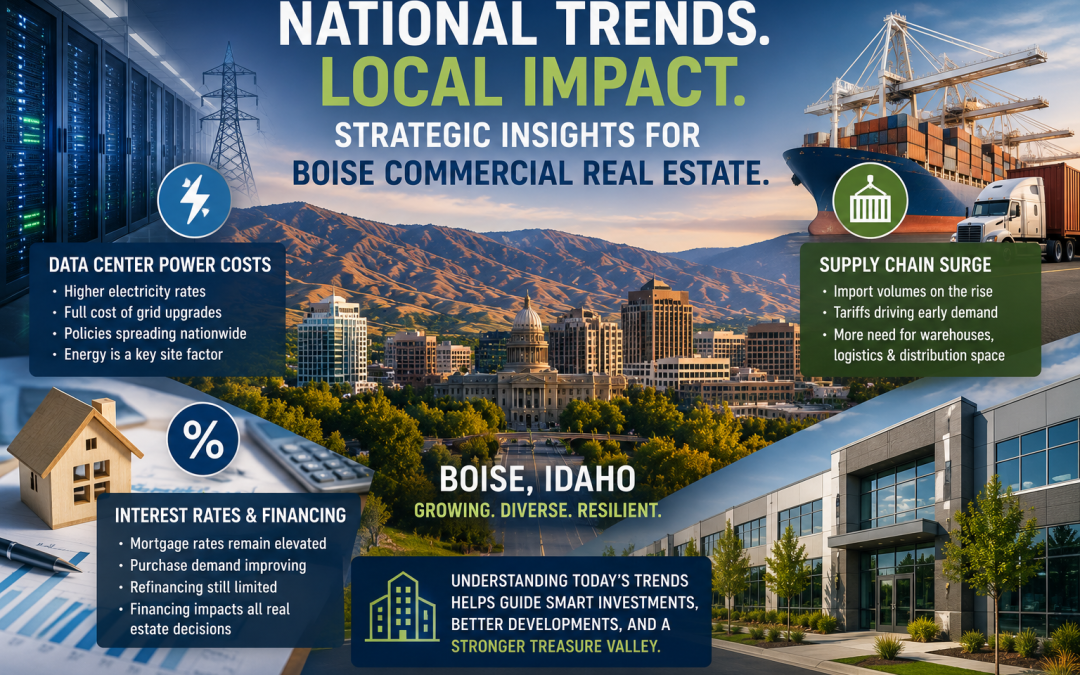
What Rising Data Center Power Costs and National Economic Trends Could Mean for Boise Commercial Real Estate
Commercial real estate doesn’t operate in a vacuum.
Utility costs, supply chains, interest rates, and consumer spending all influence where companies invest and how developers plan future projects. Three recent national trends illustrate how quickly the commercial real estate landscape continues to evolve—and why Boise investors should pay attention.
According to reporting by Lou Hirsh in CoStar News, Oregon has approved higher electricity rates for large data centers, U.S. ports are preparing for a surge in cargo volumes ahead of new tariffs, and mortgage applications continue responding to elevated interest rates. You can read the original CoStar News article here: https://product.costar.com/home/news/567108818. This article is based on that reporting while exploring what these national developments could mean for Boise commercial real estate, industrial development, investment activity, and long-term growth across the Treasure Valley.
Data Centers May Face Higher Development Costs
Artificial intelligence has dramatically increased demand for data centers across the country.
Those facilities consume enormous amounts of electricity, placing additional pressure on local power grids.
Oregon recently became the first state to require many large data center operators to pay significantly more for electricity while also covering the full cost of grid improvements built specifically to serve their projects.
Key Takeaways
- Oregon approved higher electricity rates for qualifying data centers.
- Large facilities must now pay the full cost of dedicated power infrastructure.
- Several other states are considering similar policies.
- Regulators hope the changes protect residential and commercial utility customers from higher costs.
As AI continues expanding, energy availability is becoming just as important as land availability when companies evaluate new locations.
Why This Matters for Boise Commercial Real Estate
Idaho has become increasingly attractive for technology investment because of its business climate, available land, and growing economy.
However, energy policy could become an even larger factor in future Boise development decisions.
Companies planning data centers, semiconductor facilities, advanced manufacturing plants, or other energy-intensive operations will likely evaluate:
- Long-term electricity costs
- Grid reliability
- Utility capacity
- Infrastructure expansion requirements
- Regulatory certainty
For developers, sites with existing utility capacity could become more valuable as electrical infrastructure grows increasingly expensive.
Supply Chains Continue Driving Industrial Demand
Another important trend comes from the nation’s ports.
Retailers are accelerating imports ahead of potential tariff increases expected later this summer.
That means warehouses, logistics providers, trucking companies, and distribution centers could remain busy throughout the second half of the year.
While Boise is not a coastal port market, the Treasure Valley continues benefiting from regional distribution activity throughout the Pacific Northwest.
Higher cargo volumes often translate into increased demand for:
- Warehouse space
- Industrial buildings
- Freight services
- Distribution centers
- Third-party logistics facilities
As supply chains continue evolving, industrial real estate remains one of the strongest sectors within Boise commercial real estate.
Interest Rates Continue Influencing Real Estate Decisions
Mortgage activity remains sensitive to financing costs.
Although mortgage rates have eased slightly in recent weeks, borrowing costs remain well above the levels many buyers enjoyed several years ago.
Purchase activity has shown modest improvement compared with last year, while refinancing remains relatively limited.
For commercial real estate, interest rates continue influencing:
- Investment property pricing
- Construction financing
- Development feasibility
- Owner-user acquisitions
- Capital availability
Investors continue watching financing costs closely as they evaluate new projects throughout Idaho.
Local Insight
These three stories may seem unrelated at first.
But together they illustrate how today’s commercial real estate market depends on much more than local supply and demand.
Energy policy affects technology investment.
Global trade affects warehouse demand.
Interest rates influence nearly every commercial transaction.
Boise’s economy remains well positioned because it benefits from multiple sectors, including technology, logistics, manufacturing, healthcare, and professional services.
Markets with diversified economies often adapt more successfully as national conditions change.
For investors, developers, and business owners, understanding these broader trends can provide an important advantage when planning future commercial real estate decisions.
Mike Gioioso (joy-OH-so) has for 16+ years been helping companies of all sizes buy, build, and lease perfect places for business in greater Boise, Idaho and beyond.
www.streetsmartidaho.com
mike@streetsmartidaho.com
208-209-9166
Tags: #boisecommercialrealestate, #boisedevelopment, #datacenters, #idahoindustrialrealestate, #industrialdevelopmentboise, #warehousespaceboise, #logisticsrealestate, #commercialpropertyinvestment, #aiinfrastructure, #energycosts, #officedevelopmentboise, #supplychain, #commercialrealestatetrends, #idahoeconomy, #treasurevalleybusiness