
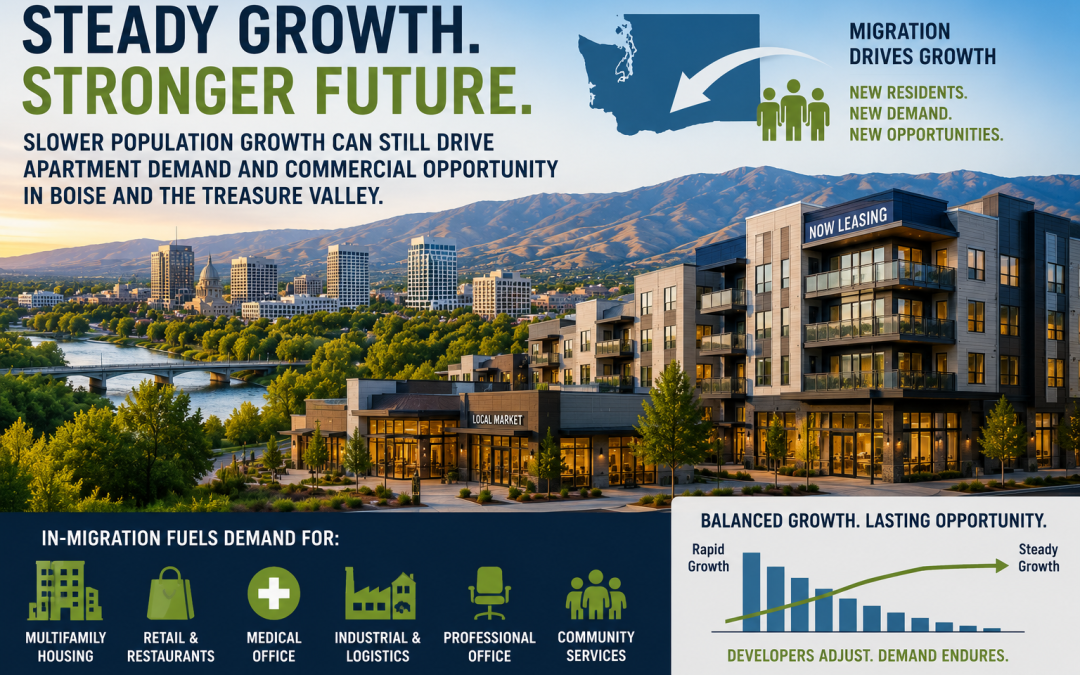
How Slower Population Growth Could Still Support Apartment Demand—and What It Means for Boise Commercial Real Estate
Population growth doesn’t have to be booming to create commercial real estate opportunities.
In many markets, even moderate growth can keep apartment demand healthy, encourage new development, and support long-term investment. Washington’s latest population data offers a good example of how steady migration—not rapid expansion—can continue shaping commercial real estate.
According to reporting by Elliott Krivenko in CoStar Analytics, Washington’s population continued to grow during the past year even as the pace slowed from previous highs. You can read the original CoStar Analytics article here: https://product.costar.com/home/news/1625393339. This article is based on that reporting while exploring what these demographic trends could mean for Boise commercial real estate, multifamily investment, and future development throughout the Treasure Valley.
Migration Continues To Drive Housing Demand
Washington added approximately 44,000 new residents between April 2025 and April 2026, bringing the state’s population to roughly 8.2 million.
Although growth slowed compared with the rapid expansion seen during much of the previous decade, Washington remained among the nation’s fastest-growing states.
One statistic stands out.
Approximately 72% of the state’s population increase came from people moving into Washington, rather than from natural population growth.
That reinforces an important commercial real estate principle:
People moving into a region immediately create demand for housing, retail, healthcare, restaurants, and other commercial services.
Apartment Demand Remains Healthy Even With Slower Growth
Slower population growth doesn’t automatically translate into weaker apartment markets.
The CoStar analysis found that migration continues supporting rental demand throughout Washington’s largest urban areas.
Much of the state’s growth occurred in counties surrounding Seattle and Spokane, where most multifamily development has also been concentrated.
At the same time, apartment construction has become more balanced.
While the number of multifamily units under construction remains well below the record levels reached in 2022, developers have recently begun increasing new project starts again—particularly in the central Puget Sound region.
That suggests builders remain confident that long-term housing demand will continue.
Why This Matters for Boise Commercial Real Estate
The Treasure Valley shares many similarities with Washington’s current growth pattern.
Boise is no longer experiencing the extraordinary migration surge seen during the height of the pandemic, but the region continues attracting new residents from across the country.
Steady in-migration supports demand for much more than apartments.
Growing populations typically increase demand for:
- Multifamily housing
- Neighborhood retail
- Medical office space
- Restaurants
- Grocery stores
- Industrial distribution
- Professional office buildings
- Community services
Commercial development often follows rooftops.
As more households move into an area, businesses typically follow to serve those new residents.
Developers Are Adjusting Rather Than Pulling Back
Another important takeaway from Washington’s experience is that developers aren’t abandoning the market.
Instead, they’re becoming more selective.
Construction activity has moderated from peak levels, but new projects continue moving forward where long-term demand remains strongest.
That disciplined approach helps reduce the risk of oversupply while allowing markets to continue growing at a healthier pace.
Boise developers appear to be following a similar strategy.
Rather than building everywhere, many are focusing on high-growth corridors where new housing, infrastructure improvements, and employment growth continue creating opportunities.
What This Could Mean for Boise Development
If migration into Idaho remains positive, even at a slower pace than previous years, the Treasure Valley could continue experiencing steady commercial real estate growth.
Areas that may benefit include:
- Multifamily communities
- Mixed-use developments
- Retail centers serving expanding neighborhoods
- Medical office campuses
- Industrial business parks
- Flex office developments
The pace of development may become more measured, but long-term demand fundamentals remain supported by continued population growth.
My Take
From my perspective in Boise commercial real estate, this report reinforces something many investors sometimes overlook.
Growth doesn’t have to be explosive to create opportunity.
Healthy, consistent migration often produces more sustainable commercial real estate markets than periods of rapid expansion followed by sharp slowdowns.
The Treasure Valley appears to be entering a phase where developers, investors, and businesses are making more disciplined decisions based on long-term demand instead of short-term momentum.
If Idaho continues attracting new residents while maintaining a balanced pace of development, Boise could remain one of the strongest commercial real estate markets in the western United States for years to come.
Mike Gioioso (joy-OH-so) has for 16+ years been helping companies of all sizes buy, build, and lease perfect places for business in greater Boise, Idaho and beyond.
www.streetsmartidaho.com
mike@streetsmartidaho.com
208-209-9166
Tags: #boisecommercialrealestate, #boisedevelopment, #multifamilydevelopment, #apartmentinvestment, #treasurevalleygrowth, #boisehousingmarket, #populationgrowth, #migrationtrends, #mixedusedevelopment, #retailleasingboise, #commercialrealestateinvestment, #multifamilyhousing, #industrialrealestate, #officeleasingboise, #commercialdevelopment, #idahopopulationgrowth, #boiseinvestmentproperties