
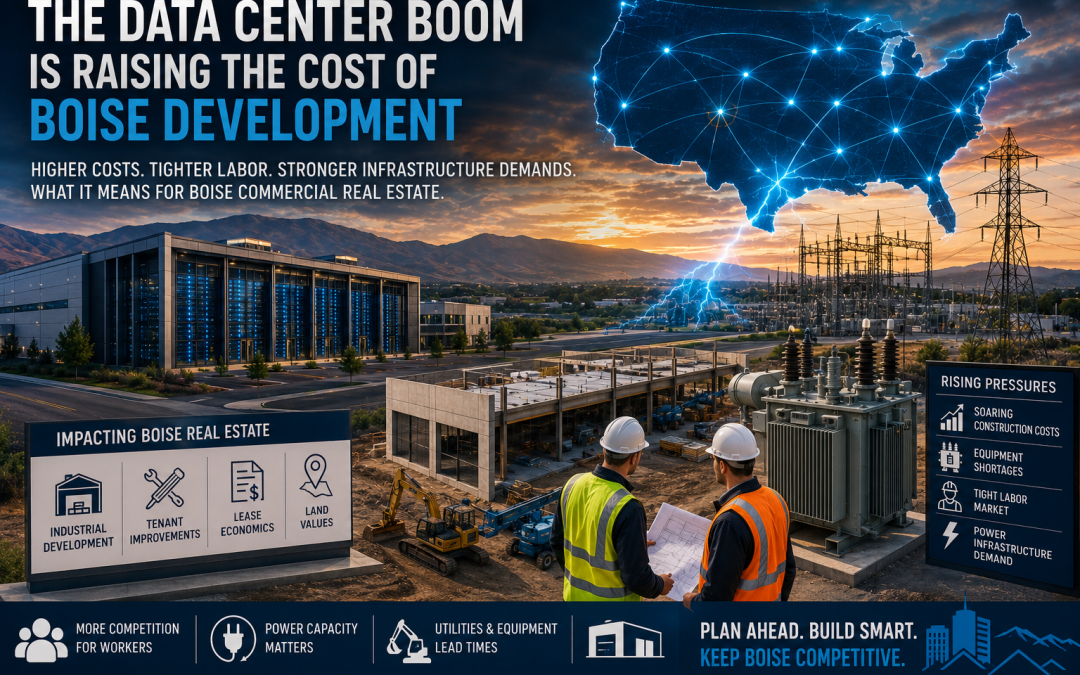
How the Data Center Boom Could Raise Boise Commercial Real Estate Development Costs
The biggest impact of America’s data center boom may not be the data centers themselves.
It may be what they consume.
Electricity. Land. Transformers. Construction materials. Electricians. HVAC specialists. Engineers. Capital.
As billions of dollars pour into artificial intelligence infrastructure, those projects are competing for many of the same resources needed to build warehouses, retail centers, apartments, offices, manufacturing plants, and other commercial properties.
According to reporting by Lou Hirsh in CoStar News, rapidly expanding data center construction is already contributing to higher construction costs, equipment shortages, and tighter skilled-labor markets across the country.
You can read the original CoStar News article here: https://product.costar.com/home/news/817493384
For Boise commercial real estate, this matters even if a massive AI data center never gets built next door.
The Treasure Valley competes for many of the same workers, electrical equipment, contractors, and infrastructure.
And that means the AI boom could eventually show up in Boise construction budgets.
Data Centers Are Creating Competition for Construction Resources
The scale of planned data center development is enormous.
According to research cited by CoStar, U.S. data center capacity could increase from roughly 24 gigawatts today to approximately 110 gigawatts by 2030.
That expansion requires far more than large buildings filled with computer servers.
Data centers require extensive electrical systems, cooling equipment, backup power, substations, transformers, transmission infrastructure, and specialized construction.
All of those projects require people to build them.
That’s where the commercial real estate impact begins.
National construction costs were increasing at roughly a 4% annual pace as of May, according to Oxford Economics data cited by CoStar.
But some major data center markets were experiencing increases closer to 7%.
Why?
Part of the answer is competition.
When several multibillion-dollar projects are being constructed at the same time, developers begin competing for the same contractors, workers, materials, and equipment.
That competition pushes prices higher.
Boise Doesn’t Need Data Centers to Feel the Effects
Construction markets aren’t completely local anymore.
A major electrical contractor doesn’t necessarily have to stay in Idaho.
Neither does an electrician, engineer, equipment supplier, or specialized subcontractor.
If large projects in Phoenix, Salt Lake City, Las Vegas, Dallas, or another Western market are willing to pay substantially more, workers and contractors can follow the money.
That’s important for Boise development.
A Treasure Valley developer planning a 50,000-square-foot industrial project may not think they are competing with a billion-dollar AI campus.
But indirectly, they could be.
Both projects may need:
- Electricians
- Electrical switchgear
- Transformers
- HVAC equipment
- Engineers
- Equipment operators
- Concrete contractors
- Steel
- Utility infrastructure
When demand for those resources increases nationally, local projects can feel the pressure.
Transformers Could Become a Major Development Bottleneck
One number in the CoStar reporting deserves particular attention.
Research from Wood Mackenzie indicates that power transformer costs have increased approximately 77% since 2019.
That’s significant because transformers are fundamental pieces of electrical infrastructure.
And supply chains for certain electrical components still haven’t completely normalized from disruptions earlier in the decade.
Data centers are adding another layer of demand.
For developers, this creates a problem beyond price.
Time may become more important than cost.
A developer might be able to absorb a higher equipment price.
It’s much harder to deal with a critical electrical component that won’t arrive for another year or longer.
That can delay construction.
It can delay tenant openings.
It can delay rent commencement.
And it can change the financial return on an entire development.
For Boise commercial real estate developers, utility coordination and electrical equipment procurement may need to happen earlier than ever.
Power Availability Could Change Industrial Land Values
We’ve traditionally evaluated industrial land using familiar criteria.
Freeway access.
Zoning.
Topography.
Land price.
Labor availability.
Distance to customers.
Those still matter.
But electrical infrastructure deserves to move much higher on the list.
As data centers, semiconductor plants, advanced manufacturing, and AI infrastructure consume more electricity, access to power could become a major competitive advantage.
That has direct implications for Boise industrial real estate.
Two parcels might look nearly identical.
But if one can obtain the required electrical service quickly while the other needs years of utility improvements, they aren’t really comparable development sites.
The difference may become even greater for manufacturing tenants.
High-tech manufacturers can require far more electricity than traditional warehouse users.
Micron’s expansion makes this especially relevant to the Treasure Valley.
As semiconductor-related suppliers and advanced manufacturers consider Idaho, power capacity could become one of the first questions they ask.
Skilled Construction Labor Is Getting Tighter
Equipment isn’t the only constraint.
People are too.
Data centers require specialized trades, including electricians, technicians, equipment operators, and workers experienced with complex cooling and power systems.
Those are some of the same workers needed for many other commercial projects.
According to JLL research cited by CoStar, construction project growth is currently running considerably faster than construction employment growth.
Approximately 61% of U.S. metropolitan areas are already considered constrained for construction labor.
That figure could reach approximately 72% by 2027.
Several Western markets are already feeling significant pressure, including Phoenix and Salt Lake City.
Boise sits between many of these rapidly growing Western markets.
That makes the trend worth watching closely.
If wages rise substantially elsewhere, Idaho contractors may have to increase compensation to keep skilled employees.
Those costs eventually make their way into construction bids.
The Labor Battle Could Hit Boise Development From Two Directions
There’s another complication.
Data centers aren’t only creating demand for workers inside the buildings.
They also require enormous amounts of supporting power infrastructure.
That means utilities and infrastructure contractors are competing for many of the same specialized workers.
An electrician might be needed for a commercial development.
Or a data center.
Or a substation.
Or a transmission project.
Or a semiconductor plant.
Multiply that competition across dozens of major projects and the labor constraint becomes easier to understand.
For Boise landlords and developers, this could lead to:
Higher construction bids.
Longer construction schedules.
Greater contingency requirements.
More difficulty securing subcontractors.
Earlier equipment ordering.
And potentially higher tenant improvement costs.
Those issues can affect whether a project makes financial sense.
Rising Costs Could Change Lease Economics
This is where the data center boom moves directly into leasing.
Suppose a landlord is negotiating with a tenant that needs significant improvements.
The landlord agrees to provide a large tenant improvement allowance.
But between signing the lease and beginning construction, electrical equipment gets more expensive and subcontractor bids rise.
Someone has to pay the difference.
That could mean higher rent.
It could mean a larger tenant contribution.
It could mean reducing the scope of improvements.
Or the deal might no longer work.
For anyone involved in retail leasing Boise, office leasing, medical office, industrial leasing, or restaurant development, construction costs are already a major part of negotiations.
If AI infrastructure adds another source of cost pressure, TI packages could become even more important.
Data Center Resistance Is Growing Too
There is another side to the data center boom.
Communities across the country are beginning to question how much development they want.
According to the CoStar report, at least 15 states have been considering some form of data center restriction or pause, while research from Interconnected Capital identified more than 150 local governments considering moratoriums as of late June.
The concerns vary.
Power consumption.
Water usage.
Land use.
Environmental effects.
Infrastructure demands.
Public safety.
Communities in several Western states are among those debating restrictions.
That could eventually matter for Idaho.
Western states have attracted data center interest partly because they can offer large development sites.
But land availability alone isn’t enough.
Communities increasingly want to understand what they receive in exchange for dedicating enormous amounts of power and infrastructure to these projects.
That conversation could become important if more data center developers begin looking seriously at Idaho.
Local Insight: Utility Due Diligence Needs to Start Earlier
For Boise investors and developers, one practical lesson stands out:
Don’t wait until late in the development process to figure out utilities.
Historically, a developer might first focus on land acquisition, zoning, site planning, and financing.
Electrical capacity could sometimes be addressed later.
That approach is becoming riskier.
Before committing heavily to a development site, I would want a much clearer understanding of:
- Available electrical capacity
- Required utility upgrades
- Transformer availability
- Equipment lead times
- Substation proximity
- Estimated utility construction schedules
- Future power requirements of likely tenants
This is especially important for industrial and advanced manufacturing projects.
The best-looking development site in the market isn’t necessarily the best site if you can’t power the building.
Investors Should Pay Attention to Replacement Costs
Higher construction costs also affect existing commercial properties.
If it becomes substantially more expensive to build a new warehouse, retail center, flex building, or office property, existing buildings can become more valuable.
That’s the replacement-cost argument.
Suppose an existing industrial building trades for substantially less than what it would cost to buy land and construct the same property today.
That pricing gap can discourage competing development.
For investors in Boise commercial real estate, rising construction costs can therefore create both risks and opportunities.
New development becomes harder.
But well-located existing buildings can become more difficult to replace.
That can support rents and property values—assuming tenant demand remains healthy.
What Boise Commercial Real Estate Should Watch Next
The AI boom is creating an unusual commercial real estate cycle.
Data centers themselves represent one of the fastest-growing property sectors.
But their impact extends much further.
They consume enormous amounts of electricity.
They require specialized infrastructure.
They compete aggressively for construction workers.
They absorb electrical equipment.
And they’re pushing communities to rethink how major industrial developments should be regulated.
For Boise, several indicators deserve attention over the next few years:
Construction labor costs. Are skilled-trade wages accelerating?
Transformer lead times. How long does critical equipment take to arrive?
Utility capacity. Where is Idaho Power expanding infrastructure?
Tenant improvement costs. Are landlords seeing electrical and HVAC budgets climb?
Advanced manufacturing demand. Are Micron suppliers and technology companies requiring more power-intensive facilities?
Data center proposals. Are developers beginning to target more Idaho sites?
Those trends could influence development decisions throughout the Treasure Valley.
AI’s Real Estate Impact May Be Bigger Than the Data Centers
When people think about AI and commercial real estate, they often picture enormous data centers.
But that may be only part of the story.
The larger impact could come from the competition those facilities create for electricity, infrastructure, construction equipment, skilled labor, and capital.
A Boise developer may never build a data center.
Yet the project could still pay higher wages because data centers are competing for electricians.
Wait longer for transformers because AI campuses are consuming supply.
Spend more on utility improvements because electrical infrastructure is stretched.
Or benefit because an existing building becomes more valuable compared with the cost of new construction.
That’s why the data center boom isn’t just a technology-sector story.
It is becoming a construction story.
An infrastructure story.
A labor story.
And increasingly, a Boise commercial real estate story.
Mike Gioioso (joy-OH-so) has for 16+ years been helping companies of all sizes buy, build, and lease perfect places for business in greater Boise, Idaho and beyond.
www.streetsmartidaho.com mike@streetsmartidaho.com 208-209-9166
Tags: #boisecommercialrealestate, #boisedevelopment, #datacenters, #aidatacenters, #boiseconstructioncosts, #idahopowerinfrastructure, #boiseindustrialrealestate, #industrialdevelopmentboise, #treasurevalleydevelopment, #commercialconstructionboise, #transformershortage, #constructionlaborshortage, #artificialintelligenceinfrastructure, #micronboise