
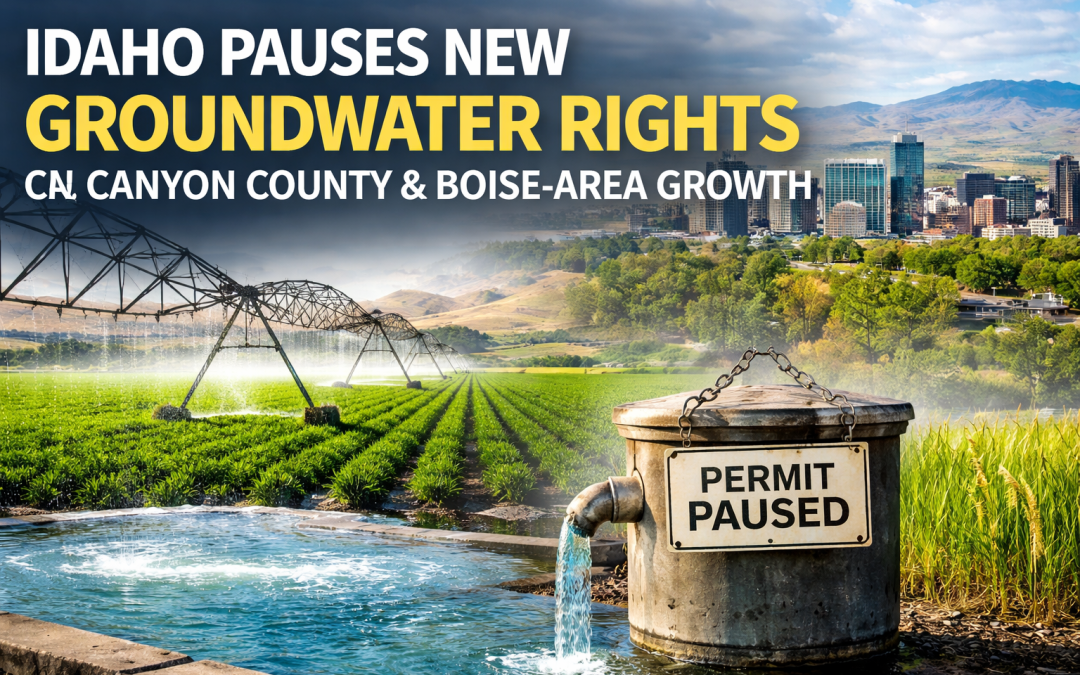
Idaho Pauses New Groundwater Rights in Canyon County — What It Could Mean for Boise-Area Growth
Water rarely grabs headlines in Boise commercial real estate. But sometimes it quietly shapes what can — and cannot — be built.
A recent decision by the Idaho Department of Water Resources could influence development patterns in parts of the Treasure Valley over the next several years.
According to reporting by IBR Staff in the Idaho Business Review (see the original article here: https://idahobusinessreview.com/2026/03/23/idaho-halts-new-groundwater-permits-in-southern-canyon-county-for-5-years/), state regulators have placed a five-year pause on new groundwater permits in southern Canyon County while they gather more data about the local aquifer system.
For developers, land investors, and property owners in the western Boise metro, that decision may quietly influence how — and where — future growth happens.
What’s Changing in Southern Canyon County
The order, issued by IDWR Director Mathew Weaver, temporarily stops the processing of new groundwater right applications in an area south of Lake Lowell, covering farmland south and southwest of Nampa.
The move immediately affects 21 pending groundwater applications.
Those applications together requested 121 cubic feet per second of water flow, which could support irrigation for about 7,000 acres of farmland.
State officials say the pause isn’t because the aquifer is already failing. Instead, it’s because the state doesn’t yet have enough monitoring data to confidently predict long-term impacts.
Key facts from the decision include:
- A five-year moratorium on new groundwater permit approvals
- 21 pending applications placed on hold
- The affected zone includes land south of Lake Lowell in Canyon County
- Current monitoring wells show slightly rising aquifer levels overall, but data gaps remain
- The state plans to expand monitoring wells and update groundwater modeling
During the pause, regulators plan to collect more information, expand the monitoring network, and improve regional groundwater modeling.
Why the State Is Taking a Cautious Approach
Even though current monitoring wells show relatively stable groundwater levels, the state says the data doesn’t yet tell the full story.
Most of the monitoring network sits north of the area where development pressure is increasing.
That means the aquifer south of Lake Lowell — where farmland and rural land are often targeted for future development — is less understood from a hydrology standpoint.
Officials want to avoid approving large new withdrawals before they fully understand how additional pumping could affect existing users.
The pause is essentially a data-gathering window designed to answer several key questions:
- How much groundwater is truly available in the southern basin
- How injection wells influence recharge
- Whether new irrigation or development could affect existing water rights
What This Means for Boise Commercial Real Estate
For most existing businesses and properties, this change will likely have little immediate impact.
The order includes several exemptions. It does not apply to:
- Replacement or deepening of existing domestic wells
- Wells tied to existing water rights
- Transfers or modifications to established water rights
However, the broader development implications could be meaningful.
Southern Canyon County has long been considered future growth territory for the Boise metro, especially as the region expands west.
If groundwater availability becomes more restricted — or even just more carefully regulated — it could influence several trends:
1. Slower agricultural expansion
Large irrigation permits are currently paused, which could affect farmland development plans.
2. Development pressure shifting closer to existing infrastructure
Areas already served by municipal water systems may become more attractive for builders.
3. Greater attention on water rights during land deals
In rural land transactions, water access may become an even more critical due-diligence factor.
In fast-growing regions like the Treasure Valley, water availability can quietly shape where new housing, industrial parks, or logistics developments emerge.
My Take: Water Is the Hidden Driver of Long-Term Growth
In Boise commercial real estate, we often focus on population growth, migration, and economic expansion.
But infrastructure — especially water — often determines the true limits of development.
This temporary pause doesn’t necessarily signal a water shortage. Instead, it shows regulators trying to stay ahead of growth rather than reacting after problems appear.
For investors and developers, the takeaway is simple:
Land value in the Treasure Valley isn’t just about location anymore.
It’s increasingly about infrastructure, utilities, and water security.
As Boise continues expanding west toward Canyon County, those factors will play a bigger role in determining which sites move forward — and which ones wait.
Mike Gioioso (joy-OH-so) has for 16+ years been helping companies of all sizes buy, build, and lease perfect places for business in greater Boise, Idaho and beyond. www.streetsmartidaho.com mike@streetsmartidaho.com 208-209-9166
Tags: #Boisecommercialrealestate, #Boisedevelopment, #TreasureValleygrowth, #CanyonCountyrealestate, #Nampadevelopment, #Idahowaterpolicy, #groundwaterrightsIdaho, #IdahoDepartmentofWaterResources, #LakeLowell, #Idaholanddevelopment, #commerciallandBoise, #TreasureValleyrealestate