
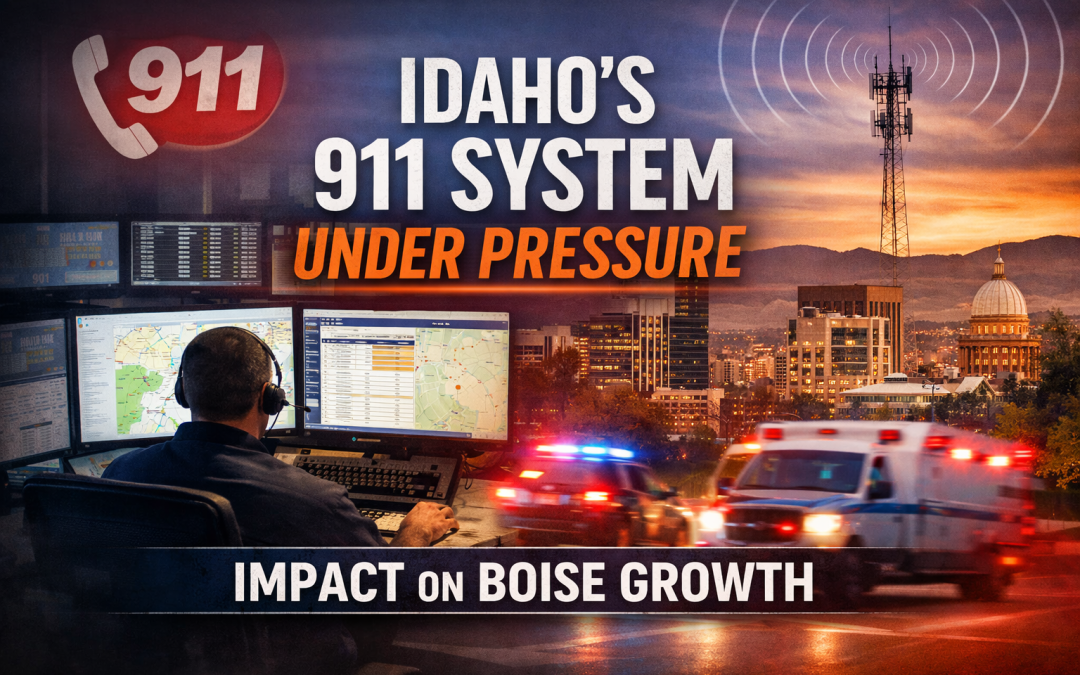
Idaho’s 911 System Is Under Pressure—And That Has Big Implications for Boise Growth
When people think about Boise commercial real estate, they usually focus on deals, development, and population growth.
But behind the scenes, there’s another system that matters just as much: emergency infrastructure.
Because no matter how strong a market is, it only works if the systems supporting it can keep up.
According to reporting by Idaho Press staff, based on Idaho Capital Sun (read the full article here: https://www.idahopress.com/news/local/idaho-watchdog-agency-says-state-should-consider-creating-statewide-911-system/article_1e7a2f81-cd69-40bd-8048-2abed65ab18c.html), a new watchdog report suggests Idaho should consider building a statewide 911 program to address growing strain across local emergency communication systems.
This may sound like a policy issue—but it’s actually a growth issue.
What’s Breaking Down in Idaho’s Emergency System
The report outlines several challenges happening right now across the state:
- Most 911 centers are facing financial pressure, especially in smaller communities
- Nearly two-thirds are using aging equipment near end of life
- Many centers are dealing with staff shortages
- The funding model hasn’t changed since the late 1980s
- Oversight is fragmented, with no strong statewide coordination
One of the biggest takeaways:
Idaho’s emergency system hasn’t scaled with its growth.
And that gap is starting to show.
Why This Matters for Boise Development
Boise and the surrounding Treasure Valley are growing fast. That growth depends on more than just land and buildings—it depends on infrastructure that can support it.
Emergency response is a key part of that.
Here’s where this connects directly to Boise development:
- New housing = more calls for service
- More retail and mixed-use = higher population density
- Industrial growth = increased logistics traffic and risk exposure
- Expanding suburbs = longer response times without system upgrades
If emergency systems fall behind, it creates friction across the entire market.
The Push for a Statewide Approach
The watchdog agency suggests Idaho consider moving toward a state-level 911 program to improve:
- Coordination across jurisdictions
- Long-term planning
- Funding oversight
- Technology upgrades (including Next Generation 911)
Right now, most systems are run locally by cities and counties.
That local control has benefits—but it also creates inconsistency, especially as regions grow at different speeds.
The report stops short of recommending consolidation of call centers, noting concerns around cost, redundancy, and maintaining service quality.
Instead, the focus is on better coordination—not centralization.
What This Signals for Commercial Real Estate
This is where things get real for investors, developers, and landlords in Boise commercial real estate.
Infrastructure gaps don’t just affect public services—they affect:
- Site selection decisions (especially for large employers)
- Insurance costs and risk assessments
- Municipal approval timelines
- Long-term asset value and market perception
As Boise continues to attract out-of-state capital, these factors become more visible—and more important.
Institutional investors, in particular, look closely at:
- Emergency response capabilities
- Infrastructure readiness
- Government coordination
It’s all part of how they evaluate a market’s durability.
My Take (Local Insight)
From a boots-on-the-ground Boise perspective, this is a classic “growing pains” situation.
The market has expanded quickly—but some of the systems behind it are still catching up.
And here’s the key:
Infrastructure doesn’t just support growth—it either accelerates it or slows it down.
If Idaho moves toward a more coordinated 911 system, it could:
- Improve response times
- Create more consistency across markets
- Increase confidence for developers and investors
If not, we may start to see friction—especially in fast-growing suburban areas where development is outpacing services.
The next phase of Boise commercial real estate isn’t just about building more—it’s about making sure the foundation underneath it can handle what’s coming.
The Bigger Picture
This report also ties into a broader trend:
As Boise grows into a more mature market, expectations are rising—not just for buildings, but for everything around them.
That includes:
- Roads and transportation
- Utilities and infrastructure
- Public safety systems
Markets that align these pieces well will win the next wave of growth.
Mike Gioioso (joy-OH-so) has for 16+ years been helping companies of all sizes buy, build, and lease perfect places for business in greater Boise, Idaho and beyond. www.streetsmartidaho.com mike@streetsmartidaho.com 208-209-9166
Tags: #Boisecommercialrealestate, #Boiserealestate, #Boisedevelopment, #TreasureValleyrealestate, #Idahocommercialrealestate, #911systemIdaho, #emergencyservicesinfrastructure #publicsafetyinfrastructure