
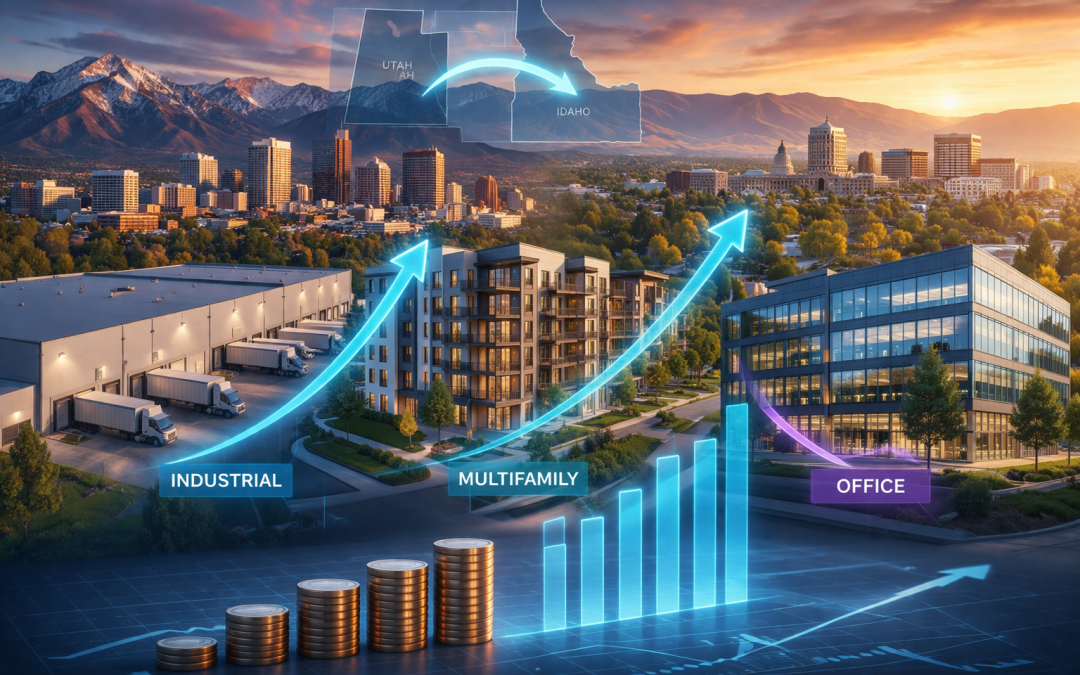
Industrial and Multifamily Deals Drive Investment Comeback in the Mountain West — What Boise Investors Should Watch
Commercial real estate investment across the Mountain West has been uneven since the pandemic. Some sectors cooled dramatically, while others quietly surged.
A recent market report from Utah suggests investment momentum may be stabilizing again — especially in industrial and multifamily properties.
According to reporting by John Gillem of CoStar Analytics, investment sales activity in Salt Lake City increased sharply during 2025 as buyers returned to certain property types even while office buildings continued to struggle. You can read the original report here:
https://product.costar.com/home/news/1839488157
For those following Boise commercial real estate trends, the Salt Lake City market often acts as a useful comparison. Both cities share similar growth patterns, strong population inflows, and expanding technology economies.
The trends happening in Utah can sometimes offer early clues about where investor demand may shift next across the Intermountain West, including Idaho.
A Surge in Investment Activity
After several slow years, overall commercial property investment increased significantly in Salt Lake City during 2025.
Preliminary transaction data shows roughly $955 million in property sales, representing a 33% increase compared with 2024.
While that number is still below the investment highs seen before the pandemic, it marks the strongest sales activity since 2022.
Several sectors helped drive the rebound:
- Industrial properties generated the largest share of investment
- Apartment transactions continued gaining momentum
- Retail investment remained relatively steady
- Office sales declined sharply
In other words, the recovery isn’t evenly spread across the real estate landscape.
Instead, investors appear to be concentrating on sectors with stronger long-term demand.
Industrial Properties Are Leading the Recovery
Industrial real estate was the clear standout in Salt Lake City last year.
Transaction volume for warehouses and distribution properties reached approximately $513 million, representing more than half of all commercial sales activity.
That figure represented a dramatic increase from the previous year, when industrial deals totaled just over $200 million.
The surge reflects a broader national trend. Investors continue targeting logistics and manufacturing facilities tied to:
- Supply chain expansion
- e-commerce distribution
- technology infrastructure
- regional manufacturing growth
For markets like Boise, which has seen increasing interest in logistics and semiconductor supply chains, industrial properties are becoming one of the most closely watched asset classes.
Multifamily Investment Is Rebounding
Apartment buildings also played a major role in sustaining investment activity.
Multifamily transactions reached roughly $241 million, accounting for about one quarter of all property sales in the market.
That sector has been recovering gradually after hitting a low point several years ago.
Several factors are supporting renewed investor interest:
- Continued population growth in the region
- Stabilizing construction pipelines
- Potential improvements in apartment occupancy
Analysts suggest apartment sales activity could continue increasing through 2026 as leasing demand improves.
For rapidly growing cities across the Mountain West, including Boise, housing demand remains one of the most powerful drivers of development.
Office Properties Continue to Struggle
While industrial and apartment deals surged, the office sector moved in the opposite direction.
Only about $100 million in office transactions were recorded during 2025, representing a steep decline compared with the previous year.
A decade ago, office buildings were one of the most actively traded asset classes in Salt Lake City. At one point, they accounted for roughly a third of all investment volume.
But several factors have weakened investor appetite:
- Post-pandemic changes in office demand
- new construction delivered between 2020 and 2022
- slower corporate expansion in some industries
These pressures have affected valuations and reduced the number of transactions occurring in the sector.
Why Boise Investors Should Pay Attention
Salt Lake City and Boise share several similarities:
- strong population growth
- expanding technology sectors
- increasing migration from larger coastal markets
- growing demand for industrial logistics space
Because of those parallels, investment trends in Utah often mirror shifts that later appear in Idaho.
From a Boise commercial real estate perspective, several insights stand out.
Industrial properties remain the dominant investment target
Demand for warehouses, manufacturing facilities, and logistics centers continues to attract capital throughout the Mountain West.
Boise’s location along major regional shipping routes makes it attractive for companies seeking distribution hubs serving Idaho, Utah, Oregon, and Nevada.
Multifamily housing demand remains strong
Population growth across the Treasure Valley continues fueling apartment development.
Investors are closely watching rent growth potential and construction pipelines when deciding where to deploy capital.
Office markets are still recalibrating
Like many cities nationwide, Boise’s office sector is navigating changing workplace patterns.
Investors increasingly focus on newer, higher-quality office properties while older buildings may require repositioning or redevelopment.
Local Insight: The Mountain West Investment Story
One lesson from Salt Lake City’s numbers is that capital hasn’t disappeared from commercial real estate — it has simply shifted toward different sectors.
Industrial and housing assets are currently absorbing the majority of investor attention.
Cities that continue attracting residents and technology investment — like Boise — are likely to remain on investors’ radar.
Over the next several years, capital flows in the Mountain West will likely focus on markets that can still deliver:
- population growth
- job expansion
- rent growth potential
- manageable new supply
Boise checks many of those boxes.
My Take
Real estate investment cycles rarely move in straight lines.
The recent increase in Salt Lake City deal volume suggests investors are slowly regaining confidence — but they are being selective about where they place capital.
Industrial properties and apartments remain the most attractive sectors across the region, while office buildings continue adjusting to a new market reality.
For anyone watching Boise commercial real estate, these patterns reinforce a broader trend: the future of investment activity will likely be driven by logistics, housing demand, and technology-related industries.
Mike Gioioso (joy-OH-so) has for 16+ years been helping companies of all sizes buy, build, and lease perfect places for business in greater Boise, Idaho and beyond.
www.streetsmartidaho.com
mike@streetsmartidaho.com
208-209-9166
Tags: #Boisecommercialrealestate, #Boisedevelopmenttrends, #Boiseindustrialrealestate, #TreasureValleyeconomicgrowth, #Boisemultifamilydevelopment, #Boiseapartmentinvestment, #Boisewarehousespace, #Boiselogisticsrealestate, #MountainWestcommercialrealestate, #SaltLakeCitycommercialrealestate, #SaltLakeCityinvestmentmarket, #Boiseofficemarket, #Boiserealestateinvestment, #TreasureValleydevelopment