
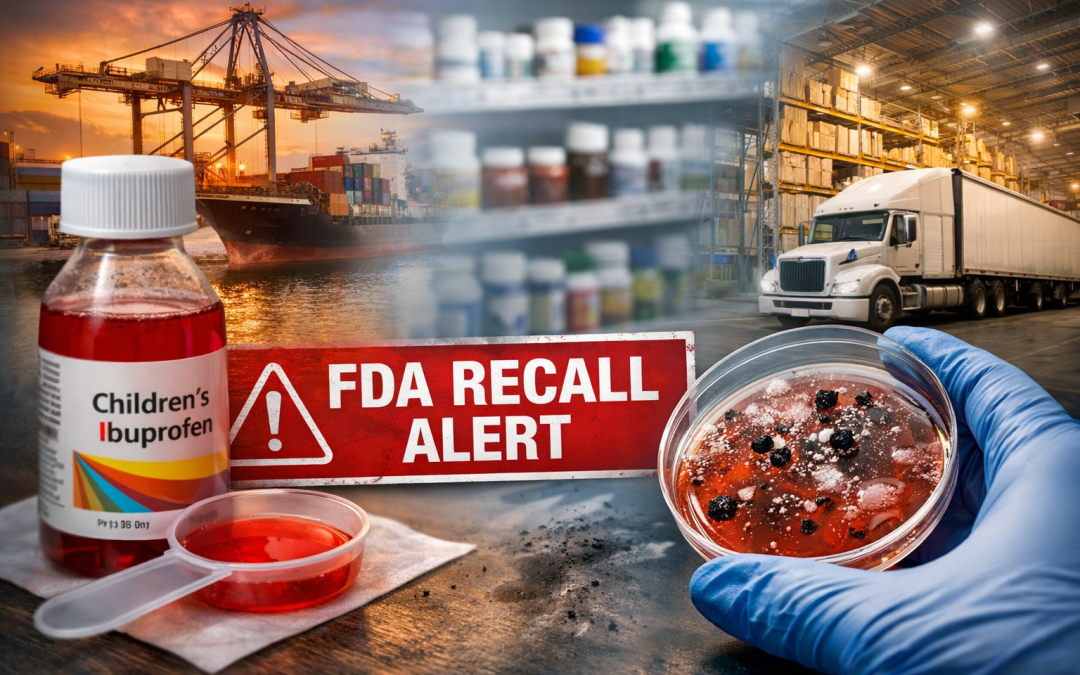
FDA Recall of Children’s Ibuprofen Raises Broader Questions About Consumer Safety and Supply Chains
Sometimes national health alerts can ripple into local conversations about trust, safety, and how products move through the economy.
A recent recall involving a widely used children’s medication highlights how complex supply chains—and the companies behind them—play a role in everyday consumer confidence.
According to reporting distributed by Reuters and published in the Idaho Business Review (read the original article here: https://idahobusinessreview.com/2026/03/20/childrens-ibuprofen-recalled-contamination-idaho/), the U.S. Food and Drug Administration has issued a Class II recall involving certain bottles of children’s ibuprofen that were distributed nationwide, including in Idaho.
The recall involves thousands of bottles of a liquid medication used to treat pain and fever in children.
What Triggered the Recall
The recall was initiated by Strides Pharma, a global pharmaceutical company with operations in the United States.
According to the FDA’s enforcement report, the recall affects approximately 89,592 bottles of a product labeled Children’s Ibuprofen Oral Suspension.
Investigators found contamination in the medication, specifically:
- Gel-like material inside the liquid medicine
- Visible black particles in the product
The affected medication comes in four-ounce bottles containing a 100-milligram liquid suspension.
The FDA classified the recall as Class II, which means the product may cause temporary or medically reversible health effects, but is unlikely to result in severe long-term harm.
Key Details Consumers Should Know
Consumers who purchased the affected medication are advised to stop using it immediately.
Important identifiers include:
- Product name: Children’s Ibuprofen Oral Suspension
- Bottle size: Four fluid ounces
- Lot numbers:
- 7261973A
- 7261974A
- Expiration date: January of the following decade
Because the medication was distributed across the United States, the recall may affect consumers in multiple states, including Idaho.
However, the FDA has not identified specific pharmacies or retailers where the product was sold.
Why This Matters Beyond a Single Product
Ibuprofen is one of the most widely used medications in the country.
It belongs to a group of drugs called nonsteroidal anti-inflammatory drugs, often used to reduce fever, swelling, and mild to moderate pain.
With billions of doses consumed annually across the United States, even a limited recall can affect many households.
While the recall itself is focused on a specific product batch, events like this also remind consumers how global pharmaceutical supply chains operate—from international manufacturing to nationwide distribution networks.
What This Signals for Consumer Markets
From a broader economic perspective, recalls can impact consumer behavior and brand trust.
When safety concerns arise, retailers and pharmacies often experience:
- Temporary shifts in purchasing patterns
- Increased demand for alternative brands
- Heightened regulatory scrutiny across suppliers
For manufacturers, recalls also create pressure to improve quality control, inspection processes, and transparency.
In industries tied to healthcare, trust plays a major role in purchasing decisions.
A Supply Chain Reminder for Business and Real Estate
While this recall is primarily a public health issue, it also highlights something important about modern supply chains.
Many consumer products—from pharmaceuticals to packaged foods—are manufactured in global facilities, shipped to distribution hubs, and then routed to pharmacies, grocery stores, and retailers nationwide.
That infrastructure relies heavily on:
- industrial logistics facilities
- pharmaceutical distribution centers
- temperature-controlled storage warehouses
- transportation networks
These sectors are part of the broader economic ecosystem that supports Boise commercial real estate, especially within industrial and logistics markets.
As healthcare and pharmaceutical distribution expand across the country, regions with strong logistics infrastructure—like Idaho’s growing industrial corridor—continue to attract investment and development.
My Take: Supply Chains Are Part of the Local Economy
Health alerts like this understandably focus on consumer safety first.
But they also remind us how interconnected today’s economy is.
A medication manufactured overseas can move through multiple distribution layers before reaching a pharmacy shelf in Idaho.
For communities across the country, including Boise, that system supports thousands of jobs and millions of square feet of warehouse, logistics, and distribution space.
From a Boise commercial real estate perspective, industries tied to healthcare distribution and pharmaceutical logistics remain important parts of the industrial market.
And as supply chains continue evolving, demand for modern distribution facilities will likely keep growing.
Mike Gioioso (joy-OH-so) has for 16+ years been helping companies of all sizes buy, build, and lease perfect places for business in greater Boise, Idaho and beyond. www.streetsmartidaho.com mike@streetsmartidaho.com 208-209-9166
Tags: #FDArecall, #children’sibuprofenrecall, #consumersafetyalert, #pharmaceuticalrecall, #drugcontamination, #nonsteroidalantiinflammatorydrugs, #NSAIDmedication, #painreliefmedication, #drugsafety