
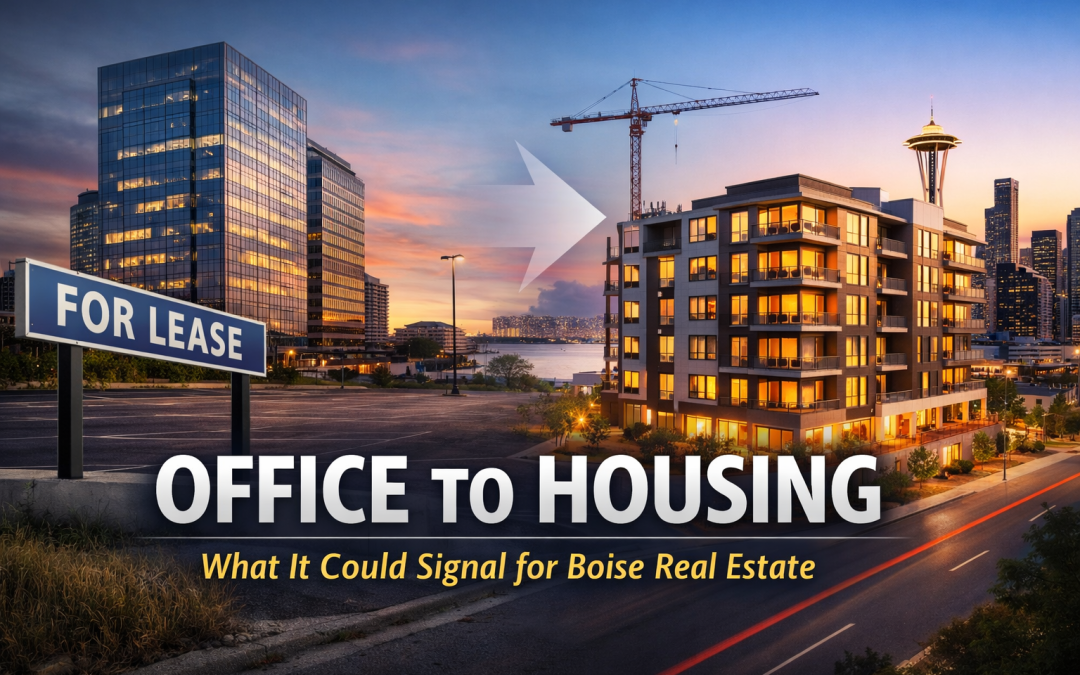
Office to Housing: What a Seattle Redevelopment Trend Could Signal for Boise Commercial Real Estate
Across the country, real estate markets are adjusting to a new reality. Office demand has softened in many downtowns, while housing shortages continue to push developers toward new solutions.
One recent project in Seattle shows how quickly that shift is happening — and why investors watching Boise commercial real estate should pay attention.
According to reporting by Randyl Drummer in CoStar News (read the original report here: https://product.costar.com/home/news/1352153372), developers are planning to build a luxury apartment building on a foreclosed parking lot in Seattle’s Uptown district. The project highlights how land once tied to office properties is being repositioned for housing as market demand evolves.
While the story is centered in Seattle, the underlying trend is relevant to fast-growing markets like the Treasure Valley.
From Office Assets to Residential Development
The planned project will bring a 10-story apartment building with 189 units to a site previously used as a parking lot.
Developers JPI and Stream acquired the property for about $7.8 million, roughly half of its assessed value. The site had been tied to financial challenges involving properties once owned by Martin Selig Real Estate, a longtime Seattle office landlord.
The change in ownership reflects larger pressures affecting many urban office markets.
Seattle’s downtown office sector has struggled since the pandemic, with vacancy levels reaching record highs. As office demand weakened, several properties tied to office portfolios entered foreclosure or were sold at discounted prices.
That shift has created opportunities for developers to rethink how land in dense urban areas is used.
Why Housing Is Becoming the Priority
Instead of another office tower, the Seattle project will focus on residential units — including larger apartments designed for families.
Key features of the planned development include:
- 189 apartments in a high-rise building
- A mix of unit sizes, including two- and three-bedroom layouts
- A design that takes advantage of hillside views toward Elliott Bay and the downtown skyline
The site sits within the Uptown area of Seattle’s Queen Anne neighborhood, a location that has seen significant apartment development in recent years.
Even with new construction adding more than a thousand units nearby, apartment vacancy in the area remains relatively modest compared with the broader regional average.
That continued demand for housing is one reason developers remain bullish on residential projects in the neighborhood.
A National Real Estate Trend Taking Shape
The Seattle redevelopment reflects a broader shift happening across many U.S. cities.
Developers are increasingly converting or repositioning sites tied to underperforming office properties into housing or mixed-use projects.
Several factors are driving the trend:
Changing office demand
Hybrid work has reduced the need for traditional office space in many downtown districts.
Persistent housing shortages
Cities across the country are struggling to add enough residential units to keep up with population growth.
Lower land acquisition costs
Financial distress among some office owners has created opportunities to purchase properties below prior valuations.
In markets where residential demand remains strong, developers see an opportunity to reposition assets toward housing.
What This Could Mean for Boise Development
Seattle and Boise have very different real estate markets, but the underlying dynamics offer useful signals.
The Boise commercial real estate market has remained healthier than many coastal cities when it comes to office demand. However, population growth in the Treasure Valley continues to create strong housing demand.
If office markets soften in the future, similar redevelopment strategies could emerge locally.
Potential opportunities could include:
- Repositioning underutilized commercial sites for residential development
- Converting office buildings to mixed-use or housing
- Redeveloping excess parking areas into higher-density projects
Boise’s growth pattern is already encouraging more urban housing near employment centers and entertainment districts.
Local Insight: Land Flexibility Will Shape the Next Development Cycle
For developers and investors watching Boise development, the bigger takeaway isn’t just about apartments.
It’s about flexibility.
Real estate markets evolve quickly. Sites that once supported office or parking uses may become far more valuable when repositioned for housing or mixed-use development.
As the Treasure Valley continues to grow, adaptable land use will likely play a bigger role in shaping the next wave of projects.
In many ways, the Seattle redevelopment shows how developers respond when markets shift — something every real estate investor should watch closely.
Mike Gioioso (joy-OH-so) has for 16+ years been helping companies of all sizes buy, build, and lease perfect places for business in greater Boise, Idaho and beyond. www.streetsmartidaho.com mike@streetsmartidaho.com 208-209-9166
Tags: #Boisecommercialrealestate, #Boisedevelopment, #TreasureValleyrealestate, #Idahocommercialrealestate, #officetoresidentialconversion, #multifamilydevelopment, #apartmentdevelopment, #housingdemandtrends, #commercialrealestatetrends, #officemarkettrends, #urbanredevelopment, #realestateinvestmenttrends