
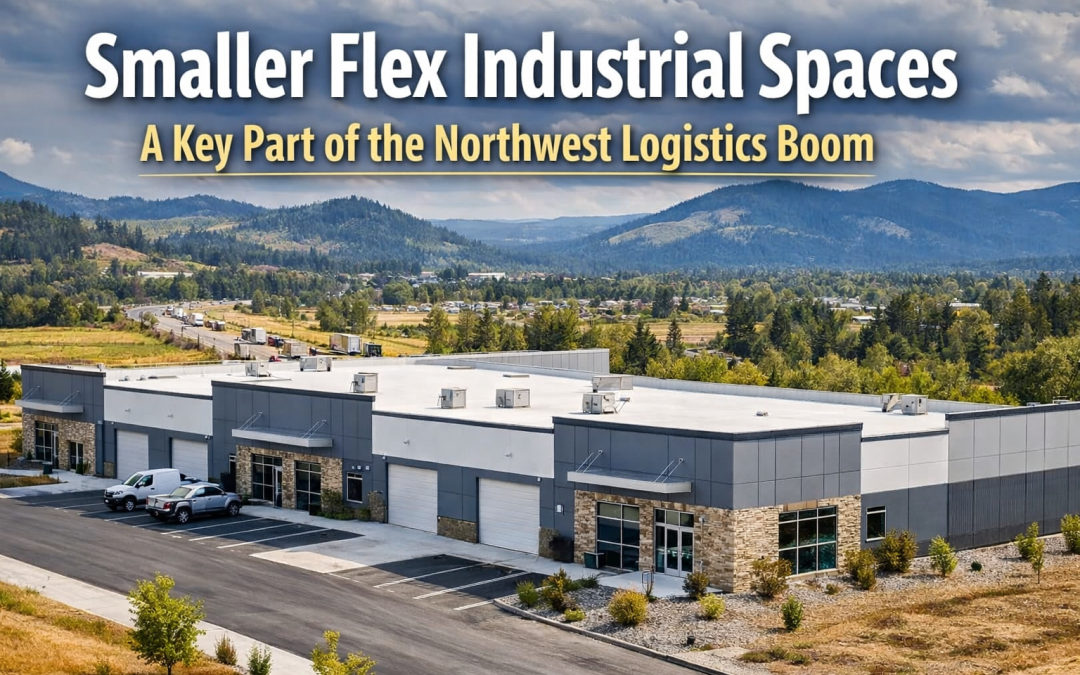
Smaller Industrial Flex Spaces Are Emerging as a Key Piece of the Northwest Logistics Network
Industrial real estate headlines often focus on massive distribution centers and million-square-foot warehouses. But a quieter trend is reshaping the logistics landscape across the Northwest.
Smaller industrial and flex buildings are becoming just as important.
According to reporting by Alexander Fairlie and Madeleine D’Angelo of CoStar Research (read the original article here: https://product.costar.com/home/news/1537189532), a recently completed flex warehouse development in Spokane Valley is helping meet growing demand for smaller, modern industrial spaces tied to the expanding Washington–Idaho logistics corridor.
While the project itself sits in Washington, the forces driving it are closely connected to the same economic trends shaping Boise commercial real estate and the broader Inland Northwest industrial market.
What’s Changing in the Industrial Market
Large warehouse buildings remain essential for regional distribution. But not every company needs hundreds of thousands of square feet.
Across the Northwest, a growing number of businesses are searching for smaller, modern industrial spaces that combine warehouse, light manufacturing, and office functions.
The Spokane Valley project — known as Bigfoot Flex — was designed specifically for that demand.
Key details from the CoStar report include:
- Approximately 35,100 square feet of flex industrial space
- Located along Barker Road in Spokane Valley
- Built on just over 10 acres of land
- 18-foot clear heights suitable for small-to-mid-size warehouse users
- Completed in about seven months
- Designed with both office and warehouse components
Developers created the project to serve smaller companies that still require professional-grade industrial facilities.
These tenants often include contractors, manufacturers, service providers, and regional distribution firms.
Why Location Still Matters in Logistics
One of the biggest drivers behind the project is transportation infrastructure.
The warehouse sits near key freight corridors connecting eastern Washington and northern Idaho. Improvements around the Sullivan Road and Trent Avenue interchange have made the area easier for trucks and freight traffic to access.
Those upgrades strengthen the broader logistics network linking several fast-growing regional markets, including:
- Spokane Valley
- Post Falls
- Rathdrum
- Coeur d’Alene
These cities form an important part of the Inland Northwest supply chain ecosystem.
As transportation connections improve, industrial development often follows.
The Rise of Smaller Industrial Users
Another reason projects like this are gaining attention is the growing number of small and mid-size companies entering the logistics economy.
These businesses may not require massive warehouse buildings, but they still need efficient space that supports shipping, storage, and light production.
Typical users of flex industrial buildings include:
- Construction companies
- Specialty manufacturers
- Regional distributors
- E-commerce fulfillment businesses
- Equipment and service providers
Because these companies often expand gradually, flex space offers a scalable solution.
Developers are increasingly building this type of product to meet demand from smaller tenants who want modern facilities but cannot justify leasing huge warehouses.
What This Means for Boise Industrial Real Estate
From a Boise commercial real estate perspective, the trend toward smaller industrial buildings is extremely relevant.
The Treasure Valley has experienced strong demand for warehouse and industrial space, especially from companies tied to logistics, manufacturing, and construction.
However, much of the recent development has focused on large distribution buildings.
The Spokane project highlights a growing opportunity for flex industrial properties designed for smaller tenants.
That type of space could become increasingly valuable in Boise as:
- Small manufacturing companies expand
- Contractors and service providers grow
- E-commerce businesses need localized fulfillment space
- Startups move from garages to commercial facilities
Developers who build flexible industrial buildings with office components may find strong demand from these users.
My Take: Flex Industrial Could Be the Next Opportunity in Boise
In the Boise commercial real estate market, industrial demand has been one of the strongest sectors over the past several years.
But the next phase of that growth may look slightly different.
Instead of focusing only on massive distribution warehouses, developers may begin targeting smaller flex industrial projects that serve local and regional businesses.
These buildings tend to lease quickly because they appeal to a wide range of tenants.
As Boise’s economy continues diversifying — especially with growth in construction, technology, and manufacturing — demand for flexible industrial space could increase significantly.
Projects like the one in Spokane Valley provide a preview of what the next wave of industrial development in the Inland Northwest might look like.
Mike Gioioso (joy-OH-so) has for 16+ years been helping companies of all sizes buy, build, and lease perfect places for business in greater Boise, Idaho and beyond.
www.streetsmartidaho.com mike@streetsmartidaho.com 208-209-9166
Tags: #Boisecommercialrealestate, #Boiseindustrialrealestate, #flexindustrialspace, #TreasureValleyindustrialmarket, #Boisewarehousedevelopment, #Boiselogisticsrealestate, #InlandNorthwestindustrialmarket, #industrialrealestatetrends, #warehouseleasingBoise, #Boisedevelopment