
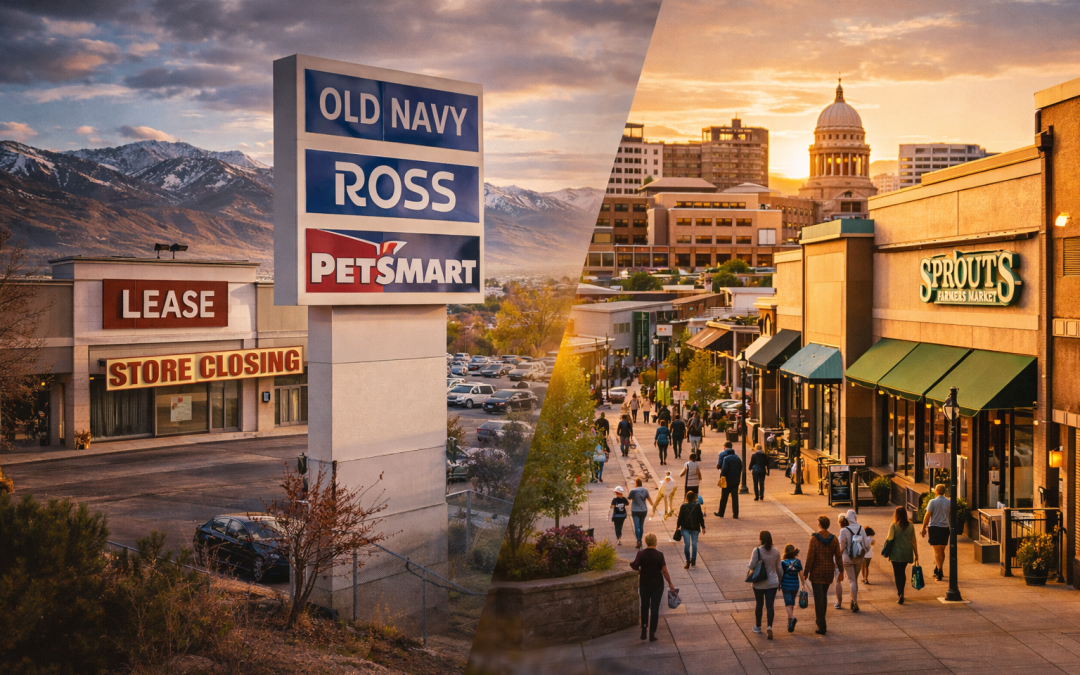
Slower Retail Leasing in Salt Lake City May Offer Clues for Boise Commercial Real Estate
Retail leasing activity doesn’t always move in straight lines. Even in growing Western markets, periods of slower deal-making can appear when economic uncertainty rises.
That appears to be happening in one of Boise’s closest regional competitors.
According to reporting and analysis by John Gillem of CoStar Analytics (you can read the original article here: https://product.costar.com/home/news/1005983824), retail leasing activity in the Salt Lake City market slowed noticeably toward the end of 2025, even though the region continues to experience strong population growth.
For professionals watching Boise commercial real estate, shifts in nearby Western markets often provide early signals about where leasing trends may be headed next.
Fewer Retail Deals Signed in Late 2025
New lease data shows that tenant activity declined during the fourth quarter of 2025 compared with historic averages.
Recent leasing statistics highlight several key changes:
- Roughly 260,000 square feet of new retail leases were signed during the fourth quarter
- That volume represents about a quarter less than the typical quarterly average before the pandemic
- The third quarter posted about 295,000 square feet of leasing activity
Combined, the second half of 2025 saw a little more than 550,000 square feet of new retail leasing.
Another notable shift was the number of deals completed. During the fourth quarter, retailers signed about 66 leases, compared with an average closer to 90 deals per quarter during the years leading up to the pandemic.
In short, tenants are still leasing space — just not at the same pace.
Retailers Are Still Taking Similar-Sized Spaces
Even though the number of deals declined, the average size of retail spaces leased has remained relatively stable.
Recent transactions averaged roughly 3,700 to 3,900 square feet, which is only slightly below the roughly 4,000 square foot average seen in earlier years.
That stability suggests retailers are not necessarily downsizing their concepts. Instead, many appear to be delaying expansion decisions or moving more cautiously with new locations.
Industry analysts attribute this hesitation to a combination of economic uncertainty and limited availability of high-quality retail space in desirable locations.
Why Supply Constraints Are Still Supporting Retail Rents
Despite slower leasing velocity, the Salt Lake City retail market still shows strong fundamentals.
Retail availability in the region currently sits around 4.3%, which remains relatively low compared with national levels that are closer to 5%.
Several factors are helping keep vacancy levels tight:
- Limited new retail construction
- Demolition or redevelopment of older retail properties
- Pre-leasing activity in new suburban retail centers
Many new neighborhood retail projects are already partially leased before construction finishes, particularly in rapidly growing suburban areas.
That dynamic is keeping competition for quality retail space relatively strong.
What This Could Mean for Boise Development
From a Boise commercial real estate perspective, the Salt Lake City market often serves as a useful comparison.
Both metro areas share several characteristics:
- strong population growth
- expanding suburban development
- rising demand for neighborhood retail centers
When leasing slows in one fast-growing Western market, it can sometimes signal broader caution among retailers.
However, the underlying trend remains positive: retailers still need space in growing communities.
For Boise, the most likely outcome may be more selective tenant expansion rather than a full slowdown in retail leasing.
Local Insight: Boise Retail Demand Is Still Driven by Growth
The Treasure Valley continues to attract new residents and businesses at a steady pace. Population growth remains one of the biggest drivers of retail leasing in Boise and surrounding cities like Meridian and Nampa.
That growth creates demand for everyday services such as restaurants, grocery stores, fitness studios, and neighborhood retail.
At the same time, national economic uncertainty can cause retailers to slow expansion temporarily.
For investors and landlords in Boise commercial real estate, that means focusing on:
- strong suburban growth corridors
- mixed-use retail environments
- well-located neighborhood centers
Those locations tend to attract tenants even during periods when leasing activity cools slightly.
Mike Gioioso (joy-OH-so) has for 16+ years been helping companies of all sizes buy, build, and lease perfect places for business in greater Boise, Idaho and beyond.
www.streetsmartidaho.com
mike@streetsmartidaho.com
208-209-9166
Tags: #boisecommercialrealestate, #boiseretailleasing, #boisedevelopment, #treasurevalleyretailmarket, #boiseinvestmentproperty, #boiseretailrealestate, #saltlakecityretailmarket, #mountainwestretailtrends, #westerncommercialrealestate, #retailleasingtrends, #suburbanretaildevelopment, #boiseeconomicgrowth, #treasurevalleydevelopment, #boisepopulationgrowth, #retailrealestatetrends