
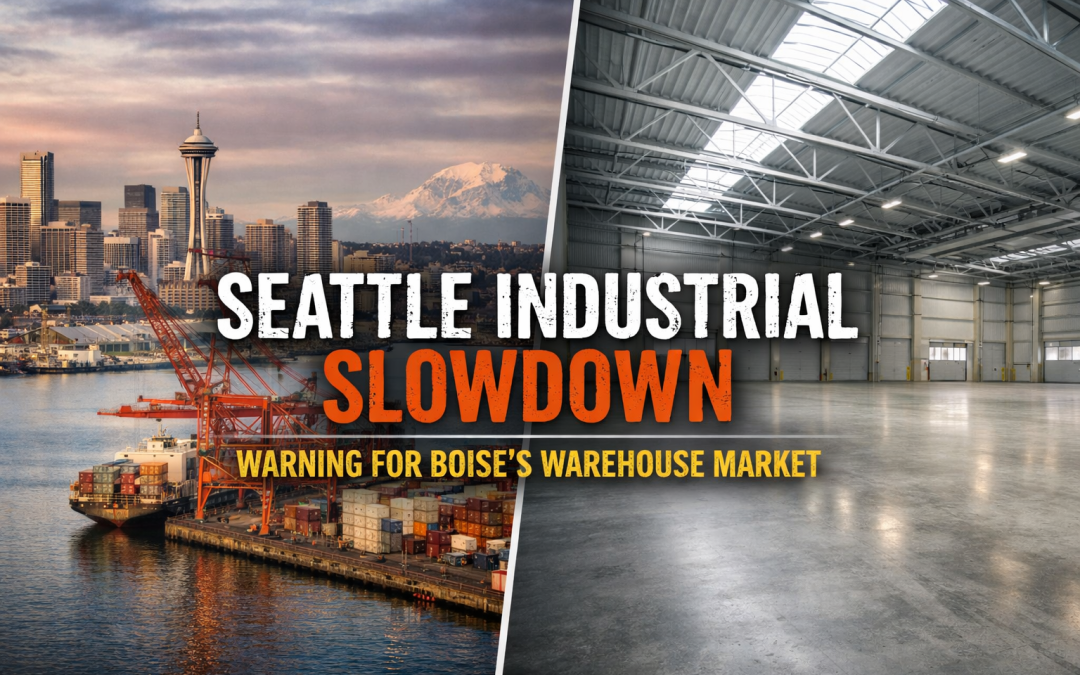
Seattle’s Industrial Slowdown Could Offer a Warning for Boise’s Warehouse Market
Industrial real estate has been one of the strongest sectors in commercial property over the past decade. Warehouses, distribution centers, and logistics facilities expanded rapidly as e-commerce and global trade surged.
But when supply grows faster than demand, even strong markets can cool.
According to reporting by Elliott Krivenko published by CoStar Group (read the original report here: https://product.costar.com/home/news/130551166), the Puget Sound industrial market has recently posted some of the weakest demand figures among major U.S. cities.
The shift highlights how quickly industrial real estate cycles can change—and why investors and developers in Boise commercial real estate should pay attention.
Industrial Demand in Seattle Has Reversed
For the past year, Seattle’s industrial sector has seen occupancy decline rather than grow.
Key data points from the CoStar report include:
- About 3.6 million square feet of industrial space lost tenants over the past year
- Among hundreds of tracked markets, Seattle ranked last for net absorption
- More than 45 million square feet of industrial space is currently available
- Over 6 million square feet of that space is being offered for sublease
In simple terms, more companies have moved out of industrial space than have moved in.
That imbalance is pushing vacancy higher and putting pressure on landlords.
The Supply Boom That Changed the Market
One of the biggest reasons behind the slowdown is the large wave of construction completed over the past several years.
Developers added roughly thirty-plus million square feet of new industrial inventory in the region over about five years.
That expansion increased the region’s warehouse supply by roughly nine percent, the fastest growth the area has seen in decades.
When new buildings arrive faster than tenants expand, available space rises quickly.
This is a classic real estate cycle: development surges when demand is strong, but the new inventory sometimes arrives just as demand begins to cool.
Trade Activity Is Also Slowing
Seattle’s industrial market is closely tied to global shipping and port logistics.
The Northwest Seaport Alliance has reported declining import container volumes over the past year.
Lower trade activity means:
- fewer goods moving through ports
- less need for storage and distribution space
- weaker demand for nearby warehouses
Because many industrial buildings in the Puget Sound area serve import-related logistics, the slowdown in port activity has rippled into the real estate market.
How Other Industrial Markets Compare
While Seattle is seeing negative absorption, several other U.S. logistics markets continue to grow.
Examples cited in the report include:
- Dallas-Fort Worth adding roughly twenty-plus million square feet of occupied space
- Phoenix gaining nearly twenty million square feet
- Houston posting strong warehouse demand
- Indianapolis also seeing major growth
These markets benefit from strong population growth, distribution networks, and large logistics hubs.
What This Means for Boise Commercial Real Estate
Although Boise is much smaller than Seattle, the trends are still relevant.
Industrial development has been a major story across Boise commercial real estate over the past decade.
The Treasure Valley has added:
- new distribution facilities
- modern logistics parks
- manufacturing and flex space
Many of these projects were driven by strong demand during the e-commerce boom.
Seattle’s situation shows what can happen when construction accelerates faster than tenant growth.
Local Market Impact for Boise’s Industrial Sector
Several lessons from the Puget Sound market apply to Boise.
Demand Still Favors New Buildings
Tenants increasingly prefer modern logistics facilities with higher ceilings, better loading capacity, and advanced distribution features.
Older warehouses may struggle if too much newer inventory hits the market.
Supply Waves Can Create Temporary Vacancy
Even in healthy economies, large construction cycles can push vacancy rates higher for a few years.
This doesn’t necessarily signal long-term weakness—but it does create short-term pressure on rents.
Economic Drivers Matter
Seattle’s slowdown is tied partly to shipping and trade volumes.
Boise’s industrial demand, by contrast, is driven more by regional distribution, population growth, and manufacturing.
That difference could help Boise avoid some of the volatility seen in port-dependent markets.
My Take: Industrial Real Estate Cycles Are Normal
Industrial property has been one of the most resilient sectors in commercial real estate.
But no market grows forever without pauses.
Seattle’s recent slowdown shows how large supply waves combined with softer demand can temporarily shift market momentum.
For investors and developers in Boise, the key takeaway is balance.
When development stays aligned with tenant demand, industrial markets remain healthy.
When supply gets ahead of leasing activity, vacancy can rise quickly—even in strong regional economies.
Watching these trends in larger markets can offer useful clues about what might happen next in Boise development and industrial real estate.
Mike Gioioso (joy-OH-so) has for 16+ years been helping companies of all sizes buy, build, and lease perfect places for business in greater Boise, Idaho and beyond. www.streetsmartidaho.com mike@streetsmartidaho.com 208-209-9166
Tags: #Boisecommercialrealestate, #Boisedevelopment, #Idahoindustrialrealestate, #industrialvacancyrates, #warehousedemand, #logisticsrealestate, #industrialdevelopment, #industrialsupplygrowth