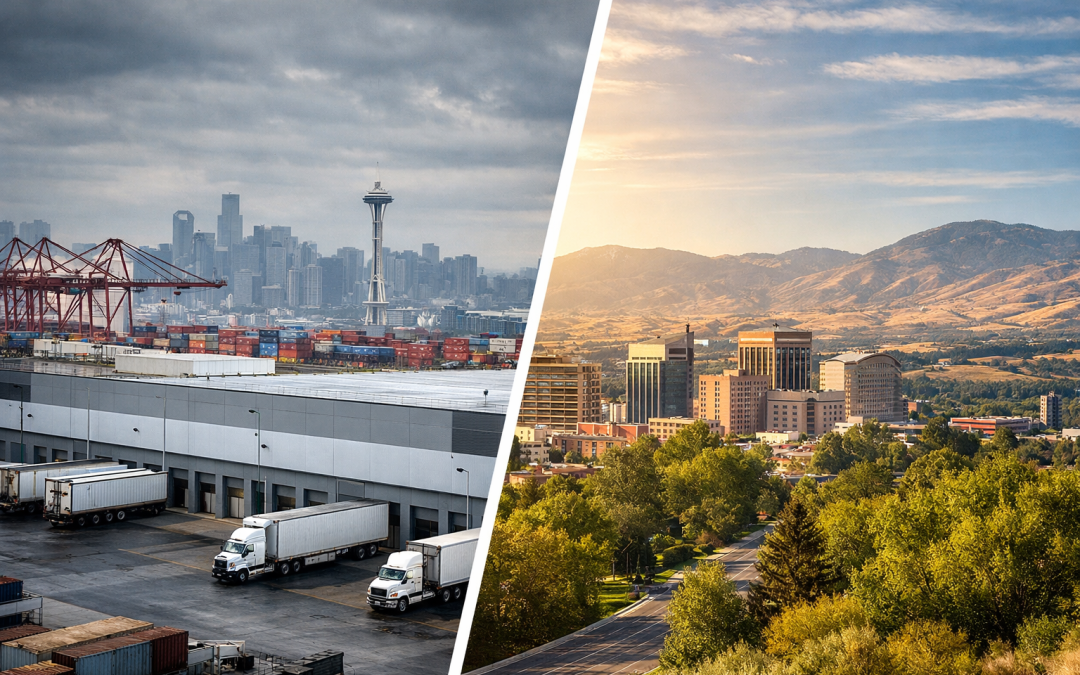
Seattle’s Industrial Slowdown Offers a Lesson for Boise Commercial Real Estate
Industrial real estate has been one of the hottest property sectors in the country for years.
Warehouses, logistics hubs, and distribution centers expanded rapidly as e-commerce grew and supply chains evolved.
But when construction moves faster than tenant demand, even strong markets can slow down.
A recent development proposal near Seattle highlights exactly how quickly that balance can shift — and why investors watching Boise commercial real estate should pay attention.
According to reporting by CoStar News (read the original article here: https://product.costar.com/home/news/1409883755), a developer is planning nearly one million square feet of new warehouse space at the former Weyerhaeuser headquarters campus in Federal Way, south of Seattle.
The proposal comes at a time when the region’s industrial market is already facing rising vacancies and weaker leasing demand.
What’s Happening in the Seattle Industrial Market
The redevelopment project is taking shape at a large corporate campus once used by Weyerhaeuser.
A California-based developer, Industrial Realty Group, purchased the 425-acre property several years ago and has been gradually repositioning it as an industrial and business park now called Woodbridge Corporate Park.
The latest proposal includes three warehouse buildings totaling more than 971,000 square feet.
Planned building sizes include:
- About 605,000 square feet
- Roughly 240,000 square feet
- Around 125,000 square feet
The site sits near Interstate corridors south of Seattle, a location that has long been attractive for logistics operations.
But the project is arriving at a time when the broader regional industrial market is cooling.
Rising Vacancies After a Construction Boom
Seattle’s industrial sector saw an enormous surge of new development during the past few years.
Developers rushed to build warehouses as e-commerce companies expanded distribution networks.
But demand has recently slowed.
According to CoStar market data cited in the report:
- Industrial vacancy has increased to about 10%
- A year earlier it was closer to 6.6%
- Most recent leases have been 50,000 square feet or smaller
That leasing pattern suggests many companies are taking smaller spaces rather than large fulfillment centers.
Even at Woodbridge Corporate Park, not all newly built space has filled yet.
One of the two warehouse buildings completed in 2023 remains vacant.
The larger building found a tenant when Amazon signed a lease for a fulfillment center in 2024.
Meanwhile, the original corporate headquarters building on the campus has remained unused since Weyerhaeuser relocated its offices years ago.
Why Developers Are Still Expanding
Despite the softer leasing environment, Industrial Realty Group continues to pursue additional development on the site.
Part of the strategy is long-term repositioning.
The company has already invested millions upgrading infrastructure at the campus, including:
- New sidewalks
- Updated lighting
- Landscaping improvements
- Bike lanes and pedestrian access
The goal is to transform the former headquarters property into a multi-tenant employment center anchored by industrial users.
Local officials recently determined the project would likely not create major environmental impacts, allowing the proposal to move forward through the approval process.
Why Boise Investors Should Pay Attention
At first glance, a warehouse project near Seattle might not seem connected to Boise commercial real estate.
But markets across the West are often influenced by the same economic forces.
Seattle’s slowdown offers a useful reminder about the industrial development cycle.
Industrial growth can move in waves
During periods of strong demand, developers build aggressively. If too many projects arrive at once, vacancy can rise quickly.
Tenant needs evolve
Recent leasing trends show more companies choosing smaller distribution spaces, which could reshape building design and site selection.
E-commerce demand remains strong — but uneven
Large tenants like Amazon still anchor many industrial projects, but not every new building will find a tenant immediately.
Local Insight: What This Means for Boise Development
From a Boise commercial real estate perspective, the Seattle situation offers an important lesson.
The Treasure Valley has experienced its own wave of industrial development as companies expand logistics operations across the Intermountain West.
Boise benefits from several advantages:
- Lower costs compared with coastal markets
- Strong population growth
- Strategic location for regional distribution
But developers here should still watch supply carefully.
When warehouse construction accelerates too quickly, vacancies can rise — even in fast-growing markets.
Industrial real estate will likely remain a major driver of Boise development, especially as supply chains continue shifting inland.
The key will be balancing new construction with realistic expectations for tenant demand.
Mike Gioioso (joy-OH-so) has for 16+ years been helping companies of all sizes buy, build, and lease perfect places for business in greater Boise, Idaho and beyond. www.streetsmartidaho.com mike@streetsmartidaho.com 208-209-9166
Tags: #Boisecommercialrealestate, #Boiseindustrialrealestate, #Boisedevelopment, #Boisewarehousemarket, #TreasureValleyindustrialmarket, #Seattleindustrialrealestate, #warehousedevelopment, #logisticsrealestate, #industrialvacancyrate, #distributioncenters, #Boiseinvestmentproperty, #TreasureValleygrowth, #industrialleasingBoise, #commercialrealestatetrends