
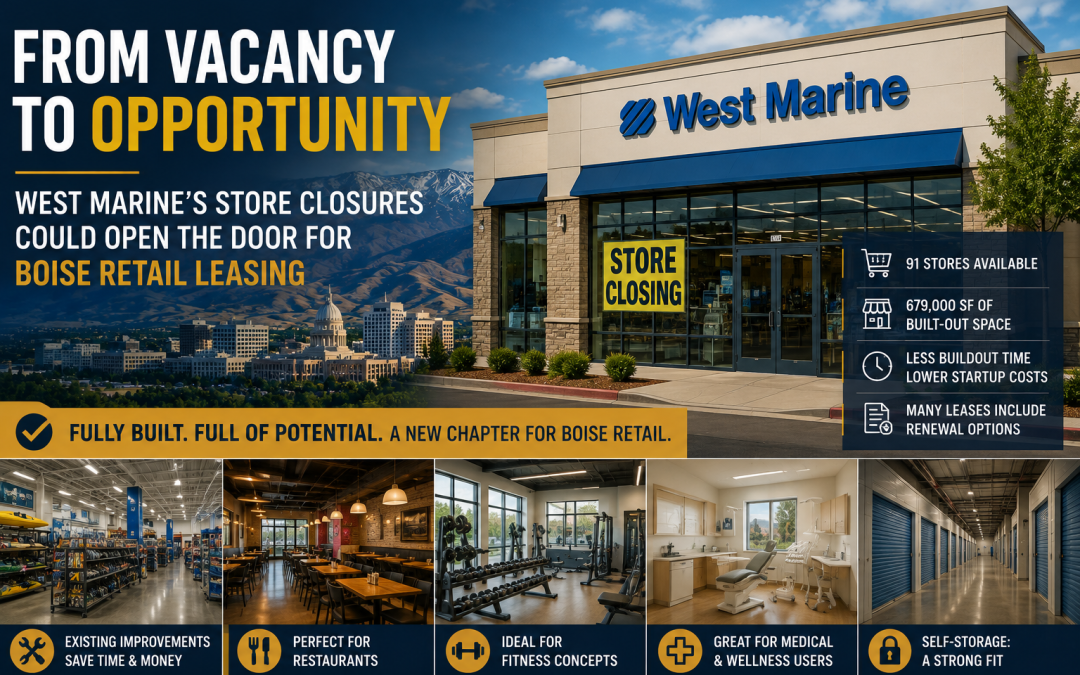
West Marine’s Store Closures Highlight a Bigger Opportunity for Boise Retail Leasing
A retailer closing dozens of stores sounds like bad news for commercial real estate.
For some landlords, it certainly is.
But retail bankruptcies can also put something valuable back into the market: fully built-out commercial space that another tenant can occupy much faster and potentially much cheaper than starting from scratch.
That is exactly what is happening as boating and fishing retailer West Marine restructures its national store portfolio.
According to reporting by Mark Heschmeyer of CoStar News, West Marine is seeking to exit or transfer leases covering 91 stores and approximately 679,000 square feet across the United States as part of its Chapter 11 bankruptcy proceedings.
You can read the original CoStar News article here: https://product.costar.com/home/news/427303933
The situation provides two important lessons for Boise commercial real estate.
For landlords, it demonstrates what can happen when occupancy costs become disconnected from a tenant’s business performance.
For expanding retailers, it shows why second-generation space can create some of the best opportunities in a challenging construction environment.
Retailers Are Paying Much More Attention to Occupancy Costs
West Marine operates roughly 200 locations nationwide, but its large real estate portfolio became a financial problem as the company’s performance weakened.
According to court information cited by CoStar, West Marine was responsible for more than $50 million in annual rent across its store network.
The company also entered bankruptcy with approximately $166.7 million of future lease commitments.
Those are significant obligations.
And they highlight something every retail landlord should remember:
A lease is only valuable if the tenant can afford it.
Landlords naturally want to maximize rent.
But the highest possible rent isn’t always the best long-term deal.
Retail tenants also have payroll, inventory, utilities, insurance, marketing, debt payments, and other operating expenses.
Eventually, everything comes back to sales.
If a retailer can’t generate enough revenue from a location to support its occupancy cost, the real estate becomes part of the problem.
West Marine said some of its leases were negotiated during stronger market conditions and became increasingly difficult to modify as the company’s circumstances changed.
Chapter 11 provides a mechanism for the retailer to restructure those obligations.
For Boise retail landlords, the lesson isn’t that long-term leases are bad.
Quite the opposite.
Long-term leases can create stable cash flow and improve property value.
But rent still needs to make sense relative to what a tenant can realistically produce from the location.
Second-Generation Retail Space Is Becoming More Valuable
There’s another side to West Marine’s restructuring.
Ninety-one existing stores are now potentially available to other retailers.
These aren’t vacant dirt parcels waiting for a developer.
Many are already functioning retail spaces.
That matters because opening a new store has become expensive.
Construction costs remain elevated.
Tenant improvement allowances can be significant.
Permitting takes time.
Mechanical equipment can be expensive.
Electrical upgrades may be required.
And a retailer starting with a shell building may spend months designing and constructing its location before making its first sale.
A second-generation space can change that equation.
Depending on the previous use, an incoming tenant may inherit useful improvements such as:
- HVAC systems
- Electrical infrastructure
- Restrooms
- Lighting
- Finished ceilings
- Flooring
- Storefronts
- Loading areas
- Stockrooms
- Parking
- Signage infrastructure
Not every improvement will work for the next tenant.
But reusing even part of the existing buildout can reduce the cost and time required to open.
That’s increasingly important for retail leasing in Boise.
When I’m evaluating space for a tenant, the quoted rental rate is only one part of the economics.
The real question is:
What will it cost the tenant to actually open the doors?
A $30-per-square-foot space requiring a massive buildout can sometimes be more expensive than a $35-per-square-foot space that already contains much of what the tenant needs.
That’s why second-generation real estate deserves attention.
Existing Buildouts Can Create Leasing Opportunities
West Marine’s available portfolio spans 28 states and includes a wide variety of property types and sizes.
Some stores are standalone buildings.
Others are located in shopping centers.
The smallest locations are only a few thousand square feet, while the largest approach 24,000 square feet.
More than 50 of the available leases reportedly include extension rights, potentially allowing replacement tenants to remain beyond the existing expiration dates.
That flexibility makes the portfolio more interesting.
But the broader trend matters more than these specific stores.
Retail restructuring regularly puts specialized commercial spaces back onto the market.
A former restaurant might be attractive to another restaurant because it already has a hood, grease interceptor, kitchen infrastructure, and upgraded electrical service.
A former fitness center may appeal to another gym because of its open floorplan, showers, and locker rooms.
A former grocery store might work for an international market or entertainment concept.
A former big-box retailer could become medical space, fitness, furniture, entertainment, or another large-format use.
The building’s previous investment can become part of the next tenant’s opportunity.
Why This Matters for Boise Retail Leasing
The Treasure Valley continues attracting new retail concepts.
But every expanding retailer has to solve the same basic equation:
Sales must justify occupancy costs and startup investment.
That’s becoming increasingly important as construction costs rise.
Suppose a tenant is considering two Boise locations.
One is a brand-new shell.
The other is a former retail location with much of the infrastructure already installed.
The shell might have better visibility or slightly lower rent.
But if the tenant needs to invest hundreds of thousands of additional dollars before opening, the second-generation space could produce a much better return.
Speed also matters.
A retailer that can open in three months rather than nine months gets six additional months of potential revenue.
That can be significant.
For landlords, this creates an opportunity as well.
Preserving useful tenant improvements after a vacancy can sometimes make a property more marketable.
Automatically demolishing everything isn’t always the best strategy.
The next tenant may value what the previous tenant left behind.
Local Insight: Rent Isn’t the Only Number That Matters
Commercial real estate conversations tend to focus heavily on rental rates.
What’s the asking rent?
What’s the effective rent?
How much are the annual increases?
Those numbers matter.
But sophisticated tenants increasingly evaluate total occupancy cost.
That includes rent plus common area charges, taxes, insurance, utilities, maintenance, and the capital required to build the space.
Then they compare that number with expected store sales.
That’s the calculation landlords should understand, too.
A tenant paying slightly less rent but operating a healthy, profitable store for 10 years may create more value than a tenant paying an aggressive rate and failing after three.
West Marine’s restructuring is an extreme example, but it illustrates the same principle.
Real estate costs can become a competitive disadvantage when they aren’t supported by store economics.
For Boise commercial real estate owners, sustainable rent growth is generally more valuable than rent growth that eventually forces tenants out.
Retail Bankruptcies Can Create Opportunity for New Concepts
There’s another reason to watch national retail restructurings.
They redistribute real estate.
When a large chain closes stores, those locations don’t disappear.
They return to the market.
That can create openings for:
- Regional retailers
- Restaurants
- Fitness concepts
- Medical users
- Entertainment businesses
- Specialty grocers
- Furniture stores
- Home improvement concepts
- Local businesses
- Expanding franchise operators
In markets with limited retail vacancy, a bankruptcy can create rare access to locations that otherwise wouldn’t become available.
That appears to be part of the appeal of the West Marine portfolio.
Some of its stores operate in markets where comparable retail space is difficult to find.
For expanding tenants, that scarcity can make an existing lease assignment particularly attractive.
The same dynamic can occur in Boise retail real estate.
Highly visible spaces at strong intersections don’t come available frequently.
When they do, tenants need to evaluate them quickly.
What Boise Landlords and Tenants Should Take Away
West Marine’s restructuring provides lessons for both sides of the lease.
For landlords, understand your tenant’s business.
A strong lease isn’t simply one with the highest rental rate. It’s one where the tenant has a realistic opportunity to remain profitable and continue paying rent.
For tenants, evaluate the entire occupancy equation.
Don’t choose a location based solely on asking rent.
Consider construction costs, existing improvements, operating expenses, visibility, demographics, access, parking, and how quickly the business can begin generating revenue.
And for investors, pay attention when large retailers restructure.
Vacant retail isn’t always distressed real estate.
Sometimes it’s recycled infrastructure.
A store that no longer works for one retailer can be an ideal location for another.
That’s particularly important in today’s development environment.
With construction costs elevated and new retail projects expensive to build, existing spaces with usable improvements can offer a meaningful head start.
For Boise commercial real estate, that could make second-generation space increasingly valuable as retailers look for ways to expand while controlling their upfront costs.
West Marine’s bankruptcy is ultimately a story about a retailer trying to reduce an unsustainable real estate burden.
But for the broader retail market, it is also a reminder that one tenant’s exit can create another tenant’s opportunity.
Mike Gioioso (joy-OH-so) has for 16+ years been helping companies of all sizes buy, build, and lease perfect places for business in greater Boise, Idaho and beyond.
www.streetsmartidaho.com mike@streetsmartidaho.com 208-209-9166
Tags: #boisecommercialrealestate, #boiseretailleasing, #retailleasingboise, #boiseretailrealestate, #secondgenerationretailspace, #boiseretailspace, #boisecommercialleasing, #treasurevalleyretail, #retailtenantimprovements, #boiseshoppingcenters, #retailvacancyboise, #retaildevelopmentboise, #boisedevelopment, #commercialpropertyinvestment, #retailleasecosts