What a Seattle Theme Park Redevelopment Reveals About the Growing Demand for Industrial Real Estate
Sometimes the most valuable land isn’t being used for its highest-value purpose.
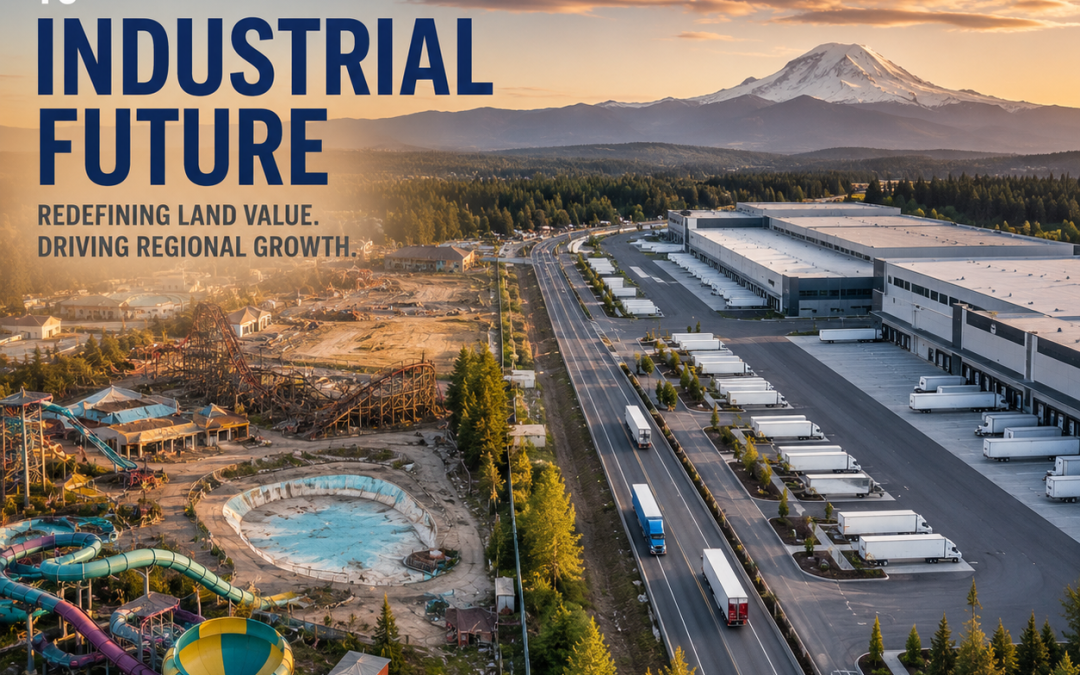
That appears to be the case with a well-known Seattle-area attraction that may soon make way for a massive industrial development.
According to reporting by Randyl Drummer of CoStar News, industrial developer Panattoni has filed plans to redevelop the Wild Waves Theme & Water Park site in Federal Way, Washington, into a warehouse project totaling approximately 1 million square feet. The original CoStar article can be found here:
https://product.costar.com/home/news/345103885
At first glance, the story may seem like a local Seattle redevelopment project.
But for Boise commercial real estate professionals, the proposed transformation highlights several larger trends involving land use, industrial demand, redevelopment opportunities, and the changing economics of commercial property ownership.
When Land Becomes More Valuable Than the Existing Business
One of the most interesting aspects of the proposed redevelopment is what it says about land value.
Wild Waves has operated for decades and remains Washington’s only water and theme park. Yet rising operating costs and pandemic-related financial challenges reportedly contributed to the decision to close after the 2026 season.
Meanwhile, developers continue searching for large sites near transportation corridors that can support modern logistics facilities.
The Wild Waves property offers exactly that.
Located near Interstate 5 on more than 66 acres, the site provides the scale, access, and visibility industrial developers often seek.
This highlights a reality seen across many markets:
Sometimes the underlying real estate becomes more valuable than the business operating on it.
Key Facts
- Wild Waves is expected to close after the 2026 season
- Panattoni plans approximately 1 million square feet of warehouse space
- The project would occupy roughly 66 acres
- The site sits near Interstate 5 in Federal Way
- Construction could be completed by 2028
- No tenant has yet been announced
Industrial Demand Is Changing, Not Disappearing
One surprising aspect of the story is that the proposal comes during a period of rising industrial vacancy in the Seattle region.
According to CoStar data cited in the report, industrial vacancy in the Puget Sound market has climbed as developers delivered millions of square feet of new warehouse space over the past several years.
That may sound like a warning sign.
However, institutional developers continue planning projects.
Why?
Because commercial real estate development is often based on long-term expectations rather than short-term conditions.
Many developers believe today’s vacancy challenges may eventually be absorbed as population growth, e-commerce activity, manufacturing expansion, and supply-chain investments continue.
Large industrial projects typically require years of planning, permitting, and construction.
Developers are often looking several years ahead rather than reacting to current market conditions.
What This Means for Boise Industrial Real Estate
The Boise industrial market shares several characteristics with many Sun Belt and Western growth markets.
Population growth continues.
Business migration remains active.
Distribution, manufacturing, and logistics users continue evaluating Idaho as an alternative to more expensive coastal markets.
The Seattle story highlights a trend that Boise investors and developers should monitor closely:
Industrial users increasingly value well-located sites near major transportation corridors.
In Boise, that often means locations near Interstate 84, the Boise Airport area, Nampa’s industrial corridors, Caldwell’s logistics zones, and portions of Meridian that continue attracting business investment.
As developable land becomes more limited, redevelopment opportunities may become increasingly important.
Properties originally designed for one use may eventually be repositioned for another if market demand shifts significantly.
Redevelopment Is Becoming a Bigger Part of Commercial Real Estate
Across the country, many of the most interesting commercial real estate projects involve redevelopment rather than ground-up construction.
Older office campuses become industrial parks.
Retail centers become mixed-use developments.
Underutilized sites become distribution facilities.
The proposed Wild Waves redevelopment fits squarely within that trend.
Instead of expanding outward indefinitely, developers are increasingly looking at existing properties and asking a simple question:
Can this land generate more economic value through a different use?
That question is becoming increasingly relevant in many growing markets, including Boise.
Local Insight
The biggest takeaway from this story is not necessarily the warehouse itself.
It’s the changing economics of land.
As cities grow and transportation infrastructure becomes more important, large parcels with strategic locations become increasingly valuable.
For Boise commercial real estate investors, developers, and landowners, that trend creates both opportunities and challenges.
Some properties may see new redevelopment potential that did not exist a decade ago.
Others may face increasing competition from newer, more efficient projects.
The proposed transformation of a major entertainment property into a logistics facility demonstrates how quickly market demand can reshape land use decisions.
While Boise is not Seattle, many of the same forces influencing redevelopment, industrial growth, and land values are already shaping the future of commercial real estate throughout the Treasure Valley.
Mike Gioioso (joy-OH-so) has for 16+ years been helping companies of all sizes buy, build, and lease perfect places for business in greater Boise, Idaho and beyond.
www.streetsmartidaho.com mike@streetsmartidaho.com 208-209-9166
Tags: #boisecommercialrealestate, #industrialrealestate, #warehousedevelopment, #industrialdevelopment, #commercialrealestate, #boisedevelopment, #logisticsrealestate, #industrialproperty, #commercialproperty, #redevelopment, #landdevelopment, #industrialinvestment, #warehousespace, #supplychain, #economicdevelopment