
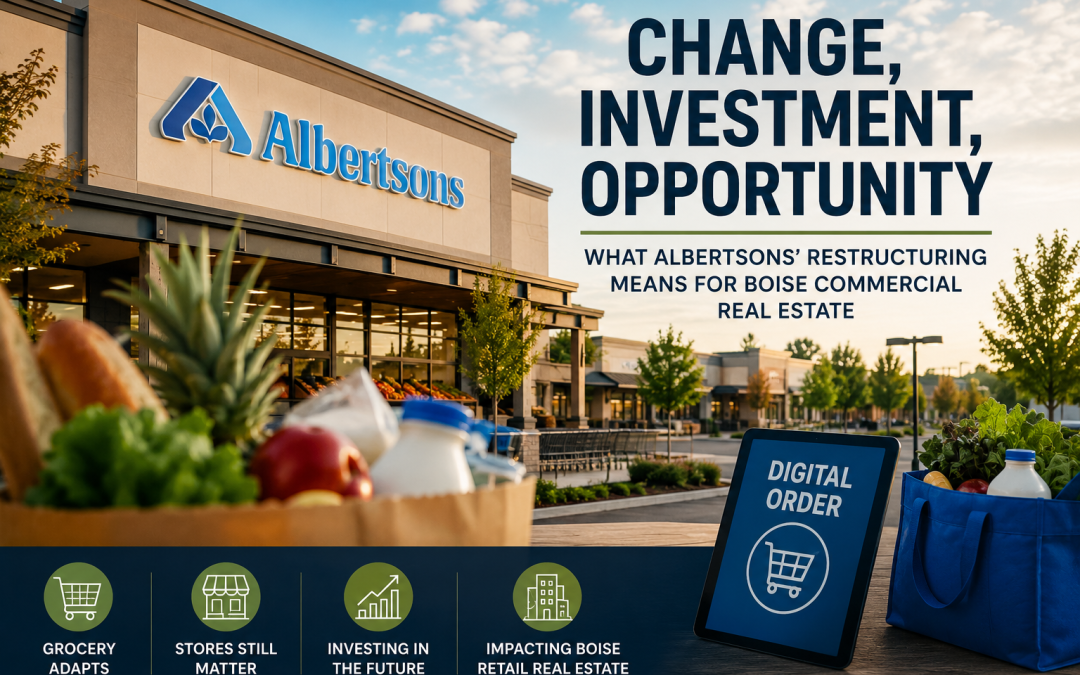
Albertsons Restructuring Offers a Bigger Lesson for Boise Commercial Real Estate
When one of Boise’s largest homegrown companies changes how it operates, the impact is worth watching beyond Wall Street.
Albertsons Companies is dealing with softer grocery performance while investing in digital sales, pharmacy, store improvements and a major restructuring of its operations. For Boise commercial real estate, the bigger question is what these moves tell us about the changing grocery business—and the retail properties built around it.
According to reporting by IBR Staff in the Idaho Business Review, Boise-based Albertsons reported weaker first-quarter grocery performance and reduced its financial expectations for fiscal 2026 while launching a restructuring program known as ACI Edge.
The original Idaho Business Review article is available here:
https://idahobusinessreview.com/2026/07/23/albertsons-cuts-outlook-launches-restructuring-boise/
The numbers show a retailer under pressure, but they also reveal where Albertsons believes future opportunities may exist.
Grocery Is Changing, Not Disappearing
Albertsons reported that identical sales declined 0.8% during the 16 weeks ending June 20.
Overall net sales were roughly $24.9 billion, up just 0.2%, with higher fuel sales helping the total. Net income declined from $236.4 million in the comparable period a year earlier to $84.7 million.
Management also lowered its expectations for the full fiscal year.
Albertsons now anticipates identical sales ranging from a 1.5% decline to a 0.5% decline. Its adjusted EBITDA forecast was reduced to between $3.55 billion and $3.625 billion, while projected adjusted earnings per share also moved lower.
Those figures deserve attention, but another number may be even more interesting for commercial real estate.
Digital sales increased 13%.
Pharmacy also continued growing.
That combination illustrates how grocery stores are becoming much more than places where shoppers push carts through aisles.
Today’s supermarket can function as a grocery store, pharmacy, prepared-food destination, pickup location, e-commerce fulfillment point and neighborhood service hub.
That evolution matters for retail leasing in Boise because grocery stores remain important anchors for shopping centers throughout the Treasure Valley.
Albertsons Is Trying to Operate More Like One Company
Albertsons’ response goes beyond cutting costs.
Its new ACI Edge program represents a significant operational restructuring.
The company plans to reorganize its 11 divisions into four larger regions while moving center-store merchandising into a centralized enterprise structure.
The goal is to simplify decision-making, strengthen relationships with suppliers and create greater consistency across its different grocery banners.
From a commercial real estate perspective, centralization is an interesting trend to watch.
Large retailers increasingly use detailed data to make decisions about locations, merchandising, customer behavior and capital investment. A more centralized organization could potentially make those decisions faster and more consistently.
For landlords and developers trying to attract major national or regional tenants, this is another reminder that site selection has become increasingly analytical.
Traffic still matters.
Visibility matters.
Access matters.
Population growth matters.
But retailers are also studying customer data, delivery patterns, digital orders, store productivity and how each location fits into a broader network.
That can influence where future stores are built—and which existing stores receive additional investment.
Store Investment Still Matters
One of the most important details in the Albertsons results may be easy to overlook.
The company spent approximately $522.1 million on capital expenditures during the quarter.
That spending helped fund 15 store remodels and four new store openings.
So while Albertsons is lowering its near-term financial expectations, it is not simply retreating from physical retail.
It is still putting substantial capital into stores.
That distinction matters for Boise development and commercial real estate investors.
The grocery industry may be changing, but physical locations remain critical infrastructure for retailers that increasingly combine traditional shopping with digital ordering, pickup, pharmacy and other services.
For shopping center owners, that helps explain why grocery anchors continue to attract investment interest.
A productive supermarket can generate frequent customer trips throughout the week. Those visits can benefit neighboring restaurants, coffee shops, fitness businesses, medical users and service retailers.
In commercial real estate, frequency matters.
A customer might visit a furniture store a few times in a decade.
They may visit their grocery store several times in a week.
That repeat traffic is one reason grocery-anchored centers can remain attractive even when individual retailers are dealing with changing consumer behavior.
What This Could Mean for Boise Retail Real Estate
Albertsons has special relevance to the Treasure Valley because the company is headquartered in Boise and has a major presence throughout Idaho.
But the larger lesson applies across the grocery sector.
Consumers are becoming more selective about where and how they spend money. Grocery operators face pressure to compete on price while simultaneously improving convenience and the overall shopping experience.
For Boise commercial real estate, I see several implications.
First, strong grocery locations should remain valuable.
Growing areas of Meridian, Kuna, Star, Nampa, Caldwell and other Treasure Valley communities continue adding rooftops. Grocery demand tends to follow population growth, making well-positioned neighborhood retail sites particularly important.
Second, the definition of a good grocery site is evolving.
A store serving online orders may need convenient pickup areas, efficient parking circulation, loading access and enough operational flexibility to support multiple ways of serving customers.
Third, older stores may require more capital.
As retailers compete on fresh food, convenience and experience, dated stores could become less competitive unless landlords and operators continue reinvesting.
Finally, surrounding tenant mix becomes even more important.
A grocery anchor can generate traffic, but landlords still need complementary businesses that give customers additional reasons to stay at the center.
Coffee, restaurants, fitness, medical services, personal care and other daily-needs businesses can help turn a grocery property into a broader neighborhood destination.
Local Insight: Watch Where Retailers Spend Money
Quarterly earnings can move up and down.
For commercial real estate professionals, I often think the more useful question is: Where is the retailer putting its capital?
Albertsons is facing softer grocery performance and lowering its outlook, yet it continues investing hundreds of millions of dollars in physical locations while reporting strong digital growth.
Those trends aren’t necessarily contradictory.
They may actually show where modern retail is heading.
Digital sales don’t automatically eliminate stores. In many cases, they change what stores need to do.
The strongest locations may increasingly serve both the customer walking through the front door and the customer placing an order from a phone.
For Boise real estate investors, developers and landlords, that means successful retail properties will need to keep adapting.
The Treasure Valley’s population growth remains an important advantage. But population growth alone doesn’t guarantee that every shopping center or retail location will succeed.
The winners will likely be properties that combine strong demographics with access, visibility, convenience, modern facilities and tenants willing to continually improve the customer experience.
Albertsons’ restructuring is therefore bigger than a Boise corporate story.
It’s another example of how major retailers are adapting their businesses while still investing heavily in physical real estate.
And for anyone involved in Boise commercial real estate, that is a trend worth watching.
Mike Gioioso (joy-OH-so) has for 16+ years been helping companies of all sizes buy, build, and lease perfect places for business in greater Boise, Idaho and beyond.
www.streetsmartidaho.com mike@streetsmartidaho.com 208-209-9166
Tags: #boisecommercialrealestate, #albertsons, #boiserealestate, #boisedevelopment, #retailleasingboise, #boiseretailrealestate, #treasurevalleycommercialrealestate, #groceryanchoredretail, #groceryrealestate, #idahocommercialrealestate, #meridiandevelopment, #nampadevelopment, #caldwelldevelopment, #retailinvestmentproperty, #treasurevalleydevelopment