
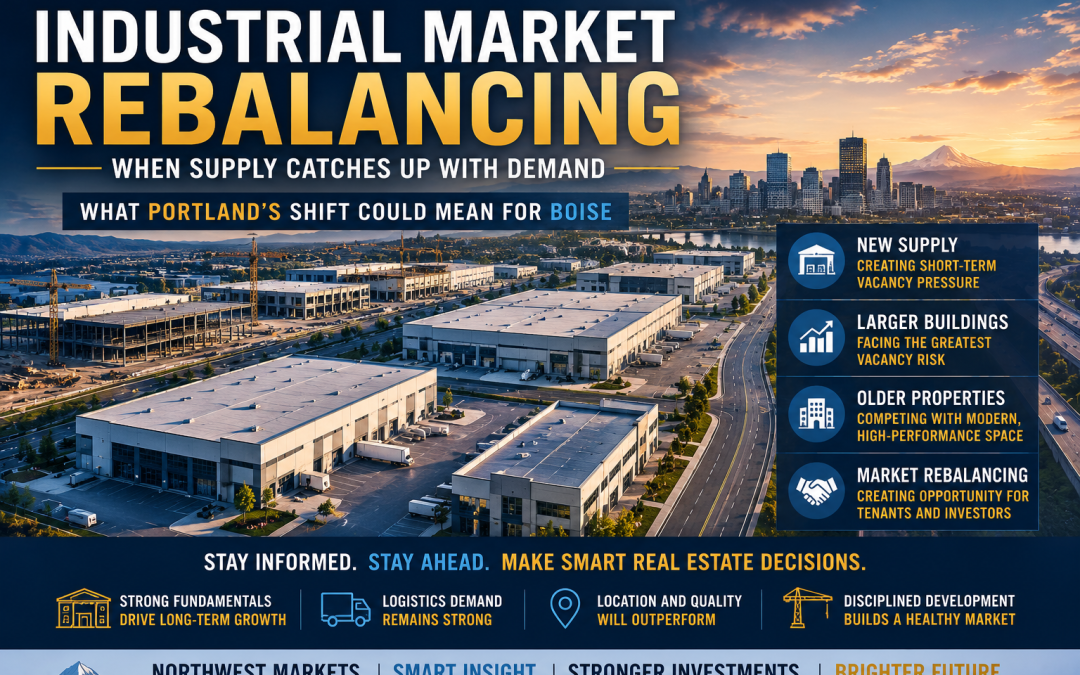
What Portland’s Rising Industrial Vacancy Could Mean for Boise Commercial Real Estate
Industrial real estate has been one of the strongest commercial property sectors over the past several years.
Warehouses filled up quickly, developers raced to build new logistics facilities, and investors poured billions into industrial assets across the country.
But recent data from Portland suggests the industrial market may be entering a new phase.
According to reporting by John Gillem of CoStar Analytics, Portland’s logistics vacancy rate has climbed significantly as newly delivered warehouse space enters the market faster than tenants are leasing it. The original CoStar article can be found here: https://product.costar.com/home/news/1751837049
While the story focuses on Portland, the trends offer valuable insight for Boise commercial real estate investors, developers, landlords, and tenants watching the industrial sector across the Northwest.
New Supply Is Testing Industrial Demand
For much of the pandemic and post-pandemic period, industrial demand appeared almost limitless.
E-commerce growth, supply chain disruptions, and inventory expansion created strong demand for warehouse and distribution facilities.
Developers responded by building aggressively.
Now many markets are experiencing the next phase of that cycle.
Key takeaways from the Portland report include:
- Logistics vacancy increased from 3.2% in 2023 to 9.1%
- Approximately 15 million square feet of logistics space has been added since 2020
- More than one-quarter of that new inventory remains available
- Over 70% of space delivered during the past year is still vacant
- More than 3 million square feet remains under construction
- Most new construction consists of large-format warehouse facilities
The challenge is not necessarily collapsing demand.
Rather, supply has temporarily grown faster than tenant absorption.
That distinction is important because it signals market rebalancing rather than a market downturn.
Bigger Buildings Face the Greatest Pressure
One of the most interesting aspects of the report is where vacancy is occurring.
The largest logistics buildings are carrying much of the available inventory.
Large warehouse projects often require only a handful of tenants to dramatically change vacancy statistics.
When one 500,000-square-foot facility remains empty, it can significantly impact an entire submarket.
This trend highlights an important lesson for Boise development projects.
Size matters.
Large speculative industrial developments can create substantial leasing risk when tenant expansion slows, even if the overall economy remains healthy.
For developers, securing tenants before construction or early in the development process becomes increasingly important as markets mature.
Older Industrial Properties Face New Competition
The report also highlights another challenge emerging in many industrial markets.
Older warehouse properties are competing against a growing inventory of modern facilities.
New industrial buildings often offer:
- Higher clear heights
- Better truck access
- More loading capacity
- Improved energy efficiency
- Modern logistics layouts
- Enhanced employee amenities
As new product enters the market, some older facilities struggle to remain competitive without renovations or repositioning.
This is a trend Boise property owners should monitor closely.
Many industrial buildings throughout the Treasure Valley were developed years before today’s logistics users began demanding larger footprints, additional trailer storage, and modern operational features.
As new industrial inventory continues entering the Boise market, older buildings may require upgrades to maintain occupancy and rental rates.
Why This Matters for Boise Commercial Real Estate
Boise’s industrial market remains healthier than many larger West Coast markets, but the same economic principles apply.
Developers throughout the region have responded to strong demand by delivering new warehouse and flex industrial projects.
For now, population growth, business expansion, and Idaho’s business-friendly environment continue supporting industrial leasing activity.
However, Portland’s experience serves as a reminder that industrial demand is not unlimited.
Markets can move from undersupplied to balanced surprisingly quickly.
Investors and developers should pay close attention to:
- Industrial vacancy trends
- Construction pipelines
- Tenant expansion activity
- Large-block availability
- Absorption rates
- New competitive supply
These metrics often provide early signals about future market conditions.
What Investors and Tenants Should Watch
For tenants, rising vacancy can create opportunity.
As more inventory becomes available, businesses may gain additional negotiating leverage, improved lease terms, and access to newer facilities.
For investors and landlords, competition may increase.
Properties that offer strong locations, functional layouts, and modern features will likely continue outperforming less competitive assets.
The industrial market remains one of the strongest sectors in commercial real estate, but success increasingly depends on selecting the right projects in the right locations.
My Take
Portland’s industrial market is providing an important lesson for the rest of the Northwest.
The story is not that industrial demand has disappeared.
The story is that supply is finally catching up.
For Boise commercial real estate professionals, that’s an important distinction.
The Treasure Valley continues benefiting from population growth, business relocation activity, and strong economic fundamentals. But developers should remain disciplined as new industrial projects move forward.
Markets perform best when construction remains aligned with actual tenant demand.
Portland’s experience demonstrates what happens when development gets slightly ahead of absorption. Boise is not there today, but it is a trend worth watching as industrial development continues across the region.
Mike Gioioso (joy-OH-so) has for 16+ years been helping companies of all sizes buy, build, and lease perfect places for business in greater Boise, Idaho and beyond. www.streetsmartidaho.com mike@streetsmartidaho.com 208-209-9166
Tags: #boisecommercialrealestate, #boiseindustrialmarket, #industrialrealestate, #warehousespace, #logisticsrealestate, #boisedevelopment, #industrialdevelopment, #commercialrealestateinvestment, #flexindustrialspace, #industrialleasing, #distributioncenters, #economicdevelopment, #supplychainrealestate, #investmentproperty, #treasurevalleygrowth