
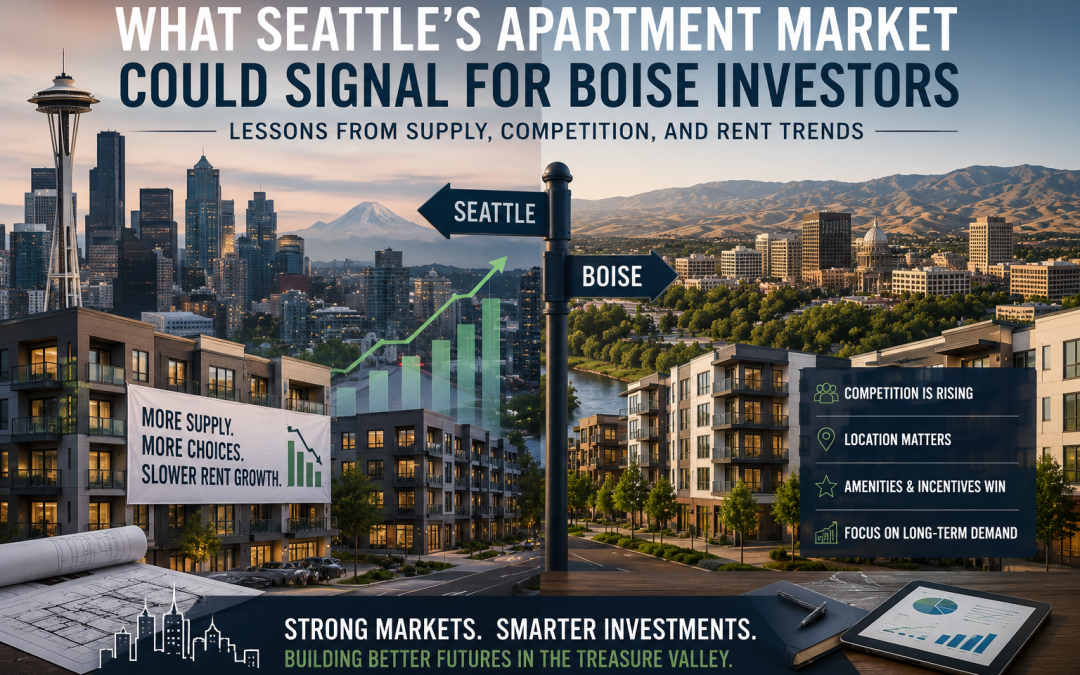
What Seattle’s Apartment Market Could Signal for Boise Commercial Real Estate Investors
Apartment markets don’t have to be booming to offer valuable lessons.
Sometimes the biggest opportunity comes from watching another city’s challenges before they arrive in your own market. Seattle’s latest multifamily data shows rents are still increasing, but new apartment construction and growing competition are making it harder for landlords to push rents higher.
According to reporting by Elliott Krivenko of CoStar Analytics, Seattle apartment rents continued to rise during May, although rent growth has slowed as the market works through a large pipeline of newly completed apartments. You can read the original CoStar News article here: https://product.costar.com/home/news/2110831529. This article is based on that reporting while exploring what these trends could mean for Boise commercial real estate, multifamily development, investment strategy, and future housing supply across the Treasure Valley.
More Apartments Don’t Always Mean Higher Rents
Seattle continues posting positive rent growth, but landlords are facing a different challenge than they did just a few years ago.
A significant amount of new apartment inventory has entered the market, giving renters more choices. As a result, many owners are offering leasing incentives to attract residents even though asking rents continue to edge upward.
Several key trends stand out:
- Asking rents remain above last year’s levels.
- Monthly rent growth continues, although at a slower pace.
- Many newly built communities are relying on concessions to fill units.
- Roughly half of apartment communities are now offering leasing incentives.
- New apartment construction is beginning to slow after several years of heavy development.
These conditions illustrate how additional supply can change landlord strategies without causing a dramatic drop in headline rental rates.
Why Boise Investors Should Pay Attention
Boise has experienced many of the same forces that shaped Seattle over the past several years.
Population growth fueled apartment construction. Investors poured capital into new developments. Developers responded with thousands of new units across the Treasure Valley.
As those projects deliver, competition naturally increases.
That doesn’t necessarily create a weak apartment market, but it often shifts negotiating power toward renters.
Property owners may find themselves competing through:
- Free rent promotions
- Reduced security deposits
- Move-in incentives
- Flexible lease terms
- Amenity upgrades
For multifamily investors, maintaining occupancy can become just as important as maximizing rental rates.
Boise Commercial Real Estate Is Becoming More Competitive
The multifamily sector rarely operates in isolation.
Apartment development affects retail leasing, office demand, healthcare expansion, and mixed-use development throughout a growing region.
As new residential neighborhoods fill, retailers gain confidence to open additional locations. Restaurants follow rooftops. Medical providers expand into growing communities. Service businesses begin searching for neighborhood commercial space.
That creates opportunities across Boise commercial real estate even if apartment owners experience more pricing competition.
The pace of Boise development remains closely connected to long-term population growth rather than short-term rent fluctuations.
Location Still Makes the Difference
One interesting takeaway from Seattle’s report is that neighborhood performance varies widely.
Some submarkets continue outperforming while others struggle with slower leasing activity or weaker employment growth.
The same principle applies in the Treasure Valley.
Certain Boise neighborhoods may continue seeing strong apartment demand because of nearby employment centers, healthcare campuses, universities, or major retail corridors. Other areas with large concentrations of newly delivered apartments may experience longer lease-up periods and greater competition.
For investors, market selection often matters just as much as timing.
My Take
Seattle’s apartment market doesn’t suggest that multifamily investing is weakening.
Instead, it shows what happens when supply begins catching up with demand.
Boise developers and investors should view that as a reminder to focus on location, product quality, and long-term market fundamentals rather than assuming rents will always climb at the same pace.
The Treasure Valley continues attracting new residents and employers, supporting demand for housing and commercial development. But as inventory grows, owners who provide the best locations, strongest amenities, and most competitive leasing experience will likely outperform the broader market.
That’s a healthy evolution for Boise commercial real estate and one that creates opportunities for disciplined investors willing to think beyond short-term rent growth.
Mike Gioioso (joy-OH-so) has for 16+ years been helping companies of all sizes buy, build, and lease perfect places for business in greater Boise, Idaho and beyond. www.streetsmartidaho.com mike@streetsmartidaho.com 208-209-9166
Tags: #boisecommercialrealestate, #boisemultifamily, #apartmentdevelopment, #multifamilyinvestment, #boisedevelopment, #treasurevalleyhousing, #apartmentmarket, #seattlerealestate, #seattleapartments, #commercialrealestateinvestment, #multifamilyhousing, #boiseinvestors, #retailleasingboise, #mixedusedevelopment, #commercialproperty, #rentalhousing, #propertyinvestment, #housingmarket, #boisegrowth, #idahorealestate, #commercialleasing, #realestatedevelopment, #populationgrowth, #multifamilytrends, #investmentproperty