
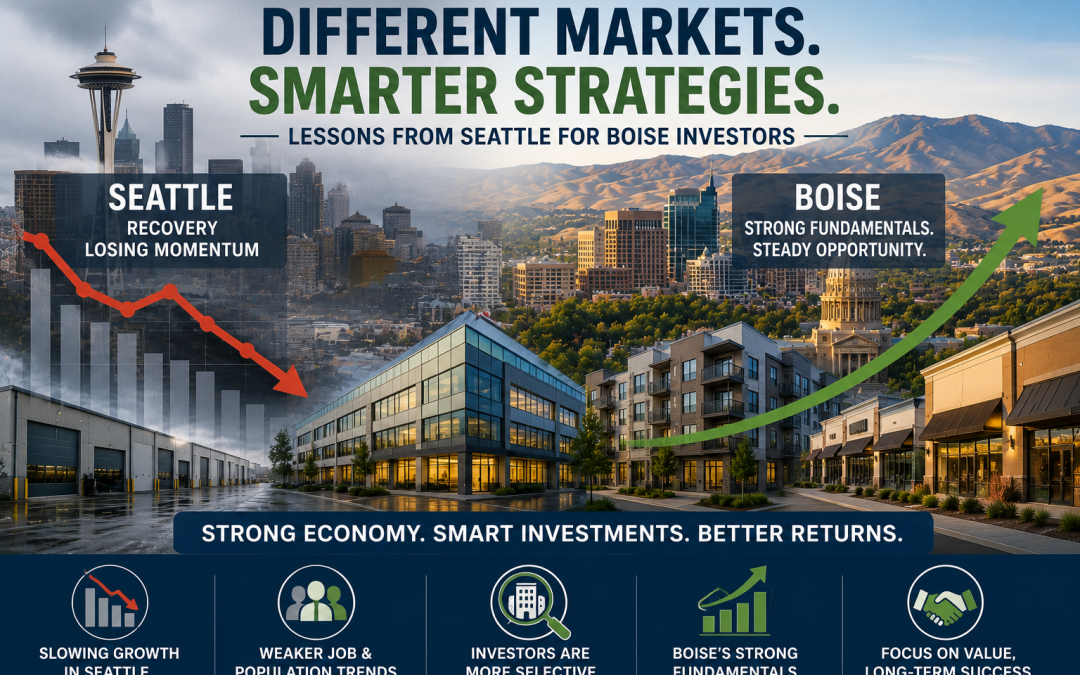
Why Seattle’s Slowing Commercial Real Estate Recovery Could Offer Lessons for Boise Investors
Commercial real estate recoveries rarely move in a straight line.
A market can rebound from its lowest point while still facing new challenges. That’s exactly what’s happening in the Seattle area, where investment activity has improved significantly since 2023 but economic headwinds are slowing further momentum.
According to reporting by Elliott Krivenko of CoStar Analytics, Seattle’s commercial real estate market has recovered well from its post-2023 lows, but slower job growth, softer population gains, and cautious investor sentiment are limiting the pace of future growth. You can read the original CoStar News article here: https://product.costar.com/home/news/1253004113. This article is based on that reporting while exploring what Seattle’s market trends could mean for Boise commercial real estate, investor strategy, leasing demand, and future development across the Treasure Valley.
Commercial Real Estate Activity Has Improved—But Growth Is Slowing
Seattle’s commercial property market has made meaningful progress over the past several years.
According to CoStar Analytics, annual sales volume across the office, industrial, retail, and multifamily sectors has more than doubled from its 2023 low.
However, that recovery has begun to level off.
While transaction activity remains much stronger than it was during the market slowdown, overall sales volume has stopped accelerating and remains below the region’s pre-pandemic averages.
That shift suggests investors are still active—but they’re becoming increasingly selective about where they deploy capital.
Economic Growth Continues to Drive Real Estate Performance
Commercial real estate follows the broader economy.
When employment and population expand, demand for office space, apartments, industrial buildings, and retail centers usually follows.
Seattle’s recent slowdown illustrates that relationship.
According to the report, several economic trends are influencing commercial property performance:
- Employment growth has flattened.
- Population growth has slowed.
- International migration has declined.
- Apartment demand has softened.
- Warehouse leasing has cooled alongside slower import activity.
- Office demand continues adjusting to hybrid work patterns.
Each of these factors reduces pressure on rents and can make investors more cautious.
Why This Matters for Boise Commercial Real Estate
Boise has experienced many of the same economic forces affecting western markets, but the Treasure Valley has generally maintained stronger population growth than many coastal cities.
That difference matters.
New residents create demand for:
- Apartments
- Retail centers
- Healthcare facilities
- Industrial space
- Professional office users
- Restaurants and neighborhood services
As long as Boise continues attracting households and employers, Boise commercial real estate may remain positioned for steadier long-term growth than some larger metropolitan areas.
Still, Boise investors shouldn’t assume the market is immune to broader economic trends.
Higher borrowing costs, slower national hiring, and cautious capital markets continue influencing investment decisions everywhere.
Investors Are Becoming More Selective
One of the biggest takeaways from Seattle’s recovery is that buyers haven’t disappeared—they’ve simply become more disciplined.
Rather than pursuing every available opportunity, many investors are focusing on assets with clear upside.
Current priorities often include:
- Stable occupancy
- Strong locations
- Value-add opportunities
- Reliable cash flow
- Long-term appreciation potential
Those same investment preferences are becoming increasingly common throughout Boise commercial real estate.
Properties with strong fundamentals continue attracting interest, while weaker assets often require pricing adjustments before transactions occur.
Key Takeaways
- Seattle’s commercial real estate market has recovered substantially since 2023.
- Transaction volume has more than doubled from its low point but remains below historical averages.
- Slower employment and population growth are reducing demand across several property sectors.
- Investors continue purchasing properties but are focusing on selective opportunities.
- Value-add buyers and owner-users remain important drivers of market activity.
My Take
As someone working in Boise commercial real estate, I think Seattle offers an important reminder that economic fundamentals matter just as much as real estate fundamentals.
Strong job creation, population growth, and business expansion remain the foundation for healthy leasing markets and long-term property values.
Boise continues benefiting from many of those drivers, but investors should continue evaluating each opportunity carefully rather than assuming every property will appreciate simply because it’s located in a growing region.
The markets likely to perform best over the next several years will be those supported by solid demographics, disciplined development, and properties that continue meeting the needs of today’s tenants. Boise has many of those advantages, but successful investing will still require careful underwriting and a long-term perspective.
Mike Gioioso (joy-OH-so) has for 16+ years been helping companies of all sizes buy, build, and lease perfect places for business in greater Boise, Idaho and beyond. www.streetsmartidaho.com mike@streetsmartidaho.com 208-209-9166
Tags: #boisecommercialrealestate, #boisedevelopment, #commercialrealestateinvestment, #seattlecommercialrealestate, #treasurevalley, #boiserealestate, #investmentproperty, #retailleasingboise, #officemarket, #industrialrealestate, #multifamilyinvestment, #commercialproperty, #economicdevelopment, #valueaddrealestate, #boiseinvestors