
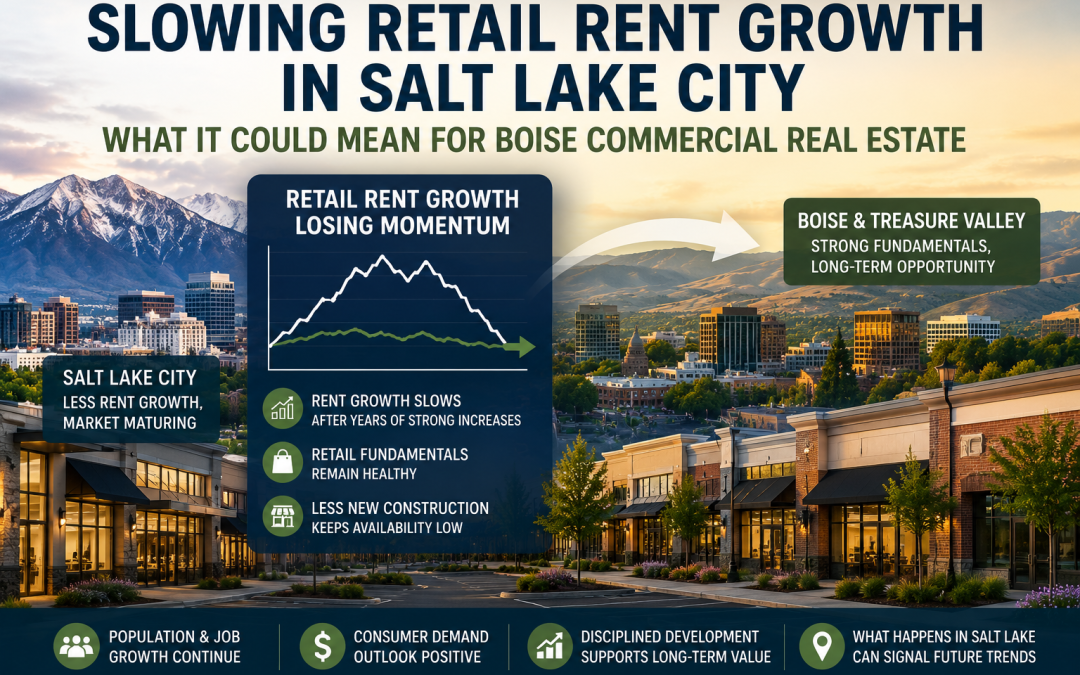
What Slowing Retail Rent Growth in Salt Lake City Could Mean for Boise Commercial Real Estate
Retail markets don’t move in perfect cycles.
One city may be seeing record rent growth while another begins to level off. That’s why neighboring markets like Salt Lake City are worth watching—they often provide an early look at trends that could eventually influence Boise commercial real estate.
According to reporting by John Gillem of CoStar Analytics in CoStar News, Salt Lake City’s retail market remains fundamentally healthy, but rent growth has slowed significantly after several years of exceptional performance. You can read the original CoStar article here: https://product.costar.com/home/news/1275910262. This article is based on that reporting while examining what those trends could mean for Boise’s retail market.
A Strong Retail Market Isn’t Always a Fast-Growing One
At first glance, Salt Lake City’s retail market still looks impressive.
Retail availability remains below the national average, and relatively few tenants are vacating space. Retail landlords continue benefiting from limited new construction and steady occupancy levels.
Yet one important metric has changed.
Retail asking rents are no longer climbing at the rapid pace seen over the past several years. Annual rent growth has slowed to roughly 0.4%, well below the national average, even though average asking rents remain near record highs.
In other words, the market hasn’t weakened—but it has matured.
What’s Behind the Shift?
Several trends are shaping today’s retail environment.
While retailers continue occupying space and availability remains tight, many businesses have become more cautious with expansion decisions.
CoStar’s analysis points to several reasons why rent growth has moderated:
- Asking rents reached historically high levels after several years of rapid increases.
- Retail expansion has become more measured.
- Limited new construction continues supporting occupancy.
- Population and employment growth remain positive.
- Broader economic uncertainty is encouraging some tenants to move more cautiously.
This combination has created a market where occupancy remains healthy, but landlords have less pricing power than they enjoyed during the post-pandemic boom.
Why Boise Commercial Real Estate Should Pay Attention
Boise and Salt Lake City share several important characteristics.
Both markets have experienced strong population growth, expanding labor markets, and increased retailer interest over the past decade.
Because of those similarities, Salt Lake’s recent slowdown offers useful insight for investors, landlords, and developers across the Treasure Valley.
A cooling pace of rent growth does not necessarily signal declining demand.
Instead, it may represent a healthier, more sustainable leasing environment where rent increases return to historical norms.
For Boise commercial real estate professionals, that’s an important distinction.
Markets don’t need double-digit rent growth to remain successful. Consistent occupancy, steady leasing activity, and disciplined development often produce stronger long-term performance than rapid price spikes.
What Landlords and Investors Should Watch
Retail fundamentals remain stronger than many expected entering 2026.
Going forward, several indicators will deserve close attention:
- Retail tenant expansion activity
- Consumer spending trends
- New retail construction
- Vacancy and availability rates
- Population and employment growth
- Interest rates and broader economic conditions
Developers should also continue evaluating how much new retail space can be absorbed without creating oversupply.
One lesson from Salt Lake City is that restrained construction can help preserve healthy occupancy levels, even when leasing activity slows.
My Take
I’ve always believed retail real estate should be evaluated over years—not quarters.
Salt Lake City’s experience reinforces that idea.
The market enjoyed tremendous rent growth for several years. Some moderation was inevitable as rents reached new highs. That doesn’t necessarily indicate weakness—it often signals that the market is transitioning into a more balanced phase.
For Boise commercial real estate, I believe the opportunity remains strong. The Treasure Valley continues attracting new residents, employers, and retailers. While rent growth may eventually normalize here as well, healthy demand, disciplined development, and limited availability should continue supporting retail property values.
Investors and landlords who focus on long-term fundamentals rather than short-term rent spikes will likely be best positioned as the next phase of the market unfolds.
Mike Gioioso (joy-OH-so) has for 16+ years been helping companies of all sizes buy, build, and lease perfect places for business in greater Boise, Idaho and beyond. www.streetsmartidaho.com mike@streetsmartidaho.com 208-209-9166
Tags: #boisecommercialrealestate, #boisedevelopment, #retailleasingboise, #retailrealestate, #shoppingcenters, #commercialrealestateinvestment, #treasurevalleygrowth, #retailmarkettrends, #retaildevelopment, #investmentproperty, #commercialproperty, #boiseeconomy, #populationgrowth, #economicdevelopment, #mixedusedevelopment, #retailmarketanalysis