
Why Advanced Manufacturing Could Become a Bigger Driver of Boise Industrial Real Estate
For years, much of the industrial real estate conversation centered around one thing: moving boxes.
Warehouses, distribution centers, trucking companies, and e-commerce helped drive enormous demand for industrial space.
But another type of tenant is becoming increasingly important.
Manufacturers are growing again—and many of them look very different from the factories of the past.
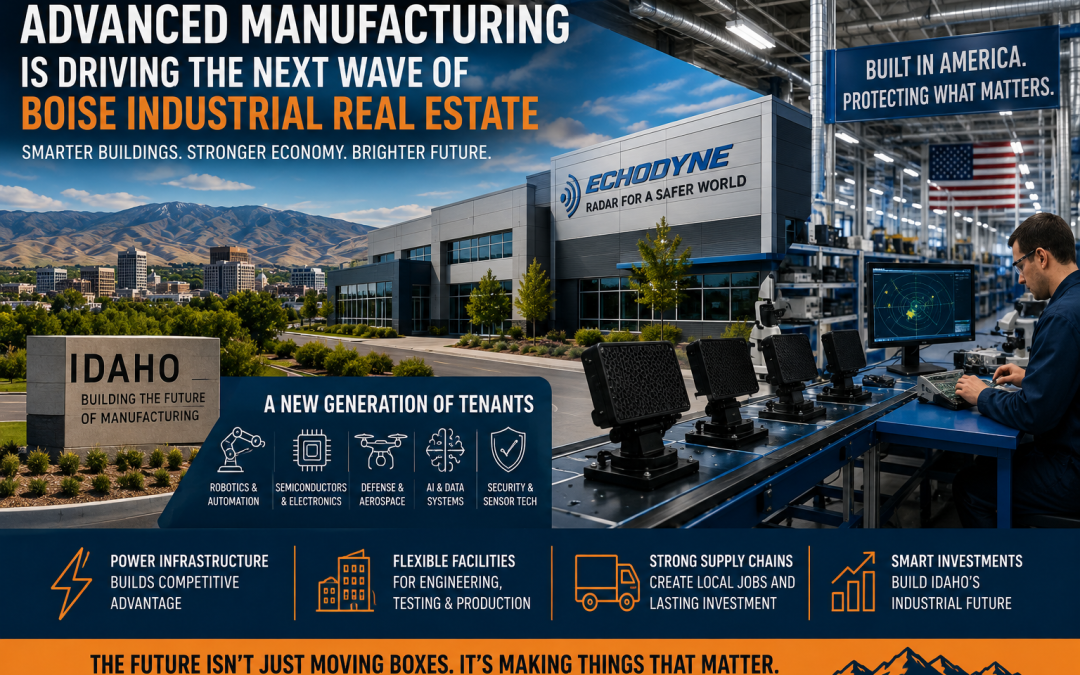
According to reporting by Randyl Drummer in CoStar News, radar technology company Echodyne recently opened a major manufacturing facility near Seattle as demand grows for sophisticated drone detection and security technology.
You can read the original CoStar News article here: https://product.costar.com/home/news/1653804826
While this project is located in Washington, the underlying trend could have important implications for Boise commercial real estate, especially as Idaho attracts more semiconductor, technology, aerospace, defense, and advanced manufacturing investment.
Advanced Manufacturing Is Creating a New Kind of Industrial Tenant
Echodyne’s expansion provides a good example of how industrial users are changing.
The Kirkland-based company has opened an approximately 86,350-square-foot manufacturing and warehouse facility in Woodinville, east of Seattle.
The company invested roughly $40 million in the operation.
At full capacity, the facility is expected to produce as many as 30,000 radar systems annually.
It is also expected to create approximately 100 jobs initially, with employment potentially reaching 200 as production increases.
But the most interesting part from a commercial real estate perspective isn’t simply the size of the building.
It’s what is happening inside it.
Echodyne develops advanced radar technology used to detect and track drones. Its systems serve defense, government, security, and commercial customers.
This is not a traditional warehouse where products arrive on one side and leave on the other.
It represents a growing category of industrial real estate where engineering, software, artificial intelligence, manufacturing, testing, assembly, and distribution can exist under the same roof.
That can dramatically change what companies need from industrial buildings.
Manufacturing Is Taking More Industrial Space
The Seattle market provides another important clue.
CoStar’s analysis indicates that manufacturers have been accounting for a larger share of industrial leasing in the Puget Sound region.
In 2020, manufacturing represented roughly 8% of newly leased industrial square footage.
In subsequent years, that share has reached as high as approximately 17%.
Looking at the number of transactions rather than square footage, manufacturing companies accounted for about 20% of new industrial leases last year, compared with roughly 13% in 2020.
That’s meaningful.
Manufacturing still represents a smaller piece of Seattle’s massive industrial market than distribution and logistics, but its share has been moving higher.
For Boise industrial real estate, this is a trend worth watching.
The Treasure Valley doesn’t need to become Seattle to experience the same shift.
It simply needs more companies that make things.
Why This Matters for Boise Commercial Real Estate
Boise already has several ingredients that could support additional advanced manufacturing growth.
The region has an expanding technology sector.
Micron is making enormous investments in semiconductor manufacturing.
Idaho has a business-friendly reputation.
The Treasure Valley continues attracting population and employers.
Idaho National Laboratory gives the state exposure to advanced energy and nuclear technologies.
And the broader Mountain West continues gaining attention from companies seeking alternatives to expensive coastal markets.
Together, those factors could create opportunities for a different class of industrial tenant.
Instead of only asking which logistics companies need warehouses, developers and brokers may increasingly need to ask:
Which manufacturers need specialized buildings?
That distinction matters because manufacturing tenants often have very different requirements.
They may need:
- Heavy electrical capacity
- Specialized ventilation
- More HVAC than a traditional warehouse
- Floor drains or process plumbing
- Compressed air
- Secure facilities
- Loading and distribution areas
- Laboratory or testing space
- Clean manufacturing environments
- Higher employee parking ratios
- Office and engineering space
- Fiber connectivity
A basic industrial shell won’t work for every user.
That could create opportunities for developers capable of delivering more sophisticated buildings.
Power Could Become One of Industrial Real Estate’s Most Valuable Amenities
Electrical capacity deserves special attention.
Modern manufacturing can consume significant amounts of electricity.
Semiconductor production, automated manufacturing equipment, robotics, data processing, testing systems, cooling equipment, and AI infrastructure all add to power requirements.
That means industrial site selection could increasingly begin with the utility system.
A property may have excellent freeway access, favorable zoning, and attractive land pricing—but still be unsuitable if the required electrical capacity won’t be available for several years.
For Boise development, this could change how industrial land is valued.
Sites near substations and major utility infrastructure may become more attractive.
Developers may need to begin discussions with utilities earlier.
Landowners may also need better information about the actual power available to their properties.
In some cases, available megawatts could eventually matter almost as much as available acres.
Defense Spending Could Create Commercial Real Estate Demand
Echodyne’s expansion also highlights another major economic driver: defense spending.
Drone warfare has dramatically changed military strategy.
That is creating demand not only for drones but also for technologies capable of identifying, tracking, intercepting, and managing unmanned aircraft.
The proposed federal defense budget referenced by CoStar includes substantial additional spending for unmanned systems and counter-drone technology.
When government spending increases in an industry, the real estate impact extends beyond the companies receiving the largest contracts.
Large contractors need suppliers.
Suppliers need manufacturing facilities.
Engineering companies need offices.
Components need to be stored.
Products need to be tested.
Employees need housing.
Workers spend money at nearby restaurants and retailers.
That creates a much larger economic ecosystem.
The same principle applies to semiconductor manufacturing.
A giant project such as Micron can create secondary commercial real estate demand well beyond the boundaries of the main facility.
Boise Could Benefit From Supply-Chain Expansion
One of the most important opportunities for the Treasure Valley may not be attracting the next giant defense contractor.
It may be attracting the companies that supply them.
Advanced manufacturing depends on complicated supply chains.
Those suppliers can include companies specializing in:
- Precision machining
- Electronics
- Sensors
- Robotics
- Metal fabrication
- Specialized plastics
- Testing equipment
- Software
- Engineering
- Packaging
- Transportation
- Facility maintenance
Many of those companies don’t require million-square-foot facilities.
They may need 10,000, 25,000, 50,000, or 100,000 square feet.
That’s much more relevant to the typical Boise industrial market.
If even a small cluster of specialized manufacturers expands into Idaho, demand for flex and industrial buildings could increase significantly.
Local Insight: Industrial Buildings Are Becoming More Complicated
One thing I would watch closely is the growing difference between a warehouse and a manufacturing facility.
From the outside, they can look similar.
Inside, they can be completely different.
A distribution tenant might primarily care about clear height, dock doors, trailer parking, freeway access, and warehouse efficiency.
A manufacturer may care just as much about electrical service, ventilation, floor loading, employee parking, water, fiber, security, and specialized improvements.
That changes the leasing conversation.
It also creates risk for landlords.
Manufacturing improvements can be expensive, and some are highly specific to one tenant.
Landlords need to understand how much money they’re putting into a building, how reusable those improvements will be, and whether the lease term justifies the investment.
On the other hand, specialized improvements can make a property extremely valuable to the right user.
For Boise commercial real estate investors, understanding the operational requirements of manufacturing tenants could become increasingly important.
Flex Space Could Be a Major Winner
One property type that could benefit from this trend is flex industrial.
Advanced technology companies often don’t fit neatly into traditional real estate categories.
They might need:
20% office.
30% engineering and laboratory space.
30% manufacturing.
20% warehouse.
That isn’t a typical office building.
And it isn’t a typical distribution warehouse.
It’s flex space.
The Treasure Valley already has many smaller companies that need this combination.
If Idaho’s technology and manufacturing economy continues growing, demand for high-quality flex buildings could increase.
Properties with adequate power, flexible floor plans, loading capability, good parking, and professional office components may be particularly well positioned.
What Boise Developers and Investors Should Watch
Seattle’s manufacturing growth doesn’t mean Boise will automatically experience the same thing.
But it does show how quickly industrial demand can evolve.
The most important signals to watch locally include:
Power infrastructure. Where are utilities adding capacity?
Micron suppliers. Which companies are entering Idaho to support semiconductor manufacturing?
Defense and aerospace. Are specialized contractors expanding in the Mountain West?
Flex leasing. Are more technology and manufacturing companies seeking hybrid facilities?
Industrial land. Which sites combine transportation access with sufficient utilities?
Workforce. Can Idaho continue producing and attracting the technicians, engineers, machinists, and skilled trades these companies require?
Those factors could determine where the next wave of industrial development occurs.
The Bigger Boise Commercial Real Estate Opportunity
The industrial boom of the last decade was heavily influenced by e-commerce and logistics.
The next one could look different.
Semiconductors.
Robotics.
Artificial intelligence.
Defense technology.
Energy systems.
Aerospace.
Advanced manufacturing.
These industries still need industrial buildings—but they often require more sophisticated real estate.
That could create opportunities throughout the Treasure Valley for developers willing to build flexible facilities, landlords willing to understand manufacturing tenants, and investors capable of identifying properties with the infrastructure these companies need.
Boise doesn’t have to become Seattle’s aerospace industry or Silicon Valley’s technology industry.
Idaho can develop its own version of advanced manufacturing.
And if that happens, the biggest commercial real estate opportunity may not simply be building more warehouses.
It may be building the places where the next generation of Idaho companies actually makes things.
Mike Gioioso (joy-OH-so) has for 16+ years been helping companies of all sizes buy, build, and lease perfect places for business in greater Boise, Idaho and beyond.
www.streetsmartidaho.com mike@streetsmartidaho.com 208-209-9166
Tags: #boisecommercialrealestate, #boiseindustrialrealestate, #advancedmanufacturingidaho, #boisemanufacturing, #industrialdevelopmentboise, #micronboise, #semiconductormanufacturingidaho, #boiseflexspace, #industrialleasingboise, #idahomanufacturing, #treasurevalleyindustrial, #defensetechnology, #aerospaceidaho, #aimanufacturing, #commercialpropertyinvestment