
What Seattle’s High-Income Retail Trends Could Mean for Boise Commercial Real Estate
Not all retail locations perform the same—even within the same city.
Some neighborhoods consistently attract stronger retailers, command higher rents, and keep vacancies low. The difference often comes down to one key factor: the spending power of nearby households.
According to reporting by Elliott Krivenko of CoStar Analytics, Seattle’s highest-income neighborhoods continue to post the region’s lowest retail availability and strongest asking rents. This article is based on that reporting while exploring what these trends could mean for Boise commercial real estate, Boise development, retail leasing, and future investment opportunities across the Treasure Valley. You can read the original CoStar News article here: https://product.costar.com/home/news/426958976.
Retail Demand Is Following Household Income
Location has always mattered in commercial real estate.
Today, retailers are looking beyond traffic counts and population growth. They’re paying closer attention to who lives nearby and how much those households spend.
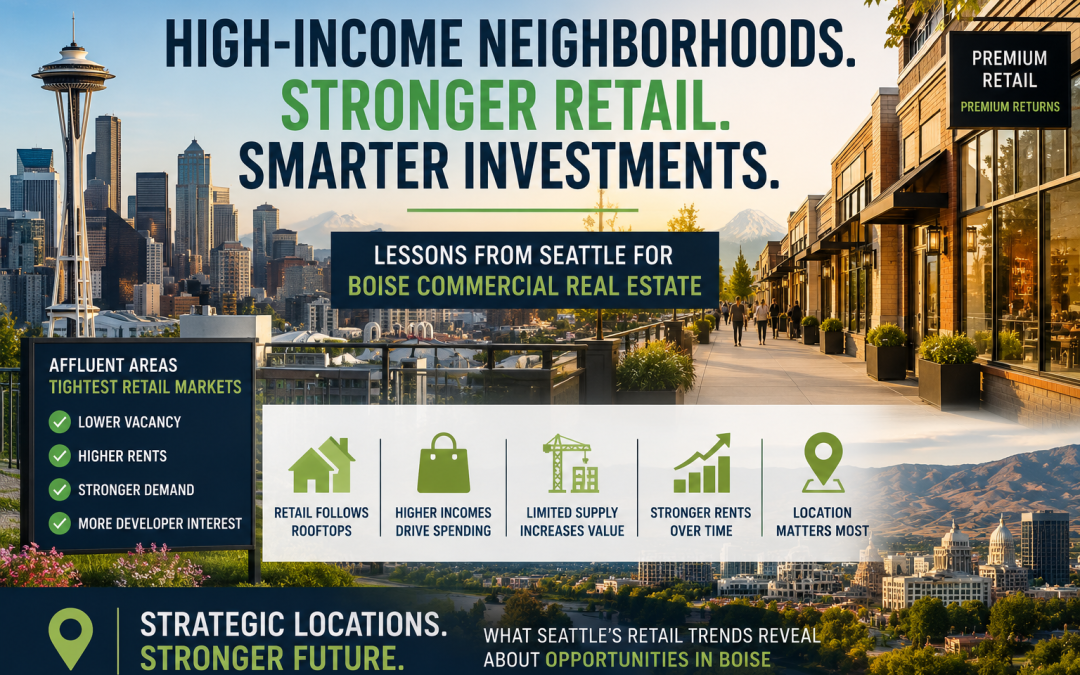
CoStar’s research found that Seattle neighborhoods with the highest household incomes continue to experience:
- The lowest retail space availability
- Higher asking rents
- Stronger long-term leasing demand
- Greater developer interest
Even as retail availability has increased slightly over the past few years, affluent neighborhoods have remained the most competitive locations for retailers.
That pattern reinforces a simple reality: businesses often follow consumer purchasing power.
Less Retail Supply Can Increase Competition
Another important trend isn’t just demand—it’s supply.
Seattle has actually seen its retail inventory shrink in recent years.
Older shopping centers have been redeveloped, some retail properties have been converted to other uses, and demolitions have outpaced new construction.
Meanwhile, much of the new retail space that has been built has already been leased before opening.
The result is a market where available retail space remains relatively limited despite continued population growth.
When supply doesn’t keep pace with demand, landlords often gain stronger negotiating positions while retailers have fewer location options.
Boise May See Similar Neighborhood-Level Trends
While Boise and Seattle are different markets, some of the same forces are beginning to shape both regions.
As Boise continues growing, retailers are becoming more selective about where they expand.
Instead of targeting every neighborhood equally, many national and regional brands focus on trade areas that offer:
- Higher household incomes
- Strong residential growth
- New housing development
- Quality schools
- Strong daytime employment
- Convenient access and visibility
That helps explain why areas such as Meridian, Eagle, North Boise, and portions of southeast Boise often attract new retail investment and continued leasing activity.
The old retail saying still applies—retail follows rooftops—but today it also follows household income and consumer spending.
Redevelopment Is Becoming Part of the Retail Story
One of the more interesting takeaways from Seattle is that retail inventory can actually shrink even while the population grows.
Redevelopment plays a major role.
Older commercial properties are sometimes replaced with:
- Mixed-use developments
- Multifamily housing
- Medical office buildings
- Hotels
- Higher-density projects
Rather than weakening the retail market, these projects often concentrate retail into newer, more productive locations.
Boise could experience more of this over time as redevelopment opportunities increase throughout the Treasure Valley.
Why This Matters for Boise Commercial Real Estate
Neighborhood-level demographics are becoming increasingly important for retail leasing decisions.
For investors, landlords, and developers, understanding where household incomes are growing may become just as valuable as tracking overall population growth.
These trends could influence:
- Retail leasing in Boise
- Shopping center redevelopment
- Mixed-use development opportunities
- Commercial land values
- Tenant site selection
- Long-term investment performance
Retail demand isn’t disappearing—it is becoming more targeted.
Properties located in strong demographic corridors may continue outperforming the broader market.
My Take
Seattle’s retail market highlights an important lesson that applies well beyond Washington.
The strongest retail locations aren’t always the busiest—they’re often the neighborhoods where consumers have the financial capacity to support local businesses over the long term.
Boise continues adding residents, employers, and higher-income households in many parts of the Treasure Valley. That creates opportunities for retailers, but it also increases the importance of choosing the right location.
For commercial real estate investors, demographic research is becoming every bit as important as property analysis. The retail centers that combine strong incomes, growing rooftops, and limited competing space may be among the best-positioned assets as Boise continues to expand.
Mike Gioioso (joy-OH-so) has for 16+ years been helping companies of all sizes buy, build, and lease perfect places for business in greater Boise, Idaho and beyond. www.streetsmartidaho.com mike@streetsmartidaho.com 208-209-9166
Tags: #boisecommercialrealestate, #boisedevelopment, #retailleasingboise, #shoppingcenterinvestment, #retailrealestate, #mixedusedevelopment, #commercialpropertyinvestment, #boiseretail, #eagleidahoretail, #meridianretail, #treasurevalleycommercialrealestate, #siteselection, #retaildevelopment, #demographictrends, #costaranalytics