
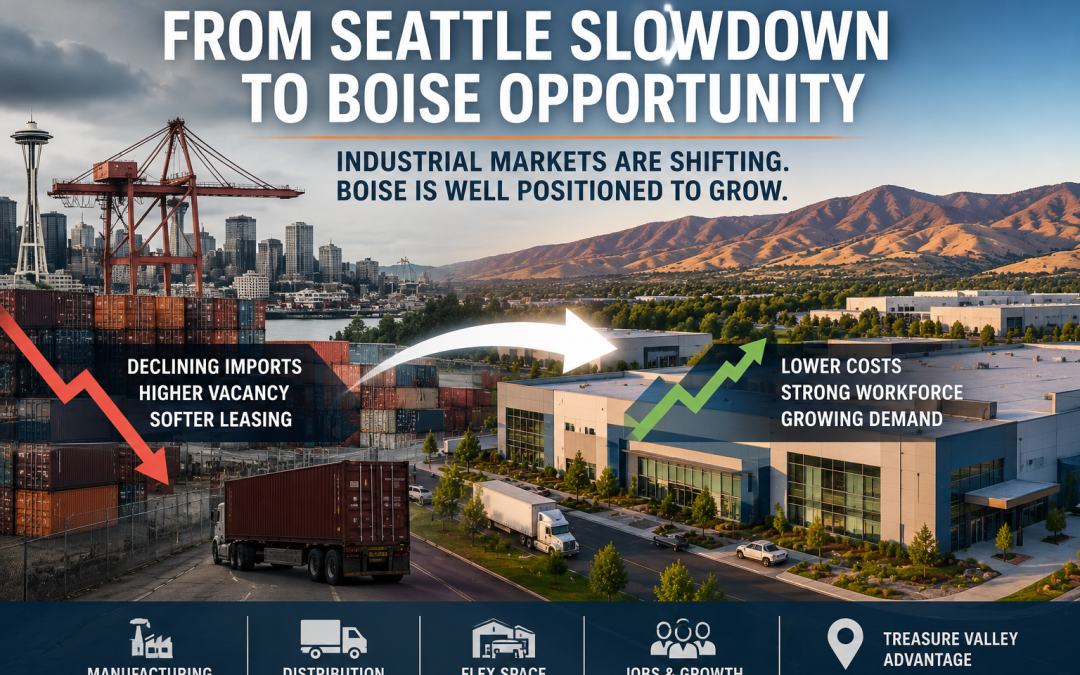
Why Seattle’s Industrial Slowdown Could Create New Opportunities for Boise Commercial Real Estate
Commercial real estate markets don’t operate in isolation.
When one major industrial market slows, companies often begin looking elsewhere for expansion, distribution, manufacturing, and logistics opportunities. That’s why recent changes in Seattle’s industrial market are worth watching—even here in Idaho.
According to reporting by Elliott Krivenko in CoStar News, Seattle’s industrial market is experiencing weaker leasing activity as import volumes through the region’s ports have declined significantly. You can read the original CoStar article here: https://product.costar.com/home/news/2140396278. This article is based on that reporting while exploring what these trends could mean for Boise commercial real estate, industrial development, and future investment across the Treasure Valley.
Global Trade Is Reshaping Industrial Demand
Seattle’s industrial market has long benefited from international shipping and port activity.
But recent changes in U.S. trade policy, combined with lower container traffic through the Northwest Seaport Alliance, have reduced demand for many of the region’s largest warehouse buildings.
According to CoStar News, container imports have fallen sharply compared with last year, leading many logistics companies to slow expansion plans.
As a result, warehouse availability has increased while leasing activity has become more selective.
Some of the key trends include:
- Lower import volumes through Seattle-area ports
- Slower leasing of large distribution facilities
- Higher industrial vacancy rates
- Continued demand for some smaller industrial buildings
The market isn’t collapsing—but it is shifting.
Smaller Industrial Buildings Continue Showing Strength
One of the more interesting takeaways from the report is the difference between large and small industrial properties.
Massive distribution centers built to serve international shipping have experienced the greatest slowdown.
Meanwhile, smaller industrial buildings occupied by regional manufacturers, service companies, contractors, and local distributors have remained comparatively stable.
That distinction is important.
Many businesses still need warehouse and industrial space. They’re simply looking for different types of buildings than they were several years ago.
This reflects a broader trend toward serving regional markets instead of relying entirely on global supply chains.
What This Could Mean for Boise Commercial Real Estate
Boise’s industrial market differs significantly from Seattle’s.
Rather than depending on a major seaport, the Treasure Valley has increasingly attracted companies looking for central western distribution, manufacturing, food production, technology, and light industrial operations.
If some companies begin reevaluating where they locate future facilities, markets like Boise could become more attractive.
Several factors continue supporting Boise commercial real estate, including:
- Lower operating costs than many West Coast markets
- Growing population and workforce
- Available industrial land for development
- Continued investment in transportation infrastructure
- Increasing interest from manufacturers and regional distributors
While Boise won’t replace Seattle’s role as a port market, it can continue strengthening its position as an inland logistics and manufacturing hub.
Why Investors Should Watch Industrial Leasing Trends
Industrial real estate remains one of the most important sectors to monitor.
Large warehouse vacancies in one market don’t necessarily signal weakness everywhere.
Instead, they often highlight changing business strategies.
Companies today are balancing inventory levels, transportation costs, labor availability, and supply chain resilience more carefully than they did just a few years ago.
That creates opportunities for markets capable of offering flexible industrial space, modern logistics facilities, and room for future expansion.
As Boise continues adding industrial parks, flex buildings, and manufacturing facilities, regional demand may become an increasingly important driver of leasing activity.
My Take
The biggest lesson from Seattle isn’t that industrial real estate is slowing.
It’s that location alone is no longer enough.
Industrial users are becoming more selective about where they invest, how much space they lease, and how they move products through their supply chains.
Boise is well positioned to benefit from that shift.
The Treasure Valley continues attracting manufacturers, food processors, technology companies, and regional distributors that value lower costs, a growing workforce, and access to western markets.
For investors, developers, and landlords involved in Boise commercial real estate, this is another reminder that industrial demand isn’t disappearing—it’s evolving.
Markets that can provide flexible industrial space, modern infrastructure, and long-term room for growth are likely to remain competitive for years to come.
Mike Gioioso (joy-OH-so) has for 16+ years been helping companies of all sizes buy, build, and lease perfect places for business in greater Boise, Idaho and beyond. www.streetsmartidaho.com mike@streetsmartidaho.com 208-209-9166
Tags: #boisecommercialrealestate, #boiseindustrialmarket, #industrialrealestate, #boisedevelopment, #warehousespace, #flexindustrial, #manufacturingrealestate, #logisticsrealestate, #commercialrealestateinvestment, #industrialdevelopment, #treasurevalleygrowth, #distributioncenters, #supplychain, #economicdevelopment, #commercialproperty, #regionaldistribution, #industrialleasing, #idahobusiness