
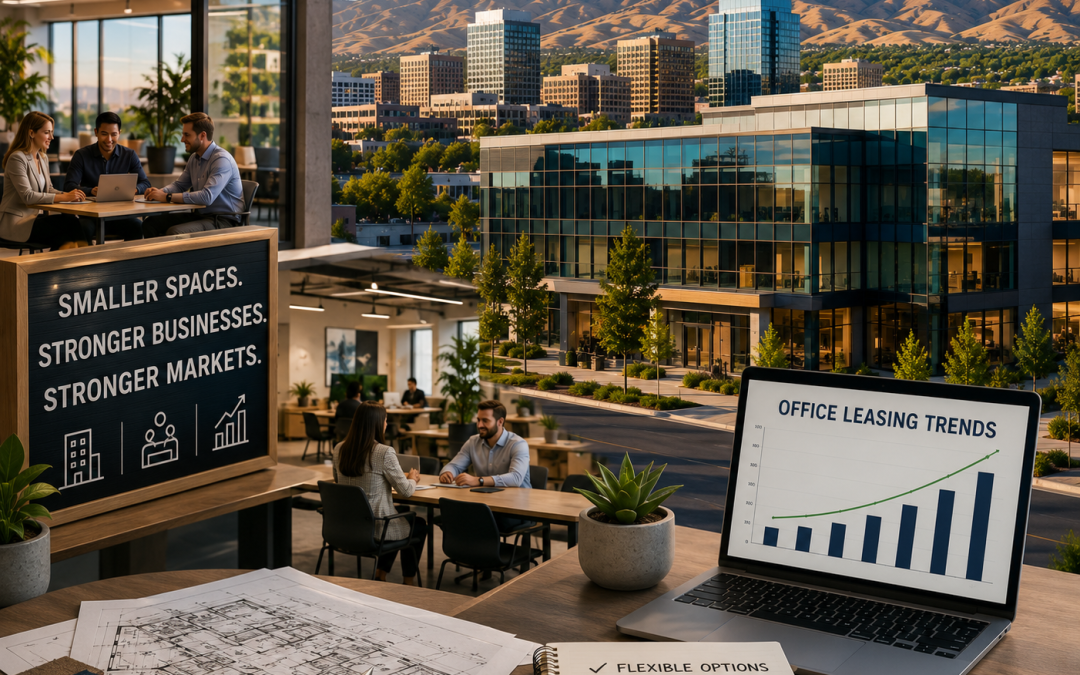
Why Smaller Office Leases Could Shape the Future of Boise Commercial Real Estate
The office market isn’t making headlines because companies are leasing massive headquarters again.
Instead, the recovery is being driven by something much different: more businesses signing leases for smaller offices. That shift is changing how landlords, developers, and investors think about office space—and it could have lasting implications for Boise commercial real estate.
According to reporting by Phil Mobley of CoStar Analytics, U.S. office leasing remained steady through the second quarter of 2026 as companies continued signing new leases. You can read the original CoStar Analytics article here: https://product.costar.com/home/news/729358564.
This article is based on that reporting while exploring what these national office leasing trends could mean for Boise commercial real estate, office development, tenant demand, and investment opportunities across the Treasure Valley.
More Companies Are Leasing Offices—Just Not as Much Space
At first glance, the office market appears to be gaining momentum.
CoStar estimates that businesses leased approximately 115 million square feet of office space nationwide during the second quarter of 2026. Over the past year, total leasing activity has climbed to within roughly 9% of pre-pandemic levels, signaling that demand has recovered significantly.
But there’s an important difference compared with previous office cycles.
The number of lease transactions has nearly returned to historic highs, while the average office lease remains about 15% smaller than before 2020.
In other words, more companies are leasing office space—but they’re choosing footprints that better match today’s workforce and workplace strategies.
Businesses Are Prioritizing Quality Over Size
One of the biggest changes in today’s office market is where tenants want to be.
Rather than leasing the largest offices possible, many companies are focusing on well-located buildings with modern amenities, flexible layouts, and attractive work environments.
Several industries continue driving demand, including:
- Financial services
- Professional services
- Artificial intelligence companies
- Venture-backed technology firms
Many of these organizations expect employees to spend more time in the office, but they are also designing workplaces more efficiently than they did before the pandemic.
At the same time, new office construction remains historically limited in many markets. That has reduced the availability of large blocks of premium office space, making it harder for major tenants to relocate even when they want to expand.
Why This Matters for Boise Commercial Real Estate
The Treasure Valley’s office market has many characteristics that align with these national trends.
Boise continues attracting:
- Technology startups
- Engineering firms
- Financial service companies
- Healthcare organizations
- Professional service providers
- Regional corporate offices
Many of these businesses don’t require 50,000-square-foot headquarters.
Instead, they’re looking for efficient offices that support collaboration, client meetings, and hybrid work while avoiding unnecessary overhead.
That could increase demand for office suites ranging from 2,000 to 15,000 square feet, particularly in high-quality buildings located near restaurants, housing, and major transportation corridors.
For Boise commercial real estate, this trend may create opportunities for landlords who can offer move-in-ready suites, flexible lease structures, and updated amenities rather than focusing solely on attracting large corporate users.
Office Owners May Need Greater Flexibility
As tenant preferences continue evolving, landlords may find themselves competing on flexibility as much as rental rates.
Businesses increasingly value features such as:
- Modern common areas
- Flexible floor plans
- Higher-quality finishes
- Shared conference facilities
- Faster technology infrastructure
- Convenient parking and nearby services
Owners willing to invest in renovations and divide larger vacant floors into smaller suites may be better positioned to capture growing demand from expanding small and midsize businesses.
Rather than waiting for one large tenant, landlords could benefit from creating spaces that appeal to multiple companies across different industries.
Local Insight
The office market isn’t disappearing—it’s adapting.
For years, success was often measured by landing one large corporate tenant. Today, healthy office buildings may instead be filled with dozens of growing businesses occupying smaller spaces.
Boise has long benefited from a diverse economy, and that diversity could become an advantage as office demand continues shifting toward smaller users.
As more entrepreneurs, technology firms, financial companies, and professional service providers establish or expand operations in the Treasure Valley, office owners who embrace flexibility may outperform those still waiting for pre-pandemic leasing patterns to return.
The national data suggests that the office recovery is real—but it’s being built one smaller lease at a time.
Mike Gioioso (joy-OH-so) has for 16+ years been helping companies of all sizes buy, build, and lease perfect places for business in greater Boise, Idaho and beyond.
www.streetsmartidaho.com
mike@streetsmartidaho.com
208-209-9166
Tags: #boisecommercialrealestate, #boiseofficespace, #boiseofficeleasing, #boisedevelopment, #officemarkettrends, #commercialofficespaceboise, #officeinvestment, #hybridwork, #flexibleofficespace, #treasurevalleyofficemarket, #commercialpropertyinvestment, #officedevelopment, #classaoffice, #businessexpansion, #idahocommercialrealestate