
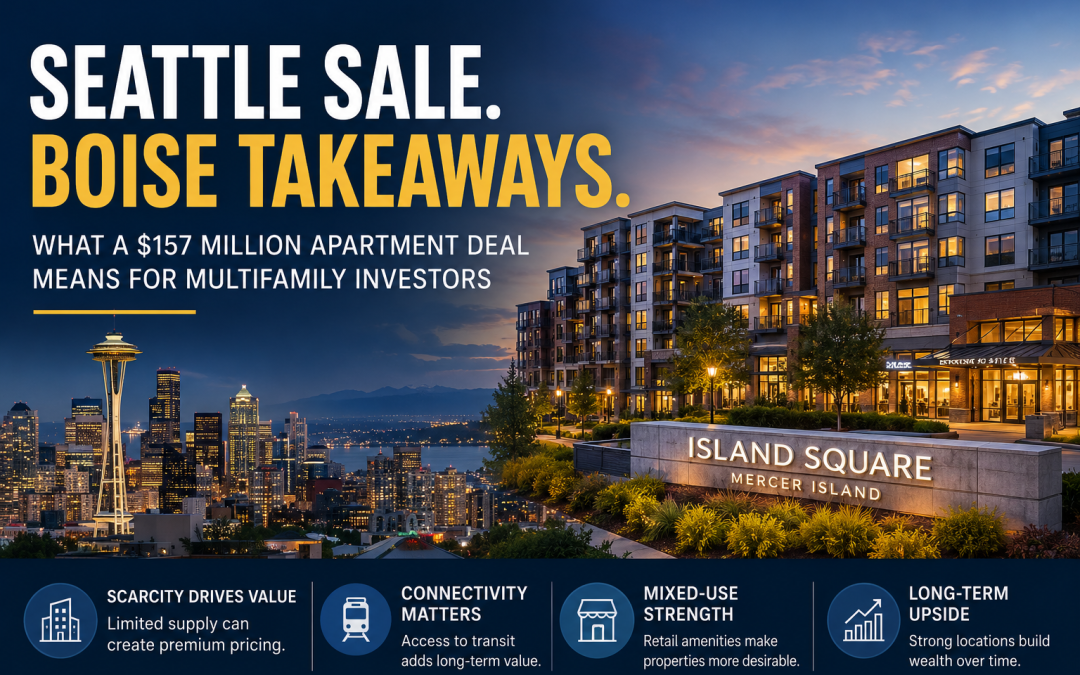
Seattle’s $157 Million Apartment Sale Offers Lessons for Boise Multifamily Investors
A $157 million apartment sale outside Seattle is a good reminder that even when multifamily transaction volume slows, investors will still pay aggressively for properties that are difficult to duplicate.
The sale of Island Square on Mercer Island works out to more than $668,000 per apartment, making it one of the more notable multifamily transactions in the Pacific Northwest this year.
For those watching Boise commercial real estate and multifamily investment, the price itself isn’t the most important part of the story.
The bigger lesson is why investors were willing to pay it.
According to reporting by Randyl Drummer for CoStar News, Chicago-based Mesirow Financial acquired Island Square from multifamily REIT UDR for approximately $157 million. The transaction is reportedly the largest apartment sale by total price in the Puget Sound region so far in 2026.
You can read the original CoStar News article for the underlying reporting.
Scarcity Can Create a Major Multifamily Premium
Island Square isn’t a typical suburban apartment complex.
The 235-unit property occupies a full block in downtown Mercer Island, an affluent community positioned between Seattle and Bellevue.
Multifamily supply on the island is extremely limited. According to CoStar’s reporting, Mercer Island has only a few hundred apartments spread among roughly a dozen properties.
That scarcity matters.
Island Square reportedly generates average rents of around $3,000 per month, approximately 40% above the broader Seattle-area average.
Add limited competing inventory and an affluent customer base, and you have something institutional investors frequently seek:
A property that is difficult to reproduce.
This concept applies well beyond Seattle.
In the Boise multifamily market, investors should pay close attention to barriers to future competition.
A property may deserve a premium because of:
- Limited developable land nearby
- Restrictive zoning
- High construction costs
- Strong surrounding household incomes
- Walkability to restaurants and services
- Access to major employment centers
- Proximity to transportation
- High-quality neighborhood amenities
Two apartment properties can generate similar income today but have very different long-term investment profiles depending on how easily another developer can build nearby.
That’s particularly important as the Treasure Valley matures.
Transportation Is Becoming Part of the Real Estate Value
Another important piece of the Island Square story is transit.
The property is roughly a five-minute walk from Mercer Island’s new light-rail station.
Service began this year as part of Sound Transit’s expansion connecting the area with Bellevue and Seattle.
That gives residents another way to reach major employment and entertainment centers without depending entirely on a car.
Boise obviously isn’t Seattle, and the Treasure Valley transportation system is very different.
But the underlying real estate principle still matters.
Connectivity creates value.
In Boise, Meridian, Eagle, Nampa and Caldwell, that connectivity may come from highway access, major arterial roads, employment centers, bike infrastructure or proximity to shopping and entertainment rather than rail.
For Boise development, accessibility should increasingly be viewed as an amenity.
Residents don’t just rent an apartment.
They’re renting access to their daily life.
How quickly can they get to work?
Where do they buy groceries?
Can they walk to coffee or restaurants?
How far away is healthcare?
How easily can they reach Interstate 84?
As congestion increases across parts of the Treasure Valley, those questions could become even more important.
Mixed-Use Amenities Can Strengthen Multifamily Properties
Island Square also includes commercial space.
Its tenants include a bank, veterinary clinic, restaurant, bagel shop and other office and retail users.
That creates another interesting lesson for Boise multifamily development.
Residential density can support commercial tenants.
Commercial tenants can also make residential projects more desirable.
Done correctly, the relationship works both ways.
We’ve already seen this concept becoming more relevant across Boise commercial real estate, particularly around mixed-use projects and growing corridors in Meridian, Downtown Boise and other parts of the Treasure Valley.
Residents increasingly value convenience.
Being able to walk downstairs or across the parking lot for food, coffee, fitness, medical services or other daily needs can help differentiate an apartment project.
For developers, however, adding commercial space simply because a project is labeled “mixed-use” isn’t enough.
The retail still has to work.
Visibility matters.
Parking matters.
Access matters.
Tenant mix matters.
And the surrounding population still needs to support those businesses.
The strongest mixed-use projects treat commercial space as an important part of the development rather than leftover square footage beneath apartments.
A $45 Million Increase Shows the Power of Long-Term Ownership
There is another number in this transaction worth examining.
UDR reportedly acquired Island Square for approximately $112 million in 2008, shortly after the property was completed.
The latest sale came in at approximately $157 million.
That’s roughly a $45 million increase in gross property value over the ownership period, before considering capital expenditures, transaction costs, financing or income generated during ownership.
That’s an important distinction.
Commercial real estate returns aren’t created only when a property is sold.
An apartment investment can generate cash flow throughout the holding period while potentially benefiting from rent growth, debt paydown and long-term appreciation.
That’s one reason basis matters so much.
Investors purchasing Boise investment property today need to think carefully about both today’s income and the property’s potential value five, ten or even fifteen years from now.
Paying the lowest price isn’t always the winning strategy.
Sometimes paying more for the better location produces the better long-term investment.
What Boise Multifamily Investors Should Watch
The Island Square transaction comes as apartment sales activity has slowed across the greater Seattle market.
Yet a high-quality property in a supply-constrained location still attracted significant institutional capital.
That distinction is important.
When markets become more challenging, capital often becomes more selective rather than disappearing completely.
Investors start separating average properties from exceptional ones.
We could see similar behavior continue in the Boise multifamily market.
Properties with strong locations, favorable debt, modern construction and durable rents may attract substantially more attention than older properties requiring major renovations or facing significant new competition.
The gap between good real estate and average real estate can become much more obvious when financing gets expensive.
That means investors need to look beyond simple price-per-unit comparisons.
A lower price per unit doesn’t necessarily mean a better deal.
The real questions include:
What rents can the property realistically achieve?
How much competing supply is coming?
What capital improvements will be required?
How expensive would it be to build the same property today?
And how difficult would it be for a competitor to recreate the location?
Those questions tell you much more than price per door alone.
Local Insight: Boise’s Best Multifamily Locations Could Become Harder to Replace
My biggest takeaway from this Seattle transaction is the value of scarcity.
Boise and the Treasure Valley are still growing, but some of our strongest locations are becoming increasingly difficult and expensive to develop.
Land prices have increased.
Construction costs remain significant.
Infrastructure requirements can add substantial expense.
Entitlement processes can take time.
And desirable infill parcels don’t suddenly appear when investors want them.
That could increase the long-term value of well-located existing multifamily properties.
For Boise investors, I would pay particular attention to properties where several advantages overlap: strong demographics, employment access, nearby retail, limited competing land and convenient transportation.
For developers, the lesson is similar.
Don’t just count units.
Think about what makes those units difficult for the next developer to reproduce.
And for owners considering whether to sell, refinance or hold, scarcity should be part of the valuation conversation.
Island Square commanded more than $668,000 per unit because investors weren’t simply buying 235 apartments.
They were buying 235 apartments in a location where creating another 235 units may be extremely difficult.
That’s a valuable distinction for anyone investing in Boise multifamily real estate.
Source: Randyl Drummer, CoStar News, Aug. 5, 2026. This article provides commentary and analysis based on CoStar’s reporting and is not presented as independent reporting of the Island Square transaction.
Mike Gioioso (joy-OH-so)
has for 16+ years been helping companies of all sizes buy, build, and lease perfect places for business in greater Boise, Idaho and beyond.
www.streetsmartidaho.com mike@streetsmartidaho.com 208-209-9166
Tags: #boisecommercialrealestate, #boiserealestate, #boisemultifamily, #boisemultifamilyrealestate, #boisemultifamilyinvestment, #boiseapartmentinvestment, #boiseapartments, #boisedevelopment, #boisemultifamilydevelopment, #boiseinvestmentproperty, #boiserealestateinvestment, #boisecommercialdevelopment, #treasurevalleycommercialrealestate, #treasurevalleymultifamily