
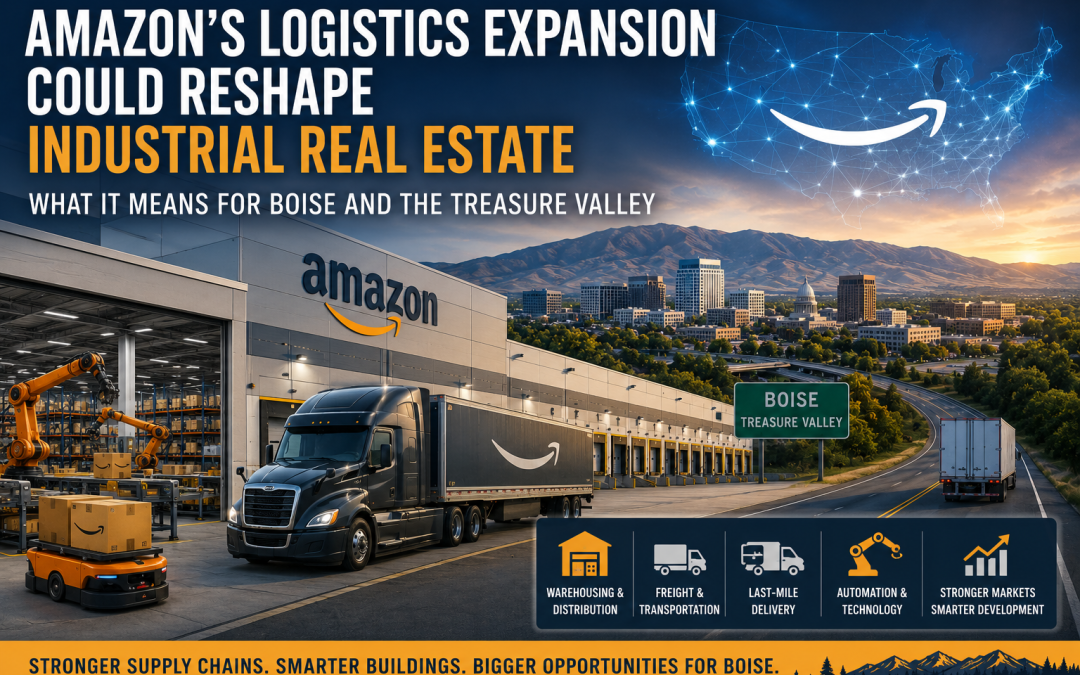
Amazon’s Logistics Expansion Could Reshape Industrial Real Estate — Including Markets Like Boise
For years, Amazon changed retail.
Now it’s trying to change logistics too.
And that could have major implications for industrial real estate markets across the country — including emerging growth markets like the Treasure Valley.
According to reporting by CoStar News and reporter Randyl Drummer, Amazon is officially expanding its logistics network into a full third-party shipping business, competing directly with companies like UPS and FedEx.
That means Amazon is no longer just delivering its own products.
It now wants to become the infrastructure behind other companies’ supply chains too.
And for industrial real estate, that matters.
Amazon Is Turning Warehouses Into a Standalone Business
The report explains that Amazon’s Supply Chain Solutions division will now offer:
- Warehousing
- Distribution
- Freight services
- Last-mile delivery
- Supply chain management
…to outside businesses across industries ranging from healthcare to retail.
This follows a familiar strategy Amazon previously used with AWS, where it transformed internal technology systems into one of the world’s largest cloud businesses.
Now the company appears to be doing something similar with logistics infrastructure.
That shift could increase pressure across:
- Industrial warehouse markets
- Distribution hubs
- Transportation corridors
- Fulfillment center operations
- Last-mile delivery networks
Why This Matters for Boise Commercial Real Estate
The Treasure Valley has quietly become a stronger industrial and logistics market over the last several years.
Population growth, western U.S. connectivity, and expanding consumer demand have all helped fuel:
- Warehouse construction
- Distribution leasing
- Flex industrial development
- Transportation-related real estate demand
As companies rethink supply chains, secondary growth markets like Boise continue attracting attention because they offer:
- Lower costs than major coastal metros
- More available land
- Easier freight movement
- Growing labor pools
- Faster development timelines
If Amazon continues expanding its third-party logistics model, it could influence how industrial tenants think about:
- Warehouse locations
- Regional fulfillment strategy
- Inventory positioning
- Shipping speed
- Distribution efficiency
A Bigger Shift Is Happening in Industrial Real Estate
One of the most important parts of the CoStar report is that Amazon may rely heavily on its existing warehouse footprint rather than aggressively building entirely new facilities.
That is important because many industrial markets — including some western growth regions — have recently seen concerns about oversupply and slowing warehouse demand.
Instead of simply building more buildings, logistics companies may now focus on:
- Maximizing efficiency
- Automation
- Robotics integration
- Faster delivery systems
- Better infrastructure utilization
Amazon reportedly already operates more than 85 same-day fulfillment centers nationwide and uses more than one million robots inside its logistics network.
That signals where the industrial market may be heading next:
higher-tech facilities focused on speed, automation, and operational efficiency.
What This Could Mean for Idaho Industrial Development
Boise commercial real estate has largely benefited from migration and population growth trends.
But logistics and infrastructure growth may become an even larger part of the region’s future.
Industrial developers throughout the Treasure Valley are increasingly paying attention to:
- Interstate access
- Truck routes
- Rail connectivity
- Last-mile delivery potential
- Workforce availability
- Land near transportation corridors
As national logistics companies evolve, those factors become more valuable.
Markets like Boise, Nampa, Caldwell, and Meridian may continue seeing industrial demand tied not only to local growth — but also to regional supply chain positioning.
Local Insight: The Warehouse Market Is Becoming More Technology-Driven
A few years ago, warehouse demand was mostly about square footage.
Today, it is increasingly about operational performance.
That includes:
- Automation capability
- Delivery speed
- Infrastructure quality
- Power capacity
- Transportation access
- Robotics integration
The industrial buildings attracting the most long-term interest are often the ones designed for modern logistics systems — not older warehouse layouts built for slower supply chains.
For Boise commercial real estate investors, this is another reminder that industrial demand is evolving quickly.
The next phase of warehouse growth may be less about quantity and more about efficiency, technology, and strategic positioning.
Mike Gioioso (joy-OH-so) has for 16+ years been helping companies of all sizes buy, build, and lease perfect places for business in greater Boise, Idaho and beyond.
www.streetsmartidaho.com mike@streetsmartidaho.com 208-209-9166
Tags: #boisecommercialrealestate, #boiseindustrialmarket, #industrialrealestateboise, #warehousedevelopmentboise, #logisticsrealestate, #amazonlogisticsexpansion, #boisewarehousemarket, #treasurevalleyindustrialmarket, #boisedevelopment, #distributioncenterrealestate, #industrialdevelopmentidaho, #boiseinvestmentproperty, #supplychainrealestate, #fulfillmentcenterdevelopment, #idahocommercialrealestate