
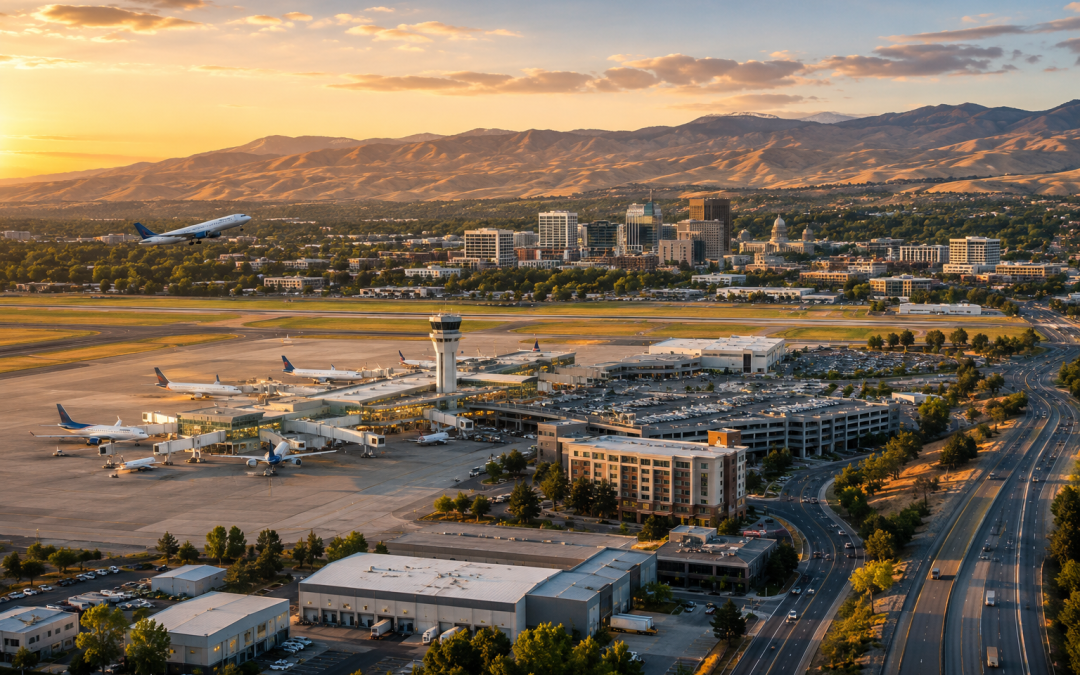
Boise Airport’s Explosive Growth Is Becoming a Major Force in Boise Commercial Real Estate
One of the biggest economic growth stories in the Treasure Valley is happening above our heads.
And it is becoming increasingly important for anyone watching Boise commercial real estate, regional development, tourism, business expansion, or long-term investment trends.
According to reporting by Idaho Business Review journalist Steve Lombard, Boise Airport just crossed a major milestone: more than 5.2 million passengers traveled through the airport in 2025. You can read the original article here: Boise Airport 100-Year Growth Story
That number alone says a lot about where the Treasure Valley is headed.
But the bigger story is what this means for future growth across retail, hospitality, industrial, office demand, and regional economic development.
Boise Is No Longer a Small Regional Market
For years, Boise was viewed as somewhat isolated compared to larger Western metro areas.
That perception is changing fast.
The airport recorded a 76% increase in passenger traffic over the past decade, climbing from 2.9 million travelers in 2015 to 5.2 million in 2025.
That type of sustained growth matters because airports are often one of the clearest indicators of regional economic momentum.
More flights typically mean:
- More corporate travel
- More tourism
- More business relocations
- More investor activity
- More convention and event demand
- More pressure on infrastructure and commercial development
And Boise’s growth appears to be accelerating rather than slowing.
The airport has now posted four straight years of record passenger totals from 2022 through 2025.
Even more notable, Boise is outperforming many airports nationally that are experiencing flatter travel demand.
Why This Matters for Boise Commercial Real Estate
The airport is becoming much more than a transportation hub.
It is increasingly functioning as a gateway to the entire Treasure Valley economy.
That has major implications across several commercial real estate sectors.
Hospitality and Hotel Development
As visitor traffic increases, demand for hotels, short-term accommodations, restaurants, and entertainment typically follows.
Areas surrounding the airport corridor could continue seeing:
- New hotel proposals
- Restaurant growth
- Retail expansion
- Service-based commercial uses
- Flex industrial and logistics demand
This is especially important as Boise continues attracting out-of-state companies, remote workers, investors, and tourists.
Industrial and Logistics Demand
Passenger growth often parallels freight and distribution growth over time.
Boise’s population expansion and regional importance are already fueling industrial development throughout the Treasure Valley.
The airport’s continued expansion could strengthen demand for:
- Warehouse space
- Distribution facilities
- Last-mile logistics
- Manufacturing support uses
- Aviation-related businesses
Industrial vacancy across parts of the Boise market has already tightened significantly over the past several years, and long-term infrastructure investments like airport expansion usually reinforce those trends.
Retail Leasing Boise Trends
One of the more interesting parts of the story is how airport growth reflects broader consumer activity.
The article noted that Boise is primarily an “origin and destination” airport, meaning most travelers are either living here or intentionally visiting here — not simply passing through on layovers.
That matters for retailers.
It signals ongoing population growth, stronger regional consumer spending, and rising visitor traffic entering the local economy directly.
As more people move to or visit the Treasure Valley, retail corridors across Boise, Meridian, Nampa, Eagle, and Kuna may continue seeing demand from:
- National chains
- Experiential retail concepts
- Restaurant groups
- Service retailers
- Entertainment operators
Expansion Plans Signal Confidence in Long-Term Growth
The airport is not planning for stagnation.
It is planning for continued expansion.
Future development plans include:
- A new concourse
- 10 additional gates
- A consolidated rental car facility
- Expanded passenger capacity
That kind of infrastructure investment usually happens when leadership expects long-term regional growth to continue.
For commercial real estate professionals, these projects matter because infrastructure often drives future development patterns.
Improved airport capacity can influence:
- Corporate relocation decisions
- Convention activity
- Tourism spending
- Site selection for employers
- Investor confidence
- Regional land values
Boise’s “Local Feel” Is Becoming a Competitive Advantage
One detail from the article stood out to me.
Even as passenger traffic explodes, airport leaders continue emphasizing Boise’s local character and convenience.
That may sound small, but it actually matters quite a bit.
Many growing cities eventually lose the ease and accessibility that originally made them attractive.
Boise still offers something increasingly rare:
a fast-growing metro area that remains relatively easy to navigate.
That balance can become a major competitive advantage when companies evaluate relocation opportunities.
The airport’s emphasis on local restaurants, local products, and regional identity also reinforces Boise’s broader economic branding as a business-friendly Western market with strong lifestyle appeal.
My Take: The Airport Is Becoming One of Boise’s Most Important Economic Indicators
When I look at Boise development trends, I pay close attention to infrastructure.
And right now, the airport may be one of the clearest signals that the Treasure Valley’s growth cycle still has momentum.
Passenger traffic is not just about vacations.
It reflects business movement, migration trends, investor confidence, and economic expansion.
The fact that Boise continues growing while some national markets level off says a lot about where this region stands competitively.
For investors, landlords, developers, and business owners, the airport’s growth is another reminder that Boise is continuing to evolve from a secondary regional market into a much more nationally connected economic hub.
That shift will likely continue influencing Boise commercial real estate, retail leasing Boise, industrial growth, hospitality development, and long-term investment activity across the Treasure Valley for years ahead.
Mike Gioioso (joy-OH-so) has for 16+ years been helping companies of all sizes buy, build, and lease perfect places for business in greater Boise, Idaho and beyond.
www.streetsmartidaho.com mike@streetsmartidaho.com 208-209-9166
Tags: #boisecommercialrealestate, #boisehousingdevelopment, #boiseinfilldevelopment, #boisedevelopment, #boisezoningchanges, #boisehousingshortage, #boiselanduse, #boisedensitydebate, #boiseneighborhoodgrowth, #boisemultifamilyhousing, #treasurevalleydevelopment, #idahohousingmarket, #boisecitycouncil, #boiseredevelopment