
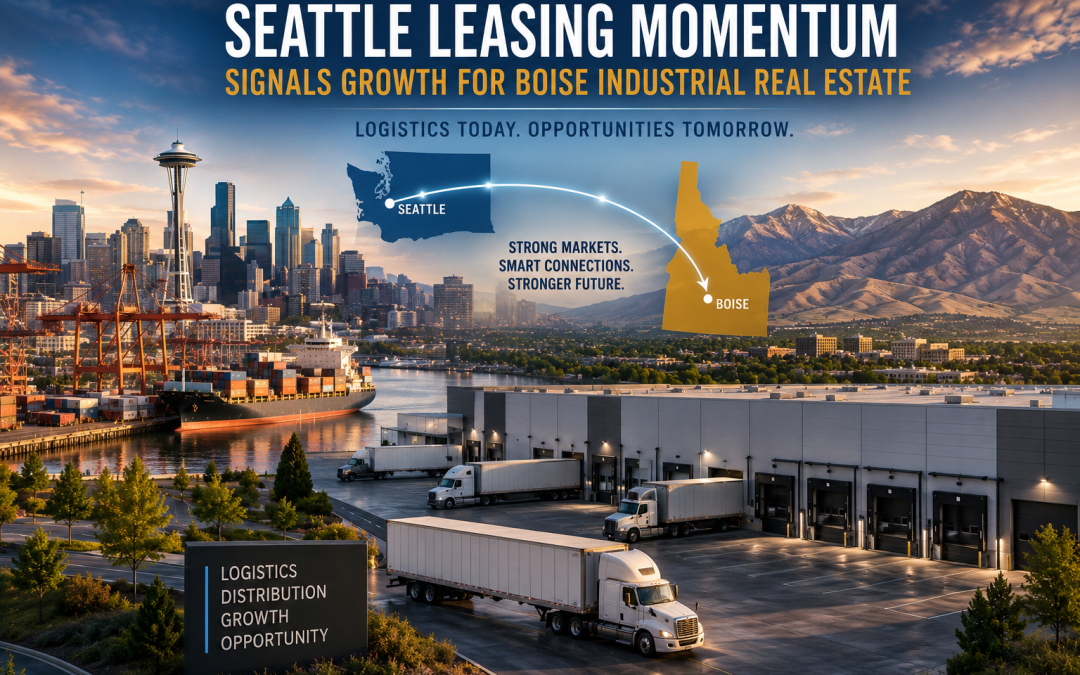
Seattle’s Massive Industrial Lease Activity Offers a Preview of Where Boise’s Logistics Market Could Be Headed
One of the clearest signals in commercial real estate right now is that industrial demand remains heavily tied to logistics, distribution, and supply-chain infrastructure.
And while the biggest lease deals are still happening in major port markets like Seattle and the broader Puget Sound region, the ripple effects are increasingly important for Boise commercial real estate as well.
According to reporting by CoStar News and CoStar Research, several major industrial lease transactions closed across the Seattle-Puget Sound market during the first quarter of 2026. You can read the original report here: Top industrial leases recognized for Seattle
The transactions included large logistics, distribution, manufacturing, and warehouse users taking or renewing space throughout markets like Tacoma, Kent, Auburn, Lakewood, and Sumner.
For Boise industrial real estate professionals, the bigger takeaway is not simply the lease sizes.
It is what those deals reveal about long-term regional distribution trends across the western United States.
Industrial Demand Is Still Being Driven by Logistics and Distribution
Many of the largest leases highlighted in the report involved companies focused on:
- Freight movement
- Distribution operations
- Warehousing
- Supply-chain logistics
- Packaging
- Manufacturing support
- Transportation infrastructure
Tenants included:
- Pacific Plumbing Supply
- Pacific Pride
- Stryder Distribution
- Pacific Forest Products
- Corporate Moving Systems
- Argents Express Group
- Emerald City Graphics
- Brinc Drones
Most of these users are tied directly to regional supply-chain activity.
That matters because Boise’s industrial market is increasingly benefiting from similar trends, although on a smaller scale.
Why Boise Is Becoming More Relevant in Western Distribution Networks
For years, major coastal logistics hubs dominated industrial leasing activity across the West Coast.
But rising costs, congestion, labor pressure, and land constraints are forcing many companies to expand inland.
That shift is helping secondary logistics markets like Boise gain attention.
Boise industrial real estate has become more attractive because of:
- Lower occupancy costs
- Available development land
- Growing population
- Access to Interstate corridors
- Expanding consumer demand
- Lower operating costs compared to coastal markets
As supply-chain operators look for additional regional distribution points, inland growth markets continue gaining momentum.
That trend has already helped fuel:
- Industrial development in the Treasure Valley
- Flex warehouse construction
- Last-mile distribution facilities
- Industrial condo demand
- Logistics leasing activity
- Manufacturing expansion
The Shift Toward Larger Regional Networks Continues
One interesting pattern from the Seattle lease activity is the mix of renewals, expansions, and subleases.
That tells us companies are still actively reevaluating their distribution footprints rather than simply downsizing.
Some tenants renewed existing locations to maintain strategic access.
Others expanded to support growth.
And some adjusted space needs through subleases and operational changes.
That flexibility is becoming a major part of today’s industrial market.
For Boise commercial real estate, this reinforces the growing value of:
- Flexible industrial buildings
- Modern warehouse layouts
- Trailer storage capacity
- Clear-height warehouse space
- Highway accessibility
- Multi-market distribution positioning
The Treasure Valley is increasingly positioned as a supplemental inland logistics market connected to larger West Coast supply chains.
Boise Could Continue Benefiting From Pacific Northwest Spillover
Seattle’s industrial market remains one of the most important logistics gateways in the Pacific Northwest because of its port infrastructure and international trade access.
But success in gateway markets often creates growth opportunities in nearby inland markets.
As companies search for cost-efficient alternatives or overflow distribution space, regions like Boise become more attractive.
That does not mean Boise replaces Seattle.
It means Boise increasingly complements larger logistics hubs.
This dynamic is similar to what has happened in other western markets where inland industrial growth accelerated alongside larger coastal port markets.
My Take
The biggest lesson from Seattle’s industrial leasing activity is that distribution demand is still evolving — not disappearing.
Companies continue adjusting supply chains, warehouse footprints, and regional logistics strategies.
And many of those decisions are creating opportunities for growth markets like Boise.
The Treasure Valley’s industrial market is no longer viewed only as local-service space.
It is increasingly part of broader regional distribution conversations tied to the Pacific Northwest and Intermountain West.
For investors, developers, landlords, and industrial users, that could create long-term demand for modern logistics space throughout Boise, Nampa, Caldwell, and surrounding industrial corridors.
Industrial real estate remains one of the strongest long-term sectors in commercial real estate.
And Boise still appears positioned to benefit from that momentum.
Mike Gioioso (joy-OH-so) has for 16+ years been helping companies of all sizes buy, build, and lease perfect places for business in greater Boise, Idaho and beyond.
www.streetsmartidaho.com
mike@streetsmartidaho.com
208-209-9166
Tags: #boisecommercialrealestate, #boiseindustrialmarket, #boisewarehousespace, #boiselogisticsmarket, #boisedevelopment, #treasurevalleyindustrial, #industrialleasingboise, #boiseflexspace, #boisedistributionspace, #idahoindustrialrealestate, #nampaindustrialmarket, #caldwellindustrialdevelopment