
Seattle’s Biggest Commercial Property Sales Could Offer Important Clues for Boise Investors
Major commercial real estate deals are still getting done across the Pacific Northwest — especially in multifamily and industrial properties tied to strong job centers, transit access, and logistics infrastructure.
And while the Seattle market is much larger and more mature than Boise, the trends behind those transactions may offer valuable insight into where Boise commercial real estate could be headed next.
According to reporting and transaction data published by CoStar News in its quarterly Seattle-Puget Sound Power Broker awards coverage, several major apartment, industrial, and office sales closed during the first quarter of 2026. You can read the original report here: Top property sales recognized for Seattle.
The deals highlight continued investor demand for well-located multifamily housing, logistics facilities, and modern office assets connected to technology and transportation corridors.
For Boise investors and developers, that matters because many of the same themes shaping Seattle are increasingly influencing the Treasure Valley.
Multifamily Continues Leading Large Investment Activity
One of the clearest themes throughout the Seattle transactions was the dominance of apartment deals.
Several of the quarter’s largest sales involved multifamily communities located near:
- major employment hubs,
- transit corridors,
- entertainment districts,
- and tech campuses.
Some of the largest transactions included:
- The Centennial apartment community in downtown Seattle
- Milehouse near the Microsoft campus in Redmond
- Allegro Lynnwood near Alderwood Mall
- Multiple garden-style apartment communities in suburban and exurban areas
What stands out is that investors continue targeting both urban core housing and suburban workforce-oriented apartment communities.
That trend is increasingly relevant in Boise commercial real estate as population growth continues pushing housing demand outward into markets like:
- Meridian,
- Kuna,
- Caldwell,
- Star,
- and Nampa.
Industrial Real Estate Remains a Major Priority
Another major takeaway from the Seattle sales activity was the continued strength of industrial and logistics properties.
Large warehouse and distribution facilities in markets like Fife and Kent attracted major institutional buyers.
The report highlighted modern logistics campuses with:
- high-clear warehouse space,
- truck courts,
- freeway access,
- and proximity to freight infrastructure.
That matters because Boise industrial real estate continues evolving in a similar direction.
The Treasure Valley increasingly serves as a regional distribution and logistics hub for the Mountain West.
As transportation networks improve and population growth expands across Idaho, industrial demand tied to:
- warehousing,
- e-commerce,
- manufacturing,
- and regional supply chain operations
could remain one of the stronger long-term sectors in Boise development.
Office Demand Is Becoming More Selective
Seattle’s office market has faced major challenges in recent years, but one interesting takeaway from the report is that newer, highly amenitized office buildings are still attracting investment interest.
The quarter included sales tied to:
- tech-oriented office properties,
- transit-accessible locations,
- and walkable mixed-use districts.
That mirrors a trend increasingly visible in Boise commercial real estate.
Tenants today are becoming much more selective about office quality.
Companies increasingly want:
- modern amenities,
- better employee experiences,
- flexible layouts,
- and locations near restaurants, retail, recreation, and housing.
Older commodity office buildings without strong locations or upgrades may face increasing competitive pressure.
Why This Matters for Boise Commercial Real Estate
Seattle often acts as an early indicator for broader western market trends.
Boise does not operate at Seattle’s pricing levels or institutional scale, but many migration, investment, and tenant behavior patterns eventually flow downstream into secondary growth markets like the Treasure Valley.
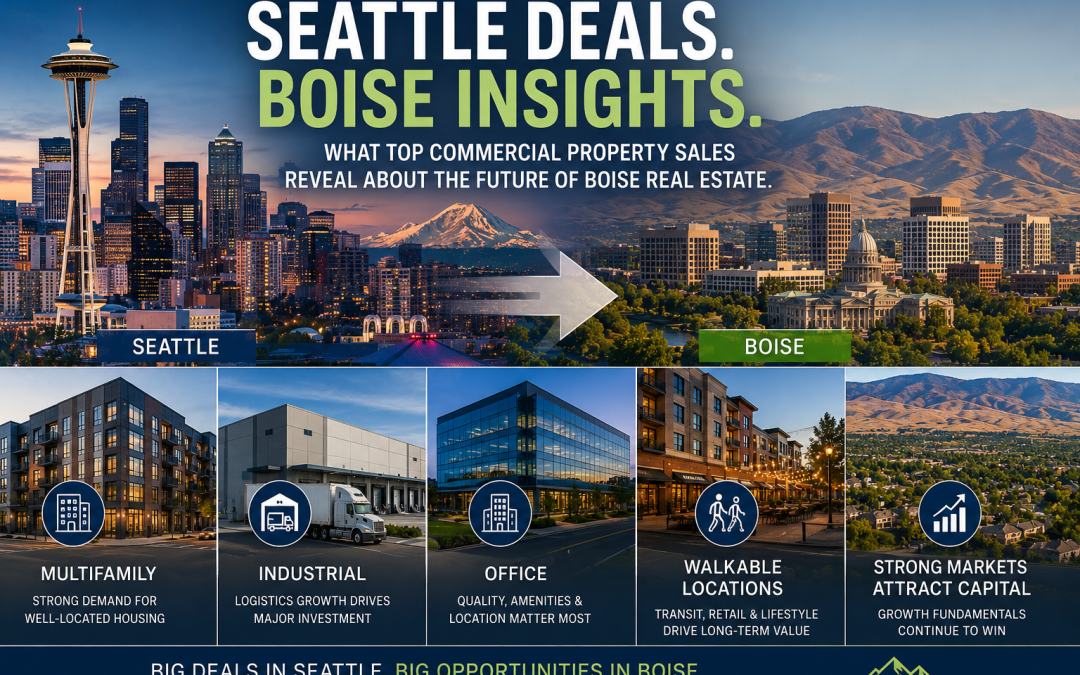
Several themes from the Seattle transactions stand out for Boise investors:
- Multifamily remains highly attractive near employment growth
- Industrial logistics facilities continue drawing capital
- Transit-oriented and walkable locations retain value
- Amenity-rich projects outperform commodity properties
- Investors still pursue growth markets despite economic uncertainty
Boise continues benefiting from many of those same fundamentals.
Local Insight
One thing I find especially interesting about these Seattle deals is how strongly investors continue prioritizing functionality and location quality.
The properties attracting the largest investments were not random assets.
They were generally tied to:
- employment density,
- transportation access,
- lifestyle amenities,
- logistics infrastructure,
- or long-term population growth.
That is increasingly the same conversation happening in Boise commercial real estate.
As the Treasure Valley grows, I think investors will continue focusing more heavily on:
- infill locations,
- industrial connectivity,
- mixed-use walkability,
- and workforce housing accessibility.
The Boise market is still smaller and more affordable than Seattle, but many of the underlying growth drivers are becoming surprisingly similar.
Mike Gioioso (joy-OH-so) has for 16+ years been helping companies of all sizes buy, build, and lease perfect places for business in greater Boise, Idaho and beyond.
www.streetsmartidaho.com mike@streetsmartidaho.com 208-209-9166
Tags: #boisecommercialrealestate, #boisedevelopment, #commercialrealestate, #idahocommercialrealestate, #seattlerealestate, #pacificnorthwestrealestate, #multifamilyrealestate, #industrialrealestate, #boiseindustrial, #retailleasingboise, #investmentproperty, #warehousespace, #logisticsrealestate, #officerealestate, #mixedusedevelopment