
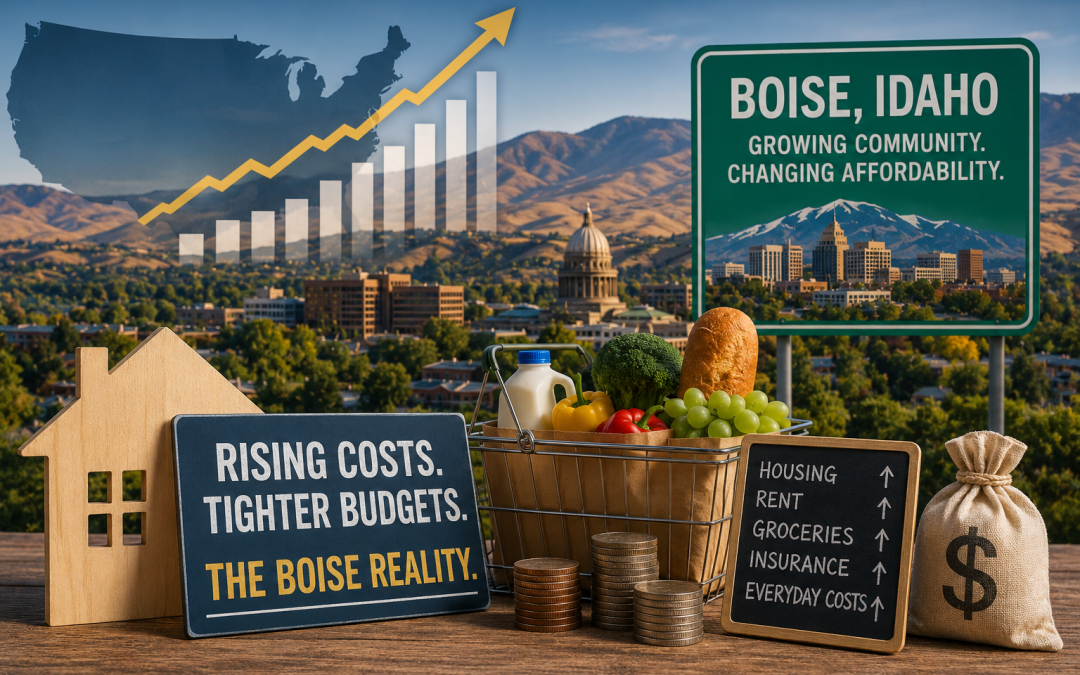
Why Boise’s Rising Income Levels May Not Mean Housing Is Becoming More Affordable
For years, earning six figures carried a certain image of financial comfort.
Today, that benchmark does not stretch nearly as far as many people think — especially in fast-growing western markets where housing, insurance, groceries, and transportation costs have climbed rapidly.
And while Idaho is not yet grouped with places like California or Massachusetts in terms of household income pressure, Boise commercial real estate professionals should still pay attention to the direction these trends are moving.
According to reporting by Idaho Business Review staff in this article about rising income thresholds and cost-of-living pressures, a new report from MoneyLion found that in several U.S. states, households earning more than $100,000 annually are now considered “lower-middle class” because of rising living expenses. You can read the original reporting here: Median income redefined to six figures across the nation.
While Idaho’s median household income remains below those levels, the broader story has important implications for Boise development, housing demand, retail leasing Boise trends, and long-term workforce growth.
The Cost of Living Conversation Is Changing
The report highlighted a growing divide between wages and actual purchasing power.
States including Massachusetts, California, Maryland, and New Jersey now require incomes above $100,000 just to fall within the lower-middle portion of the income spectrum.
That is a dramatic shift from just a decade ago, when six-figure incomes were commonly viewed as firmly upper-middle class.
The report also found:
- Hawaii had the nation’s highest annual cost for necessities
- Virginia ranked best for balancing income and basic living costs
- Utah scored well for affordability and opportunity
- Idaho household income currently falls roughly between $77,800 and $81,200 according to state data referenced in the article
For Boise real estate professionals, the more important takeaway is not the exact rankings.
It is the fact that affordability pressure is no longer isolated to coastal gateway markets.
Why This Matters for Boise Commercial Real Estate
The Treasure Valley continues attracting new residents from higher-cost western states.
Many incoming households still view Boise as relatively affordable compared to markets like San Francisco, Seattle, or Los Angeles.
But locally, many longtime Idaho residents increasingly feel the pressure from:
- rising home prices,
- insurance costs,
- rent growth,
- childcare expenses,
- and higher everyday living costs.
That creates ripple effects throughout Boise commercial real estate.
Retail Leasing Boise Trends
When households spend more money on necessities, discretionary spending often tightens.
That can impact:
- restaurant traffic,
- boutique retail,
- entertainment spending,
- and service-oriented businesses.
Retail tenants increasingly want locations with strong demographics, higher-income rooftops, and dense residential growth nearby.
Landlords and developers may also see stronger demand for value-oriented retail concepts as consumers become more price conscious.
Workforce Housing Pressures
Housing affordability directly impacts labor availability.
If workers struggle to afford housing near employment centers, businesses may face:
- staffing shortages,
- higher wage pressure,
- longer commute patterns,
- and reduced expansion flexibility.
That affects everything from industrial users to healthcare providers to restaurant operators.
For Boise development projects, workforce housing availability is becoming an increasingly important economic development issue.
Migration Still Supports Boise Growth
Even with affordability concerns, Boise continues benefiting from migration trends tied to quality of life, outdoor recreation, business growth, and relative affordability versus larger western metros.
That remains a major long-term positive for:
- multifamily development,
- retail leasing,
- industrial absorption,
- and mixed-use growth.
But the affordability advantage that once defined Boise is narrowing.
Local Insight
One of the more important shifts happening in Boise commercial real estate right now is psychological.
For years, many people moving to Idaho felt almost instant financial relief compared to markets on the West Coast.
Today, that gap is smaller than it used to be.
Boise is still far more affordable than places like coastal California or Hawaii, but residents are becoming much more sensitive to monthly carrying costs, interest rates, taxes, insurance, and everyday expenses.
That likely changes consumer behavior over time.
From a commercial real estate standpoint, I think developers, landlords, and investors increasingly need to pay attention not just to population growth — but to how financially comfortable local households actually feel.
Because confidence and spending power ultimately drive retail demand, housing demand, and long-term economic expansion.
Mike Gioioso (joy-OH-so) has for 16+ years been helping companies of all sizes buy, build, and lease perfect places for business in greater Boise, Idaho and beyond.
www.streetsmartidaho.com mike@streetsmartidaho.com 208-209-9166
Tags: #boisecommercialrealestate, #boiserealestate, #boisedevelopment, #retailleasingboise, #commercialrealestate, #idahocommercialrealestate, #costofliving, #housingaffordability, #boisehousing, #treasurevalleyrealestate, #investmentproperty, #economicdevelopment, #retailrealestate, #multifamilydevelopment, #boiseeconomy, #migrationtrends