
Why Population Growth Is Shifting to the Suburbs—and What It Could Mean for Boise Commercial Real Estate
Population growth doesn’t just determine where people live—it influences where businesses open, retailers expand, apartment developers invest, and infrastructure dollars flow.
A new trend emerging around Seattle may offer valuable insight into where future commercial real estate opportunities could develop in Boise and throughout the Treasure Valley.
According to reporting by Elliott Krivenko in CoStar Analytics, population growth across the Seattle metropolitan area is slowing overall while accelerating in many smaller suburban communities. You can read the original CoStar Analytics article here: https://product.costar.com/home/news/876694491. This article is based on that reporting while exploring what changing migration patterns could mean for Boise commercial real estate, suburban development, and future investment opportunities across the Treasure Valley.
Growth Is Moving Beyond the Largest Cities
Seattle continues adding residents, but the pace has slowed considerably.
The broader Seattle metro added roughly 26,000 new residents between April 2025 and April 2026, representing its slowest annual population growth rate of the decade.
While downtown Seattle, Bellevue, Redmond, and Shoreline are still growing, many smaller communities are now capturing a larger share of new residents.
Among the cities seeing stronger momentum were:
- Snohomish
- Woodinville
- Marysville
- Fife
- Tukwila
- Arlington
- University Place
Many of these communities offer lower housing costs, additional development opportunities, and room for future expansion.
Housing Demand Is Following Affordability
One of the clearest lessons from the Seattle market is that affordability continues influencing migration patterns.
As housing becomes more expensive in major employment centers, many residents choose nearby suburban communities where they can purchase larger homes or reduce housing costs while remaining within commuting distance.
That shift affects much more than residential construction.
Growing suburban populations create demand for:
- Grocery stores
- Medical offices
- Restaurants
- Retail centers
- Professional offices
- Industrial services
- Schools
- Entertainment venues
Population growth often arrives before commercial development fully catches up.
Why This Matters for Boise Commercial Real Estate
Boise has experienced similar growth patterns over the past several years.
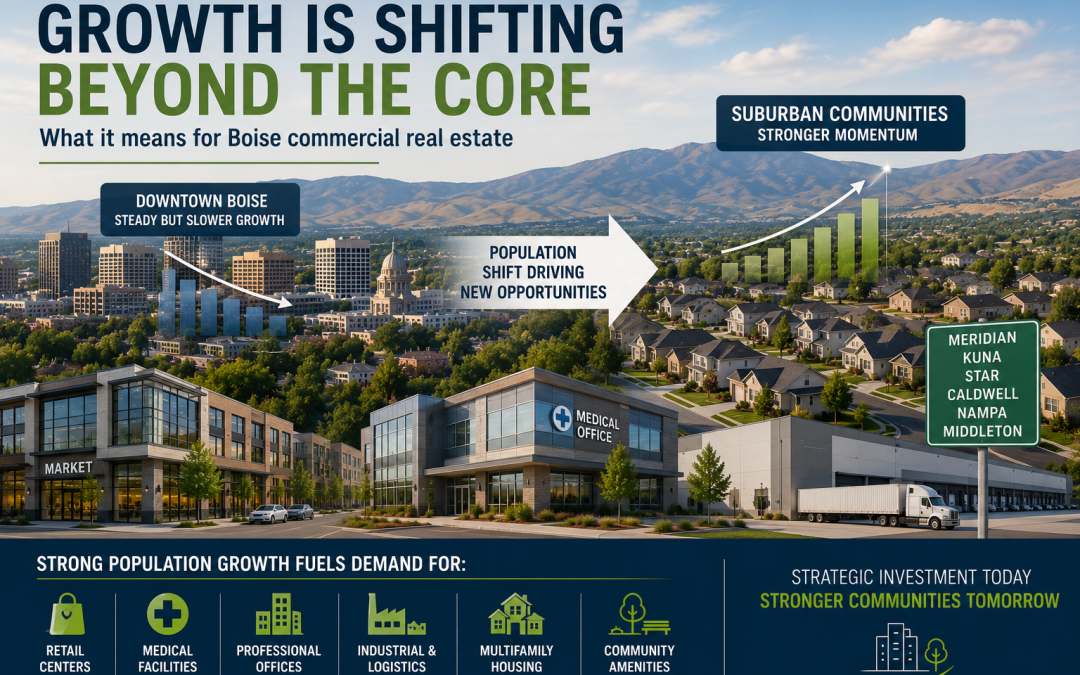
While downtown Boise remains an important employment center, surrounding communities have captured significant population growth.
Cities such as:
- Meridian
- Kuna
- Star
- Caldwell
- Nampa
- Middleton
continue attracting residents looking for more affordable housing, newer neighborhoods, and additional space.
As those communities expand, commercial real estate investment often follows.
Developers begin identifying sites for neighborhood retail centers.
Healthcare providers expand into growing trade areas.
Restaurants seek locations closer to rooftops.
Industrial businesses establish facilities near expanding transportation corridors.
Office users increasingly consider suburban locations that reduce employee commute times.
Apartment Demand May Become More Localized
The CoStar analysis also noted that slowing population growth in Seattle coincided with weaker apartment absorption in some of the region’s largest cities.
That doesn’t necessarily indicate declining apartment demand overall.
Instead, demand appears to be shifting geographically.
Developers increasingly evaluate where future residents are moving rather than simply focusing on traditional urban centers.
The same dynamic could influence multifamily development across the Treasure Valley.
Rather than concentrating exclusively in downtown Boise, future apartment investment may continue expanding into high-growth suburban communities where population gains remain strongest.
What This Could Mean for Boise Development
As the Treasure Valley continues growing, commercial development may become increasingly distributed across the region instead of concentrated in one city.
That creates opportunities for:
- Mixed-use developments
- Community shopping centers
- Medical office campuses
- Business parks
- Industrial distribution facilities
- Neighborhood service businesses
Developers who identify emerging growth corridors early often position themselves ahead of future demand.
Population trends remain one of the strongest indicators of where tomorrow’s commercial real estate opportunities will appear.
My Take
From my perspective in Boise commercial real estate, this Seattle trend feels very familiar.
The Treasure Valley has already demonstrated that growth doesn’t happen evenly. Communities outside Boise’s urban core have become increasingly attractive because they offer developable land, housing choices, and room for businesses to expand.
As more residents settle in Meridian, Star, Kuna, Caldwell, Nampa, and other fast-growing communities, demand for retail, office, healthcare, industrial, and mixed-use development is likely to follow.
For investors, the lesson is simple: don’t focus only on where growth has already happened. Pay close attention to where people are moving next. Those population shifts often become tomorrow’s strongest commercial real estate markets.
Mike Gioioso (joy-OH-so) has for 16+ years been helping companies of all sizes buy, build, and lease perfect places for business in greater Boise, Idaho and beyond.
www.streetsmartidaho.com
mike@streetsmartidaho.com
208-209-9166
Tags: #boisecommercialrealestate, #boisedevelopment, #treasurevalleygrowth, #populationgrowth, #boisehousingmarket, #mixedusedevelopment, #retailleasingboise, #multifamilydevelopment, #apartmentdevelopment, #commercialdevelopment, #meridianrealestate, #nampadevelopment, #staridahogrowth, #kunadevelopment, #industrialrealestate, #officeleasingboise, #economicdevelopment, #commercialpropertyinvestment